Livermore James J A, Klaassen Felix H, Bramson Bob, Hulsman Anneloes M, Meijer Sjoerd W, Held Leslie, Klumpers Floris, de Voogd Lycia D, Roelofs Karin
Donders Institute for Brain Cognition and Behaviour, Radboud University, Nijmegen, Netherlands.
Behavioural Science Institute, Radboud University, Nijmegen, Netherlands.
Front Neurosci. 2021 Mar 31;15:621517. doi: 10.3389/fnins.2021.621517. eCollection 2021.
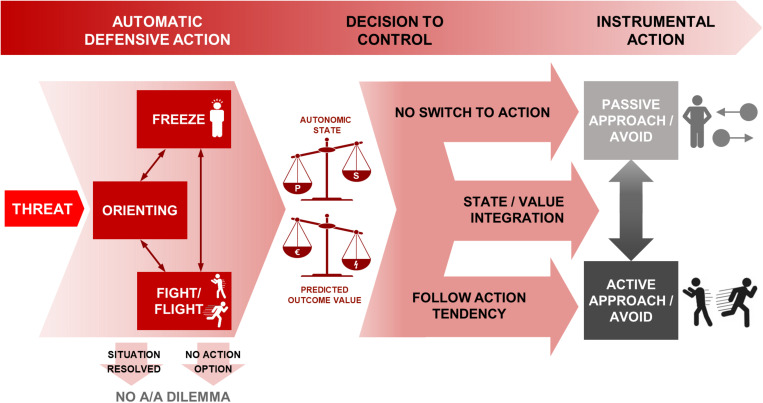
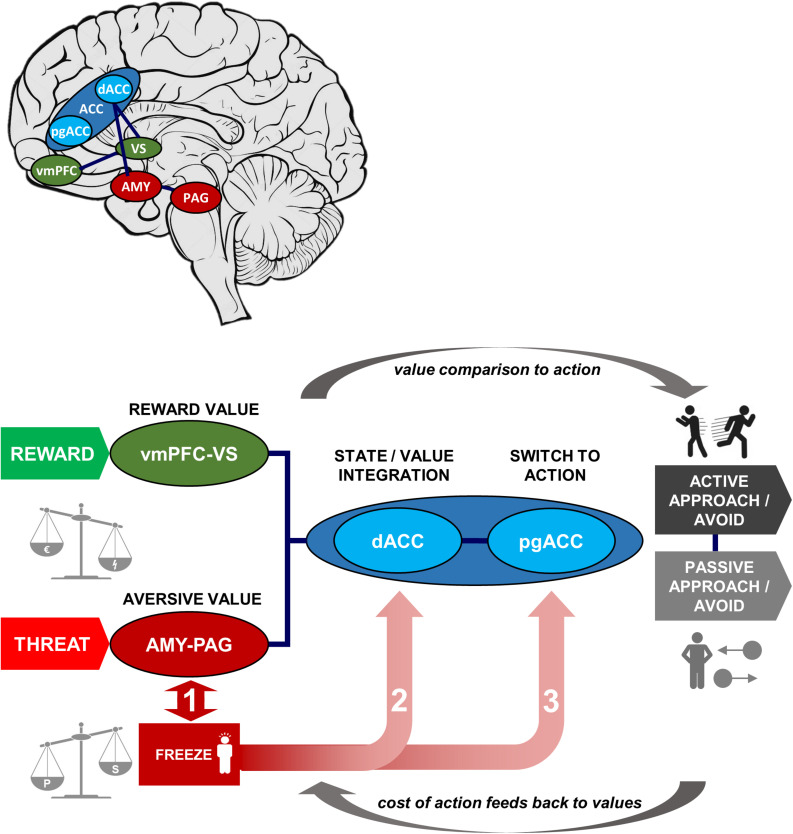
Acutely challenging or threatening situations frequently require approach-avoidance decisions. Acute threat triggers fast autonomic changes that prepare the body to freeze, fight or flee. However, such autonomic changes may also influence subsequent instrumental approach-avoidance decisions. Since defensive bodily states are often not considered in value-based decision-making models, it remains unclear how they influence the decision-making process. Here, we aim to bridge this gap by discussing the existing literature on the potential role of threat-induced bodily states on decision making and provide a new neurocomputational framework explaining how these effects can facilitate or bias approach-avoid decisions under threat. Theoretical accounts have stated that threat-induced parasympathetic activity is involved in information gathering and decision making. Parasympathetic dominance over sympathetic activity is particularly seen during threat-anticipatory freezing, an evolutionarily conserved response to threat demonstrated across species and characterized by immobility and bradycardia. Although this state of freezing has been linked to altered information processing and action preparation, a full theoretical treatment of the interactions with value-based decision making has not yet been achieved. Our neural framework, which we term the Threat State/Value Integration (TSI) Model, will illustrate how threat-induced bodily states may impact valuation of competing incentives at three stages of the decision-making process, namely at threat evaluation, integration of rewards and threats, and action initiation. Additionally, because altered parasympathetic activity and decision biases have been shown in anxious populations, we will end with discussing how biases in this system can lead to characteristic patterns of avoidance seen in anxiety-related disorders, motivating future pre-clinical and clinical research.
极具挑战性或威胁性的情况常常需要做出趋近-回避决策。急性威胁会引发快速的自主神经变化,使身体做好僵住、战斗或逃跑的准备。然而,这种自主神经变化也可能影响后续的工具性趋近-回避决策。由于基于价值的决策模型通常不考虑防御性身体状态,所以尚不清楚它们如何影响决策过程。在此,我们旨在通过讨论关于威胁诱发的身体状态对决策的潜在作用的现有文献来弥合这一差距,并提供一个新的神经计算框架,解释这些效应如何在威胁下促进或偏向趋近-回避决策。理论观点指出,威胁诱发的副交感神经活动参与信息收集和决策。在预期威胁时的僵住状态下,尤其能看到副交感神经对交感神经活动的主导,这是一种在物种间都有体现的对威胁的进化保守反应,其特征为不动和心动过缓。尽管这种僵住状态与信息处理和行动准备的改变有关,但尚未对其与基于价值的决策的相互作用进行全面的理论探讨。我们的神经框架,即威胁状态/价值整合(TSI)模型,将说明威胁诱发的身体状态如何在决策过程的三个阶段影响对相互竞争的动机的评估,即在威胁评估、奖励与威胁整合以及行动启动阶段。此外,由于在焦虑人群中已显示出副交感神经活动改变和决策偏差,我们将以讨论该系统中的偏差如何导致焦虑相关障碍中常见的回避特征模式作为结尾,以此推动未来的临床前和临床研究。