Department of Ophthalmology, Shanghai Ninth People's Hospital, Shanghai JiaoTong University School of Medicine, Shanghai, China.
Shanghai Key Laboratory of Orbital Diseases and Ocular Oncology, Shanghai Ninth People's Hospital, Shanghai JiaoTong University School of Medicine, Shanghai, China.
Front Endocrinol (Lausanne). 2021 Apr 1;12:648732. doi: 10.3389/fendo.2021.648732. eCollection 2021.
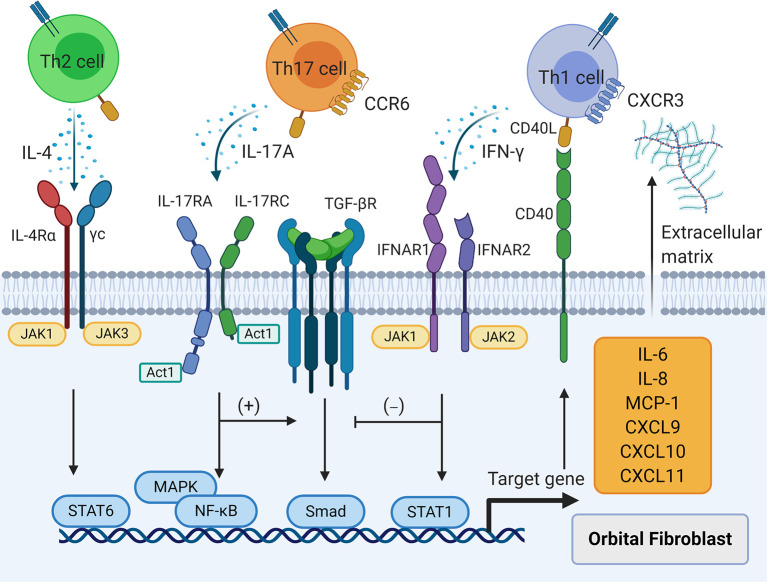
Graves' orbitopathy (GO), also known as thyroid-associated ophthalmopathy, is the most common ocular abnormality of Graves' disease. It is a disfiguring, invalidating, and potentially blinding orbital disease mediated by an interlocking and complicated immune network. Self-reactive T cells directly against thyroid-stimulating hormone receptor-bearing orbital fibroblasts contribute to autoimmune inflammation and tissue remodeling in GO orbital connective tissues. To date, T helper (Th) 1 (cytotoxic leaning) and Th2 (antibody leaning) cell subsets and an emerging role of Th17 (fibrotic leaning) cells have been implicated in GO pathogenesis. The potential feedback loops between orbital native residential CD34 fibroblasts, CD34 infiltrating fibrocytes, and effector T cells may affect the T cell subset bias and the skewed pattern of cytokine production in the orbit, thereby determining the outcomes of GO autoimmune reactions. Characterization of the T cell subsets that drive GO and the cytokines they express may significantly advance our understanding of orbital autoimmunity and the development of promising therapeutic strategies against pathological T cells.
格雷夫斯眼病(GO),又称甲状腺相关性眼病,是格雷夫斯病最常见的眼部异常。它是一种由相互关联和复杂的免疫网络介导的致盲性、致残性眼眶疾病。自身反应性 T 细胞直接针对促甲状腺激素受体表达的眼眶成纤维细胞,导致 GO 眼眶结缔组织的自身免疫炎症和组织重塑。迄今为止,辅助性 T 细胞(Th)1(细胞毒性倾向)和 Th2(抗体倾向)细胞亚群以及 Th17(纤维化倾向)细胞的新作用已被牵连到 GO 的发病机制中。眼眶固有 CD34 成纤维细胞、CD34 浸润性成纤维细胞和效应 T 细胞之间的潜在反馈环路可能会影响 T 细胞亚群的偏倚以及眼眶中细胞因子产生的偏倚模式,从而决定 GO 自身免疫反应的结果。驱动 GO 的 T 细胞亚群及其表达的细胞因子的特征可能会显著促进我们对眼眶自身免疫和针对病理性 T 细胞的有前途的治疗策略的理解。