Louis Stokes Cleveland VA Medical Center, Cleveland, OH, United States.
Center for AIDS Research, Department of Pathology, Case Western Reserve University, Cleveland, OH, United States.
Front Immunol. 2021 Mar 25;12:638010. doi: 10.3389/fimmu.2021.638010. eCollection 2021.
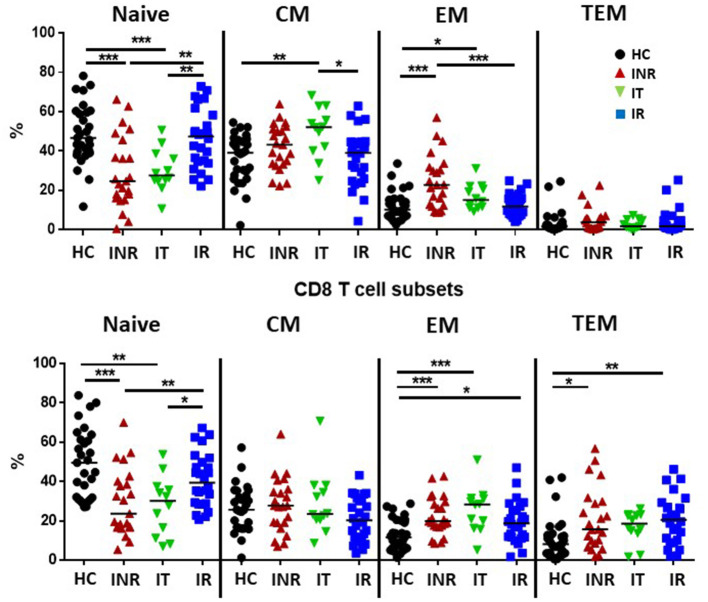
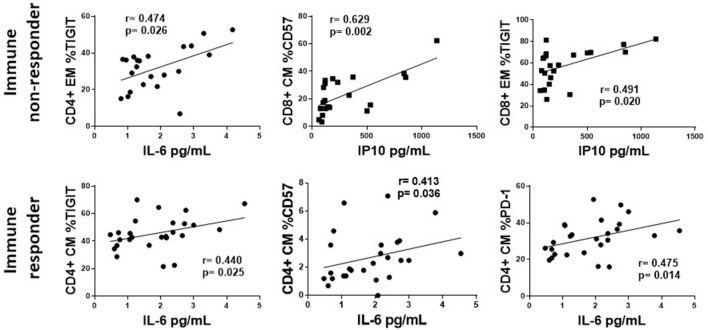
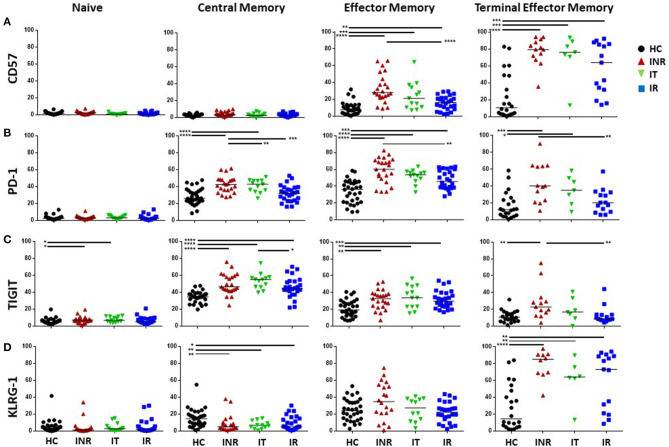
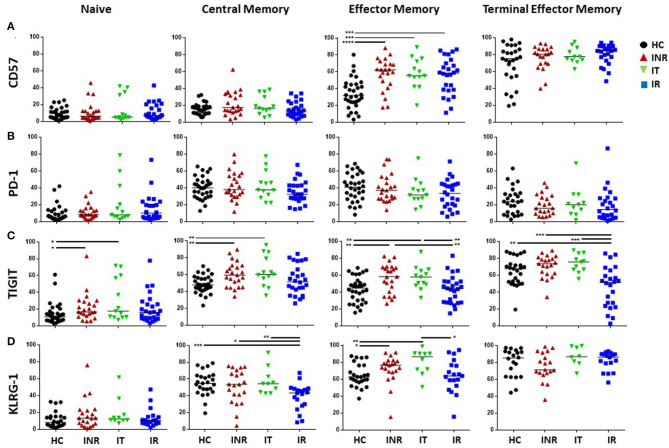
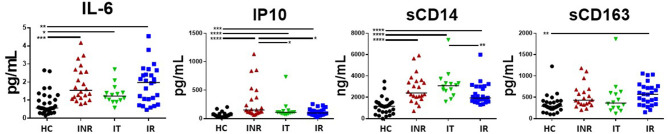
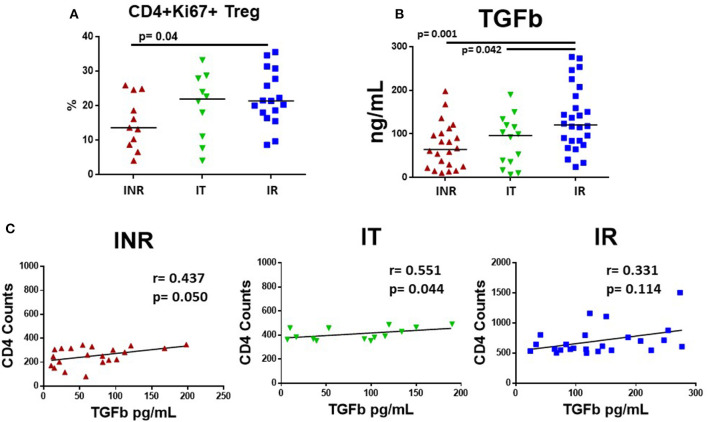
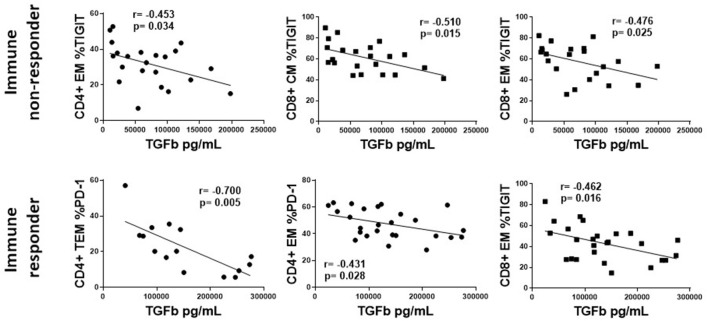
Immune non-responders (INR) are HIV+, ART-controlled (>2 yrs) people who fail to reconstitute their CD4 T cell numbers. Systemic inflammation and markers of T cell senescence and exhaustion are observed in INR. This study aims to investigate T cell senescence and exhaustion and their possible association with soluble immune mediators and to understand the immune profile of HIV-infected INR. Selected participants were <50 years old to control for the confounder of older age. Plasma levels of IL-6, IP10, sCD14, sCD163, and TGF-β and markers of T cell exhaustion (PD-1, TIGIT) and senescence (CD57, KLRG-1) were measured in ART-treated, HIV+ participants grouped by CD4 T cell counts ( = 63). Immune parameters were also measured in HIV-uninfected, age distribution-matched controls (HC; = 30). Associations between T cell markers of exhaustion and senescence and plasma levels of immune mediators were examined by Spearman rank order statistics. Proportions of CD4 T cell subsets expressing markers of exhaustion (PD-1, TIGIT) and senescence (CD57, KLRG-1) were elevated in HIV+ participants. When comparing proportions between INR and IR, INR had higher proportions of CD4 memory PD-1+, EM CD57+, TEM TIGIT+ and CD8 EM and TEM TIGIT+ cells. Plasma levels of IL-6, IP10, and sCD14 were elevated during HIV infection. IP10 was higher in INR. Plasma TGF-β levels and CD4 cycling proportions of T regulatory cells were lower in INR. Proportions of CD4 T cells expressing TIGIT, PD-1, and CD57 positively correlated with plasma levels of IL-6. Plasma levels of TGF-β negatively correlated with proportions of TIGIT+ and PD-1+ T cell subsets. INR have lower levels of TGF-β and decreased proportions of cycling CD4 T regulatory cells and may have difficulty controlling inflammation. IP10 is elevated in INR and is linked to higher proportions of T cell exhaustion and senescence seen in INR.
免疫无应答者(INR)是指 HIV 阳性、接受 ART 治疗且病毒得到控制(>2 年)但无法重建 CD4 T 细胞数量的人群。在 INR 中观察到系统性炎症以及 T 细胞衰老和耗竭的标志物。本研究旨在研究 T 细胞衰老和耗竭及其与可溶性免疫介质的可能关联,并了解 HIV 感染 INR 的免疫特征。选择年龄<50 岁的参与者,以控制年龄较大的混杂因素。将 IL-6、IP10、sCD14、sCD163 和 TGF-β 等血浆水平以及 T 细胞耗竭(PD-1、TIGIT)和衰老(CD57、KLRG-1)标志物测量 ART 治疗的 HIV 阳性参与者中,按 CD4 T 细胞计数分组( = 63)。还在未感染 HIV、年龄分布匹配的对照组(HC; = 30)中测量了免疫参数。通过 Spearman 秩相关统计检验检查 T 细胞耗竭和衰老标志物与血浆免疫介质水平之间的关联。与 HIV 阳性参与者相比,表达耗竭(PD-1、TIGIT)和衰老(CD57、KLRG-1)标志物的 CD4 T 细胞亚群的比例升高。在比较 INR 和 IR 之间的比例时,INR 中具有更高比例的 CD4 记忆 PD-1+、EM CD57+、TEM TIGIT+和 CD8 EM 和 TEM TIGIT+细胞。HIV 感染期间,IL-6、IP10 和 sCD14 血浆水平升高。INR 中 IP10 更高。INR 中 TGF-β 血浆水平和 CD4 调节性 T 细胞的循环比例较低。表达 TIGIT、PD-1 和 CD57 的 CD4 T 细胞比例与 IL-6 血浆水平呈正相关。TGF-β 血浆水平与 TIGIT+和 PD-1+T 细胞亚群的比例呈负相关。INR 具有较低水平的 TGF-β 和降低的循环 CD4 调节性 T 细胞比例,可能难以控制炎症。INR 中 IP10 升高,与 INR 中观察到的更高比例的 T 细胞耗竭和衰老有关。