van Gelderen Kasper, Kang Chiakai, Li Peijin, Pierik Ronald
Plant Ecophysiology, Department of Biology, Faculty of Science, Utrecht University, Utrecht, Netherlands.
Front Plant Sci. 2021 Mar 31;12:660870. doi: 10.3389/fpls.2021.660870. eCollection 2021.
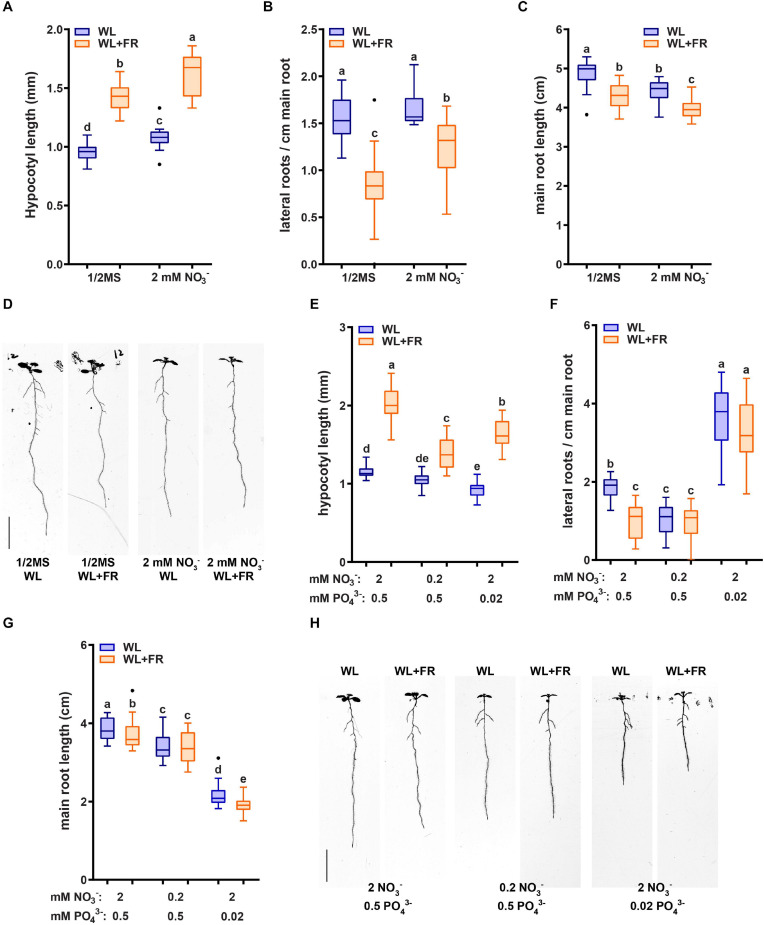
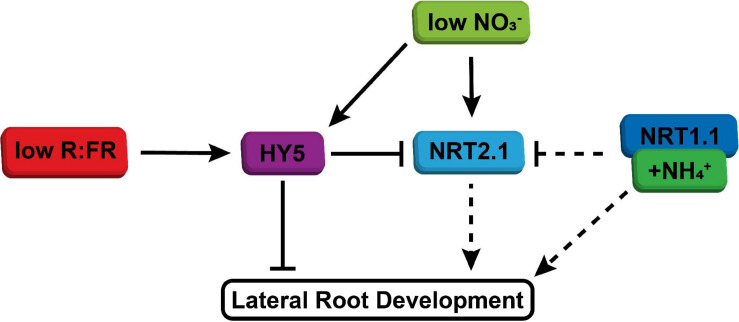
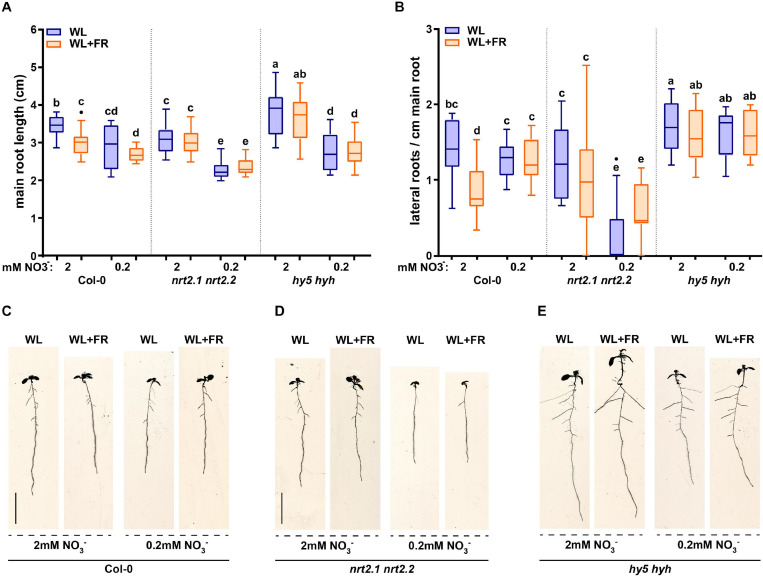
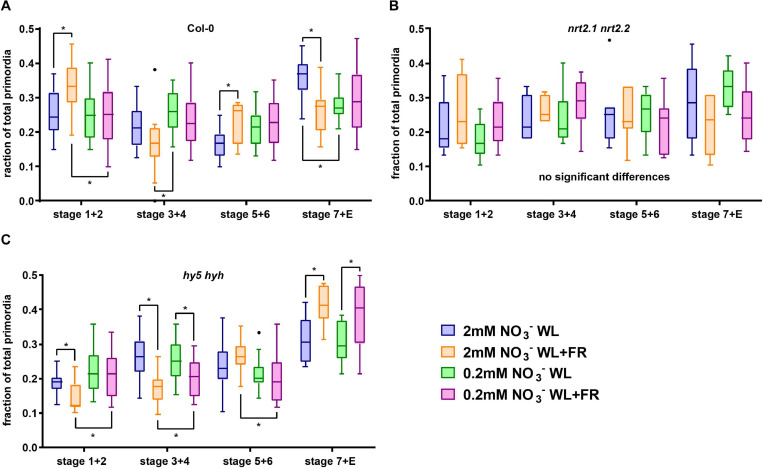
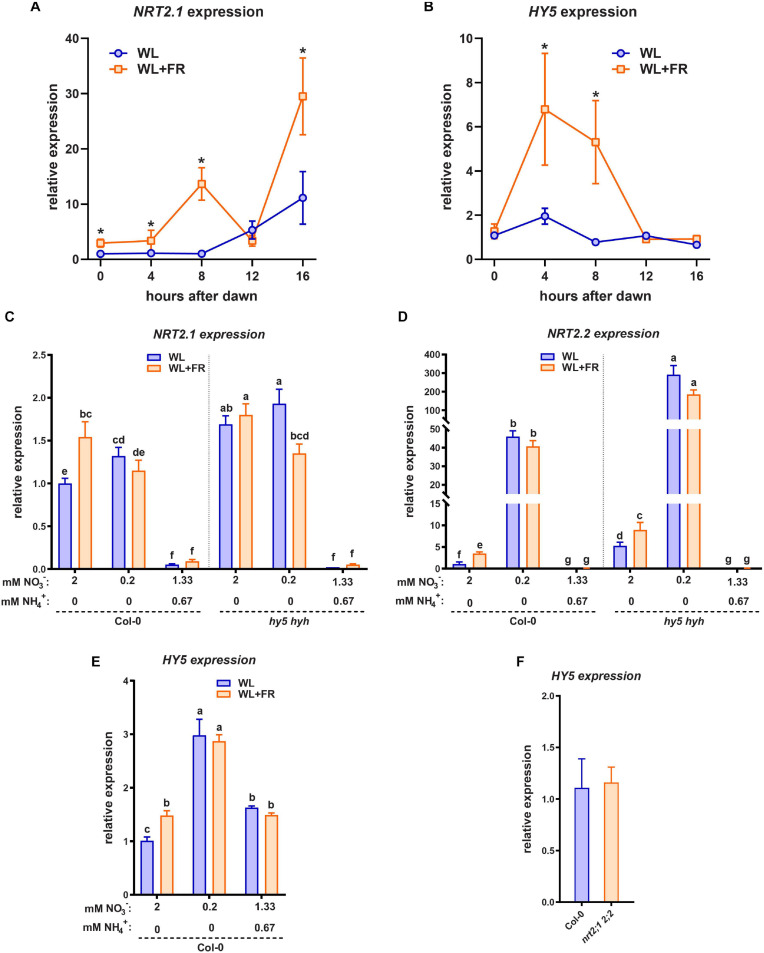
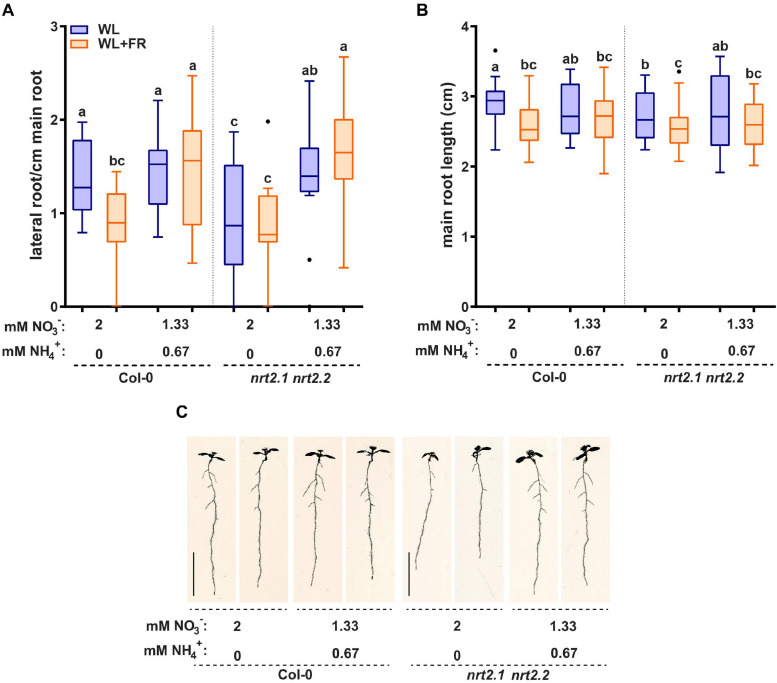
Plants are very effective in responding to environmental changes during competition for light and nutrients. Low Red:Far-Red (low R:FR)-mediated neighbor detection allows plants to compete successfully with other plants for available light. This above-ground signal can also reduce lateral root growth by inhibiting lateral root emergence, a process that might help the plant invest resources in shoot growth. Nitrate is an essential nutrient for plant growth and responds to low nitrate conditions by enhancing nutrient uptake and reducing lateral and main root growth. There are indications that low R:FR signaling and low nitrate signaling can affect each other. It is unknown which response is prioritized when low R:FR light- and low nitrate signaling co-occur. We investigated the effect of low nitrate conditions on the low R:FR response of the root system in agar plate media, combined with the application of supplemental Far-Red (FR) light to the shoot. We observed that under low nitrate conditions main and lateral root growth was reduced, but more importantly, that the response of the root system to low R:FR was not present. Consistently, a loss-of-function mutant of a nitrate transporter gene lacked low R:FR-induced lateral root reduction and its root growth was hypersensitive to low nitrate. ELONGATED HYPOCOTYL5 (HY5) plays an important role in the root response to low R:FR and we found that it was less sensitive to low nitrate conditions with regards to lateral root growth. In addition, we found that low R:FR increases expression and that low nitrate enhances expression. HY5 also affects expression, however, it depended on the presence of ammonium in which direction this effect was. Replacing part of the nitrogen source with ammonium also removed the effect of low R:FR on the root system, showing that changes in nitrogen sources can be crucial for root plasticity. Together our results show that nitrate signaling can repress low R:FR responses and that this involves signaling via HY5 and NRT2.1.
在争夺光照和养分的过程中,植物对环境变化具有很强的响应能力。低红光:远红光(低R:FR)介导的邻株检测使植物能够与其他植物成功竞争可用光照。这种地上信号还可以通过抑制侧根的形成来减少侧根生长,这一过程可能有助于植物将资源投入到地上部分的生长中。硝酸盐是植物生长必需的养分,植物通过增强养分吸收和减少侧根及主根生长来响应低硝酸盐条件。有迹象表明,低R:FR信号和低硝酸盐信号会相互影响。当低R:FR光信号和低硝酸盐信号同时出现时,哪种响应具有优先性尚不清楚。我们在琼脂平板培养基中研究了低硝酸盐条件对根系低R:FR响应的影响,并对地上部分施加补充远红光(FR)。我们观察到,在低硝酸盐条件下,主根和侧根的生长均受到抑制,但更重要的是,根系对低R:FR的响应消失了。一致的是,硝酸盐转运蛋白基因的功能缺失突变体缺乏低R:FR诱导的侧根减少,并且其根系生长对低硝酸盐高度敏感。伸长下胚轴5(HY5)在根系对低R:FR的响应中起重要作用,我们发现它在侧根生长方面对低硝酸盐条件不太敏感。此外,我们发现低R:FR会增加[具体基因1]的表达,低硝酸盐会增强[具体基因2]的表达。HY5也会影响[具体基因3]的表达,然而,这种影响的方向取决于铵的存在。用铵替代部分氮源也消除了低R:FR对根系的影响,表明氮源的变化对根系可塑性可能至关重要。我们的研究结果共同表明,硝酸盐信号可以抑制低R:FR响应,并且这涉及通过HY5和NRT2.1进行信号传导。