Centre for Cardio-Metabolic Research in Africa (CARMA), Division of Medical Physiology, Department of Biomedical Sciences, Faculty of Medicine and Health Sciences, Stellenbosch University, South Africa.
Oxid Med Cell Longev. 2021 Apr 1;2021:8850708. doi: 10.1155/2021/8850708. eCollection 2021.
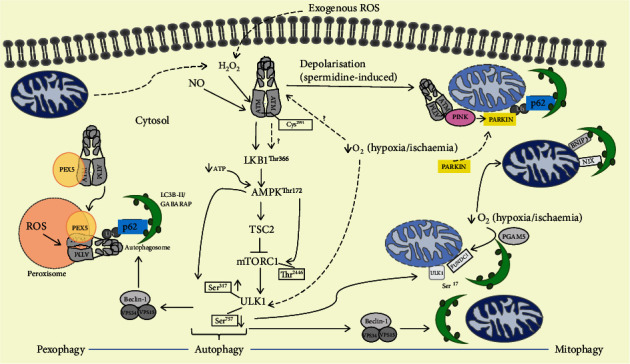
Ataxia Telangiectasia Mutated protein kinase (ATM) has recently come to the fore as a regulatory protein fulfilling many roles in the fine balancing act of metabolic homeostasis. Best known for its role as a transducer of DNA damage repair, the activity of ATM in the cytosol is enjoying increasing attention, where it plays a central role in general cellular recycling (macroautophagy) as well as the targeted clearance (selective autophagy) of damaged mitochondria and peroxisomes in response to oxidative stress, independently of the DNA damage response. The importance of ATM activation by oxidative stress has also recently been highlighted in the clearance of protein aggregates, where the expression of a functional ATM construct that cannot be activated by oxidative stress resulted in widespread accumulation of protein aggregates. This review will discuss the role of ATM in general autophagy, mitophagy, and pexophagy as well as aggrephagy and crosstalk between oxidative stress as an activator of ATM and its potential role as a master regulator of these processes.
共济失调毛细血管扩张突变蛋白激酶(ATM)最近成为一种调节蛋白,在代谢稳态的精细平衡中发挥着许多作用。ATM 作为 DNA 损伤修复的传感器而广为人知,其在细胞质中的活性正受到越来越多的关注,在细胞质中,它在一般细胞再循环(大自噬)以及靶向清除(选择性自噬)受损线粒体和过氧化物酶体中发挥核心作用,而与 DNA 损伤反应无关。氧化应激激活 ATM 的重要性最近也在蛋白质聚集体的清除中得到了强调,其中表达一种不能被氧化应激激活的功能性 ATM 构建体导致了广泛的蛋白质聚集体积累。这篇综述将讨论 ATM 在一般自噬、线粒体自噬和过氧化物酶体自噬以及聚集体自噬中的作用,以及氧化应激作为 ATM 激活剂的串扰及其作为这些过程的主调控因子的潜在作用。