Cai Zhiyuan, He Chaobin, Zhao Chongyu, Lin Xiaojun
Department of Pancreatobiliary Surgery, State Key Laboratory of Oncology in South China, Collaborative Innovation Center for Cancer Medicine, Sun Yat-sen University Cancer Center, Guangzhou, China.
Guangdong Provincial Engineering Research Center of Molecular Imaging, The Fifth Affiliated Hospital of Sun Yat-sen University, Zhuhai, China.
Front Oncol. 2021 Apr 1;11:611118. doi: 10.3389/fonc.2021.611118. eCollection 2021.
Intrahepatic cholangiocarcinoma (ICC) has a poor prognosis and 40%-60% of patients present with advanced disease at the time of diagnosis. Transarterial chemoembolization (TACE) and hepatic arterial infusion chemotherapy (HAIC) have recently been used in unresectable ICC. The aim of this study was to compare the survival differences of unresectable ICC patients after TACE and HAIC treatment.
Between March 2011 and October 2019, a total of 126 patients with unresectable ICC, as evident from biopsies and imaging, and who had received TACE or HAIC were enrolled in this study. Baseline characteristics and survival differences were compared between the TACE and HAIC treatment groups.
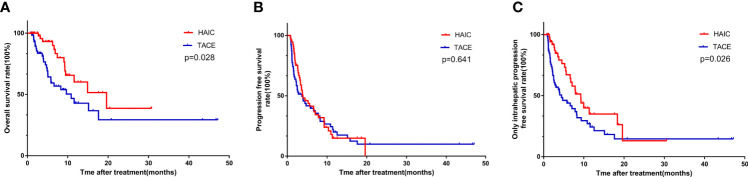
ICC Patients had significantly higher survival rates after the HAIC treatment, compared with those after TACE treatment [1-year overall survival (OS) rates: 60.2% vs. 42.9%, 2-year OS rates: 38.7% vs. 29.4%, P=0.028; 1-year progression-free survival (PFS) rates: 15.0% vs. 20.0%, 2-year PFS rates: 0% vs. 0%, P=0.641; 1-year only intrahepatic PFS (OIPFS) rates: 35.0% vs. 24.4%, 2-year OIPFS rates: 13.1% vs. 14.6%, P = 0.026]. Multivariate Cox regression analysis showed that HAIC was a significant and independent factor for OS and OIPFS in the study cohort.
HAIC is superior to TACE for treatment of unresectable ICC. A new tumor response evaluation procedure for HAIC treatment in unresectable ICC patients is needed to provide better therapeutic strategies. A randomized clinical trial comparing the survival benefits of HAIC and TACE is therefore being considered.
肝内胆管癌(ICC)预后较差,40%-60%的患者在诊断时已处于晚期。经动脉化疗栓塞术(TACE)和肝动脉灌注化疗(HAIC)最近已用于不可切除的ICC。本研究的目的是比较不可切除的ICC患者在接受TACE和HAIC治疗后的生存差异。
2011年3月至2019年10月,共有126例经活检和影像学检查证实为不可切除的ICC患者,且接受了TACE或HAIC治疗,纳入本研究。比较TACE和HAIC治疗组的基线特征和生存差异。
与TACE治疗后的患者相比,HAIC治疗后的ICC患者生存率显著更高[1年总生存率(OS):60.2%对42.9%,2年OS率:38.7%对29.4%,P=0.028;1年无进展生存率(PFS):15.0%对20.0%,2年PFS率:0%对0%,P=0.641;1年仅肝内PFS(OIPFS)率:35.0%对24.4%,2年OIPFS率:13.1%对14.6%,P = 0.026]。多因素Cox回归分析显示,HAIC是研究队列中OS和OIPFS的显著独立因素。
对于不可切除的ICC,HAIC优于TACE。需要一种新的不可切除ICC患者HAIC治疗的肿瘤反应评估程序,以提供更好的治疗策略。因此,正在考虑进行一项比较HAIC和TACE生存获益的随机临床试验。