Hu Xiangjun, Zheng Nan, Chen Yunsu, Dai Kerong, Dimitriou Dimitris, Li Huiwu, Tsai Tsung-Yuan
School of Biomedical Engineering, Med-X Research Institute, Shanghai Jiao Tong University, Shanghai, China.
Engineering Research Center of Digital Medicine and Clinical Translation, Ministry of Education, Shanghai, China.
Front Bioeng Biotechnol. 2021 Mar 30;9:645019. doi: 10.3389/fbioe.2021.645019. eCollection 2021.
Femoral offset (FO) restoration is significantly correlated with functional recovery following total hip arthroplasty (THA). Accurately assessing the effects of FO changes on hip muscles following THA would help improve function and optimize functional outcomes. The present study aimed to (1) identify the impact of FO side difference on the hip muscle moment arms following unilateral THA during gait and (2) propose the optimal FO for a physiological hip muscle function.
hip kinematics from eighteen unilateral THA patients during gait were measured with a dual-fluoroscopic imaging system. The moment arms of thirteen hip muscles were calculated using CT-based 3D musculoskeletal models with the hip muscles' lines of actions. The correlation coefficient (R) between FO and hip muscle moment arm changes compared with the non-implanted hip was calculated. We considered that the FO reconstruction was satisfactory when the abductor moment arms increased, while the extensor, adductor, and flexor moment arms decreased less than 5%.
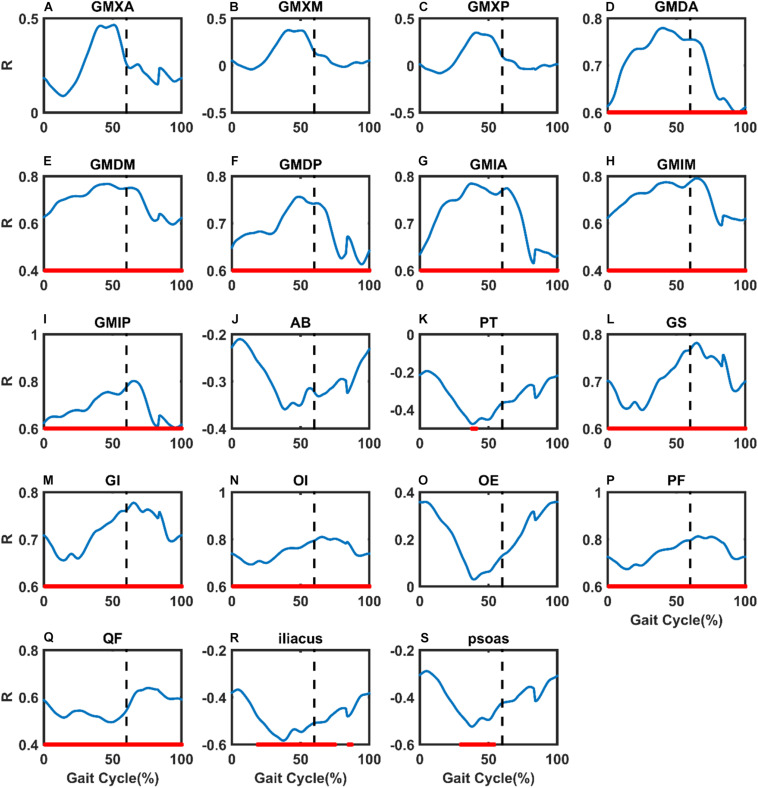
A decreased FO following THA was significantly correlated with a decrease of the abductor and external rotator moment arms during the whole gait ( > 0.5) and a decrease of extensor moment arms during the stance phase ( > 0.4). An increased FO following THA was significantly associated with shorter flexor moment arms throughout the gait ( < -0.5) and shorter adductor moment arms in the stance phase ( < -0.4). An increase in FO of 2.3-2.9 mm resulted in increased abductor moment arms while maintaining the maximum decrease of the hip muscles at less than 5.0%.
An increase of 2-3 mm in FO could improve the abductor and external rotator function following a THA. Accurate surgical planning with optimal FO reconstruction is essential to restoring normal hip muscle function in THA patients.
股骨偏心距(FO)恢复与全髋关节置换术(THA)后的功能恢复显著相关。准确评估THA后FO变化对髋部肌肉的影响有助于改善功能并优化功能结果。本研究旨在:(1)确定单侧THA后步态期间FO侧别差异对髋部肌肉力臂的影响;(2)提出生理髋部肌肉功能的最佳FO。
使用双荧光透视成像系统测量18例单侧THA患者步态期间的髋部运动学。利用基于CT的三维肌肉骨骼模型及髋部肌肉的作用线计算13块髋部肌肉的力臂。计算与未置换髋关节相比,FO与髋部肌肉力臂变化之间的相关系数(R)。我们认为当外展肌力臂增加,而伸肌、内收肌和屈肌力臂减少小于5%时,FO重建是令人满意的。
THA后FO降低与整个步态期间外展肌和外旋肌力臂降低显著相关(>0.5),以及站立期伸肌力臂降低显著相关(>0.4)。THA后FO增加与整个步态期间较短的屈肌力臂显著相关(<-0.5)以及站立期较短的内收肌力臂显著相关(<-0.4)。FO增加2.3 - 2.9 mm导致外展肌力臂增加,同时保持髋部肌肉最大减少小于5.0%。
FO增加2 - 3 mm可改善THA后的外展肌和外旋肌功能。精确的手术规划及最佳FO重建对于恢复THA患者正常髋部肌肉功能至关重要。