Vizán Pedro, Di Croce Luciano, Aranda Sergi
Centre for Genomic Regulation (CRG), Barcelona Institute of Science and Technology, Barcelona, Spain.
Universitat Pompeu Fabra (UPF), Barcelona, Spain.
Front Cell Dev Biol. 2021 Mar 31;9:654344. doi: 10.3389/fcell.2021.654344. eCollection 2021.
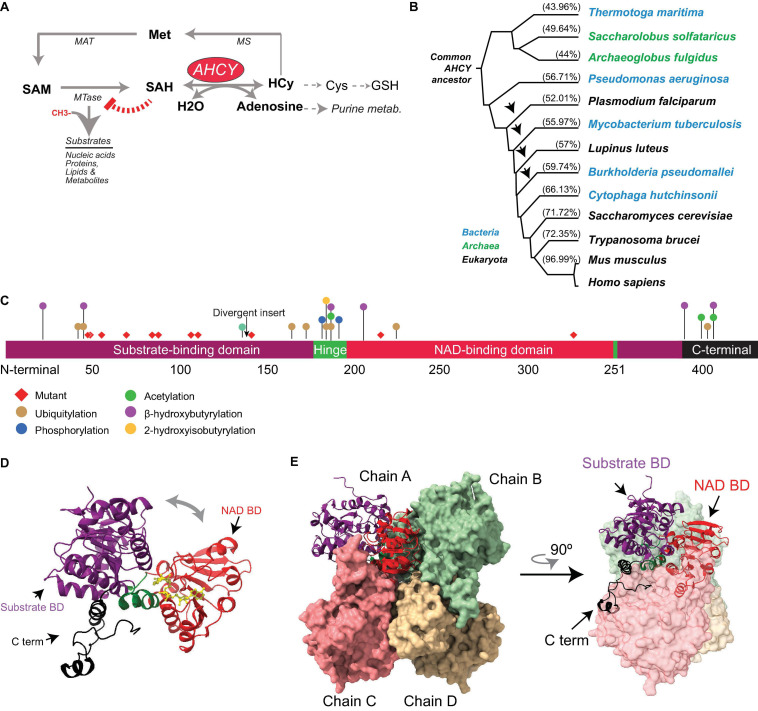
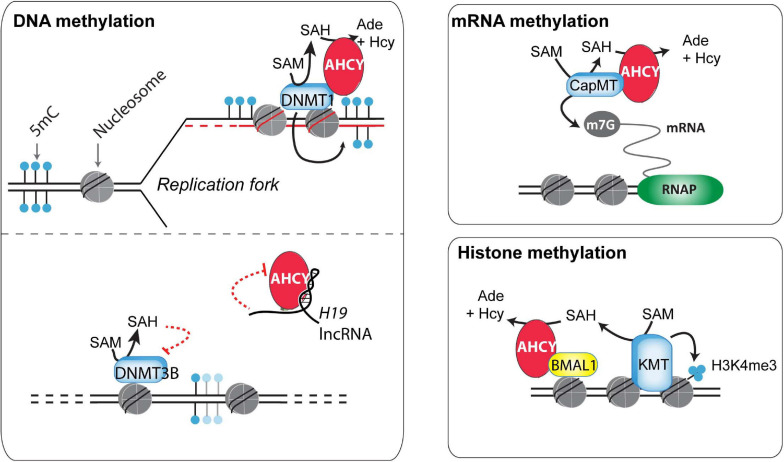
Adenosylhomocysteinase (AHCY) is a unique enzyme and one of the most conserved proteins in living organisms. AHCY catalyzes the reversible break of -adenosylhomocysteine (SAH), the by-product and a potent inhibitor of methyltransferases activity. In mammals, AHCY is the only enzyme capable of performing this reaction. Controlled subcellular localization of AHCY is believed to facilitate local transmethylation reactions, by removing excess of SAH. Accordingly, AHCY is recruited to chromatin during replication and active transcription, correlating with increasing demands for DNA, RNA, and histone methylation. AHCY deletion is embryonic lethal in many organisms (from plants to mammals). In humans, AHCY deficiency is associated with an incurable rare recessive disorder in methionine metabolism. In this review, we focus on the AHCY protein from an evolutionary, biochemical, and functional point of view, and we discuss the most recent, relevant, and controversial contributions to the study of this enzyme.
腺苷同型半胱氨酸酶(AHCY)是一种独特的酶,也是生物体内最保守的蛋白质之一。AHCY催化S-腺苷同型半胱氨酸(SAH)的可逆分解,SAH是甲基转移酶活性的副产物和强效抑制剂。在哺乳动物中,AHCY是唯一能够进行此反应的酶。据信,AHCY在亚细胞中的定位受到调控,通过去除过量的SAH来促进局部转甲基反应。因此,在复制和活跃转录过程中,AHCY被募集到染色质上,这与对DNA、RNA和组蛋白甲基化需求的增加相关。在许多生物(从植物到哺乳动物)中,AHCY缺失会导致胚胎致死。在人类中,AHCY缺乏与一种无法治愈的罕见的甲硫氨酸代谢隐性疾病有关。在本综述中,我们从进化、生化和功能的角度关注AHCY蛋白,并讨论对该酶研究的最新、相关且有争议的贡献。