Schulz-Kuhnt Anja, Neurath Markus F, Wirtz Stefan, Atreya Imke
Department of Medicine 1, University Hospital of Erlangen, Erlangen, Germany.
Deutsches Zentrum Immuntherapie, Erlangen, Germany.
Front Med (Lausanne). 2021 Mar 30;8:656745. doi: 10.3389/fmed.2021.656745. eCollection 2021.
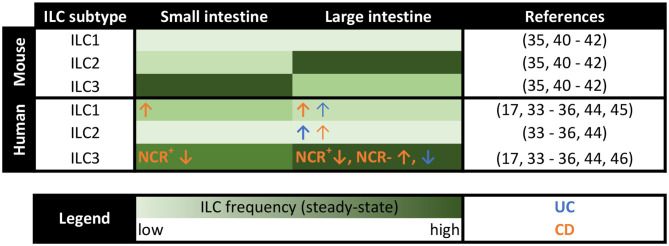
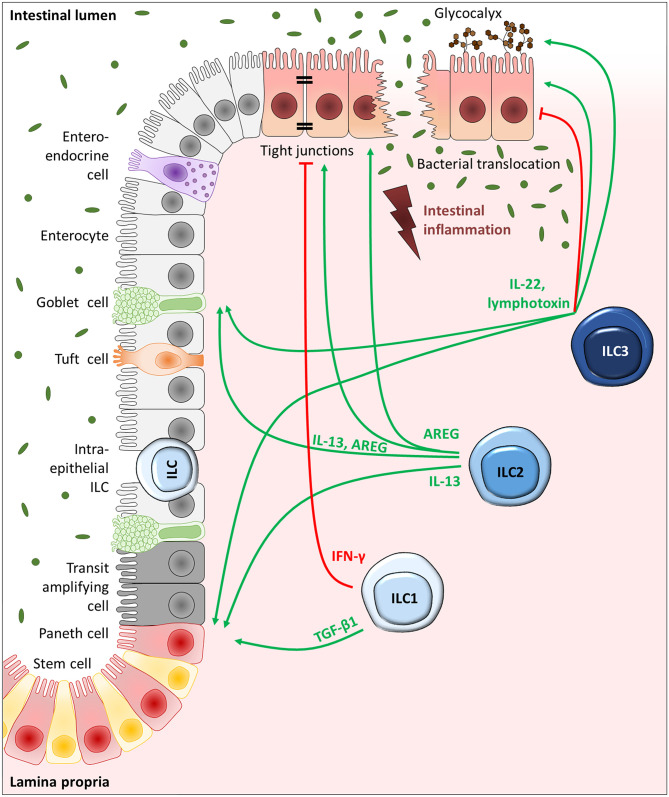
The occurrence of epithelial defects in the gut relevantly contributes to the pathogenesis of inflammatory bowel diseases (IBD), whereby the impairment of intestinal epithelial barrier integrity seems to represent a primary trigger as well as a disease amplifying consequence of the chronic inflammatory process. Besides epithelial cell intrinsic factors, accumulated and overwhelmingly activated immune cells and their secretome have been identified as critical modulators of the pathologically altered intestinal epithelial cell (IEC) function in IBD. In this context, over the last 10 years increasing levels of attention have been paid to the group of innate lymphoid cells (ILCs). This is in particular due to a preferential location of these rather newly described innate immune cells in close proximity to mucosal barriers, their profound capacity to secrete effector cytokines and their numerical and functional alteration under chronic inflammatory conditions. Aiming on a comprehensive and updated summary of our current understanding of the bidirectional mucosal crosstalk between ILCs and IECs, this review article will in particular focus on the potential capacity of gut infiltrating type-1, type-2, and type-3 helper ILCs (ILC1s, ILC2s, and ILC3s, respectively) to impact on the survival, differentiation, and barrier function of IECs. Based on data acquired in IBD patients or in experimental models of colitis, we will discuss whether the different ILC subgroups could serve as potential therapeutic targets for maintenance of epithelial integrity and/or mucosal healing in IBD.
肠道上皮缺陷的发生与炎症性肠病(IBD)的发病机制密切相关,其中肠道上皮屏障完整性受损似乎既是慢性炎症过程的主要触发因素,也是疾病加剧的后果。除了上皮细胞内在因素外,积累并被过度激活的免疫细胞及其分泌产物已被确定为IBD中肠道上皮细胞(IEC)功能发生病理改变的关键调节因子。在这种背景下,在过去十年中,先天淋巴细胞(ILC)群体受到了越来越多的关注。这尤其归因于这些新描述的先天免疫细胞优先定位于靠近黏膜屏障的位置、它们分泌效应细胞因子的强大能力以及它们在慢性炎症条件下的数量和功能改变。为了全面、更新地总结我们目前对ILC与IEC之间双向黏膜相互作用的理解,本文将特别关注肠道浸润的1型、2型和3型辅助性ILC(分别为ILC1、ILC2和ILC3)影响IEC生存、分化和屏障功能的潜在能力。基于在IBD患者或结肠炎实验模型中获得的数据,我们将讨论不同的ILC亚群是否可作为维持IBD上皮完整性和/或黏膜愈合的潜在治疗靶点。