Friesner Joanna, Colón-Carmona Adán, Schnoes Alexandra M, Stepanova Anna, Mason Grace Alex, Macintosh Gustavo C, Ullah Hemayat, Baxter Ivan, Callis Judy, Sierra-Cajas Kimberly, Elliott Kiona, Haswell Elizabeth S, Zavala Maria Elena, Wildermuth Mary, Williams Mary, Ayalew Mentewab, Henkhaus Natalie, Prunet Nathanaël, Lemaux Peggy G, Yadegari Ramin, Amasino Rick, Hangarter Roger, Innes Roger, Brady Siobhan, Long Terri, Woodford-Thomas Terry, May Victoria, Sun Ying, Dinneny José R
UC Davis & North American Arabidopsis Steering Committee Atlanta GA USA.
University of Massachusetts Boston Boston MA USA.
Plant Direct. 2021 Apr 14;5(4):e00316. doi: 10.1002/pld3.316. eCollection 2021 Apr.
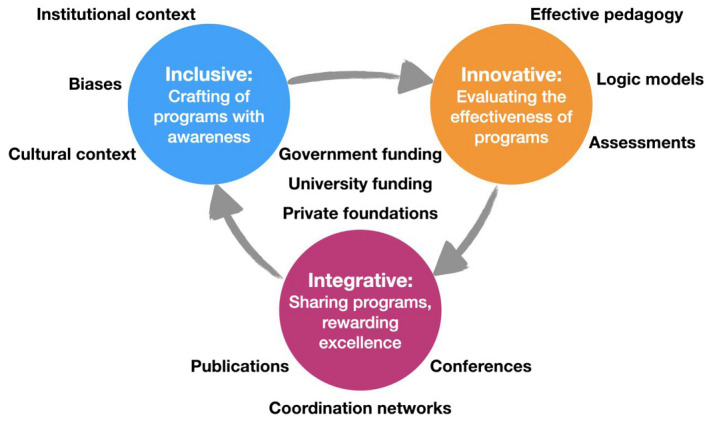
Population growth and climate change will impact food security and potentially exacerbate the environmental toll that agriculture has taken on our planet. These existential concerns demand that a passionate, interdisciplinary, and diverse community of plant science professionals is trained during the 21st century. Furthermore, societal trends that question the importance of science and expert knowledge highlight the need to better communicate the value of rigorous fundamental scientific exploration. Engaging students and the general public in the wonder of plants, and science in general, requires renewed efforts that take advantage of advances in technology and new models of funding and knowledge dissemination. In November 2018, funded by the National Science Foundation through the Arabidopsis Research and Training for the 21st century (ART 21) research coordination network, a symposium and workshop were held that included a diverse panel of students, scientists, educators, and administrators from across the US. The purpose of the workshop was to re-envision how outreach programs are funded, evaluated, acknowledged, and shared within the plant science community. One key objective was to generate a roadmap for future efforts. We hope that this document will serve as such, by providing a comprehensive resource for students and young faculty interested in developing effective outreach programs. We also anticipate that this document will guide the formation of community partnerships to scale up currently successful outreach programs, and lead to the design of future programs that effectively engage with a more diverse student body and citizenry.
人口增长和气候变化将影响粮食安全,并可能加剧农业对我们星球造成的环境破坏。这些关乎人类生存的问题要求在21世纪培养一批充满热情、跨学科且多元化的植物科学专业人才。此外,质疑科学和专家知识重要性的社会趋势凸显了更好地传达严谨的基础科学探索价值的必要性。让学生和普通大众领略植物的奇妙以及科学的魅力,需要做出新的努力,利用技术进步以及新的资金和知识传播模式。2018年11月,由美国国家科学基金会通过21世纪拟南芥研究与培训(ART 21)研究协调网络提供资金,举办了一次研讨会和工作坊,参会人员包括来自美国各地的学生、科学家、教育工作者和管理人员组成的多元化小组。该工作坊的目的是重新构想植物科学界外展项目的资金筹集、评估、认可和分享方式。一个关键目标是制定未来工作的路线图。我们希望这份文件能起到这样的作用,为有兴趣开展有效外展项目的学生和青年教师提供全面的资源。我们还预计这份文件将指导建立社区伙伴关系,以扩大目前成功的外展项目规模,并促成未来项目的设计,使其能有效地吸引更多样化的学生群体和公众参与。