The Plant Chemetics Laboratory, Department of Plant Sciences, University of Oxford, OX1 3RB Oxford, UK.
Plant Cell. 2021 Aug 13;33(7):2116-2130. doi: 10.1093/plcell/koab109.
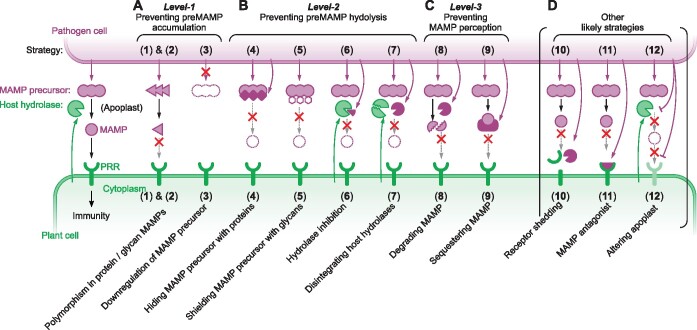
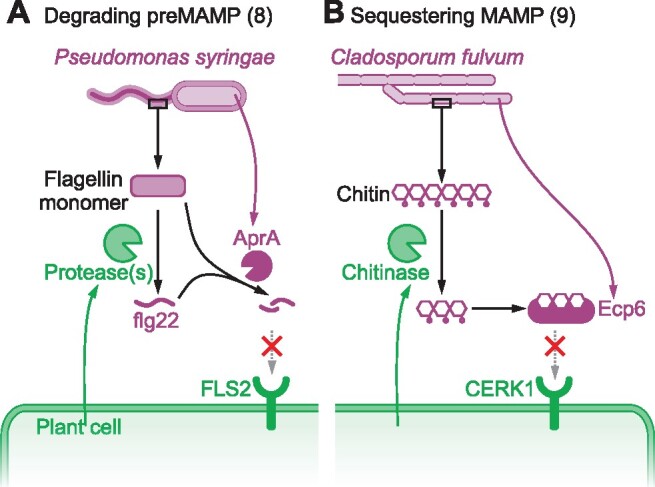
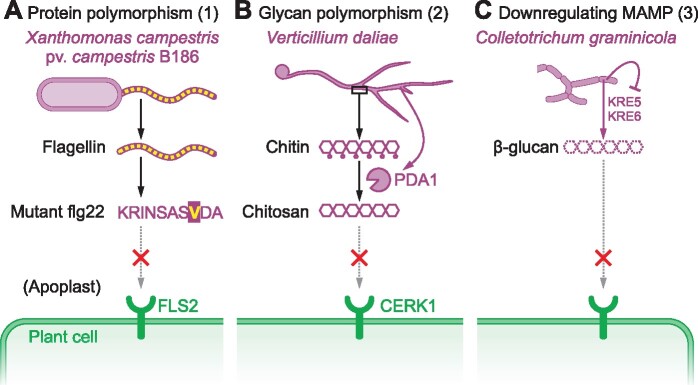
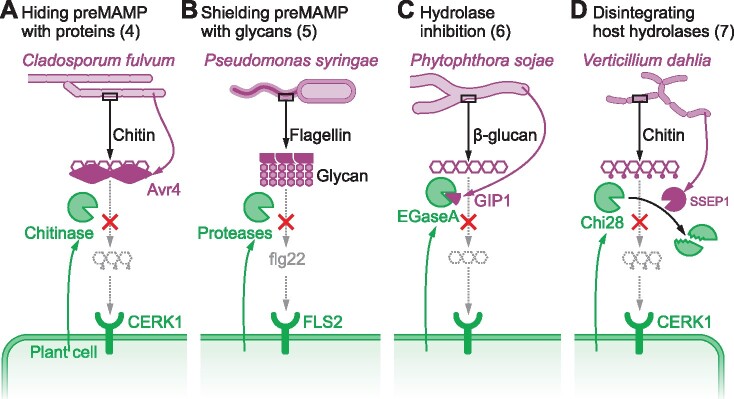
Recognition of microbe-associated molecular patterns (MAMPs) by cell-surface receptors is pivotal in host-microbe interactions. Both pathogens and symbionts establish plant-microbe interactions using fascinating intricate extracellular strategies to avoid recognition. Here we distinguish nine different extracellular strategies to avoid recognition by the host, acting at three different levels. To avoid the accumulation of MAMP precursors (Level 1), microbes take advantage of polymorphisms in both MAMP proteins and glycans, or downregulate MAMP production. To reduce hydrolytic MAMP release (Level 2), microbes shield MAMP precursors with proteins or glycans and inhibit or degrade host-derived hydrolases. And to prevent MAMP perception directly (Level 3), microbes degrade or sequester MAMPs before they are perceived. We discuss examples of these nine strategies and envisage three additional extracellular strategies to avoid MAMP perception in plants.
微生物相关分子模式 (MAMPs) 被细胞表面受体识别,这在宿主-微生物相互作用中至关重要。病原体和共生体都利用迷人而复杂的细胞外策略来建立植物-微生物相互作用,以避免被识别。在这里,我们区分了避免宿主识别的九个不同的细胞外策略,这些策略作用于三个不同的水平。为了避免 MAMP 前体的积累(第 1 级),微生物利用 MAMP 蛋白和聚糖的多态性或下调 MAMP 的产生来利用。为了减少水解 MAMP 的释放(第 2 级),微生物用蛋白质或聚糖屏蔽 MAMP 前体,并抑制或降解宿主来源的水解酶。并直接防止 MAMP 的感知(第 3 级),微生物在 MAMPs 被感知之前降解或隔离它们。我们讨论了这九个策略的例子,并设想了三种额外的细胞外策略来避免植物中 MAMP 的感知。