Centre for Virus Research, The Westmead Institute for Medical Research, Westmead, New South Wales, Australia.
The University of Sydney, Faculty of Medicine and Health, Sydney, New South Wales, Australia.
PLoS Pathog. 2021 Apr 19;17(4):e1009522. doi: 10.1371/journal.ppat.1009522. eCollection 2021 Apr.
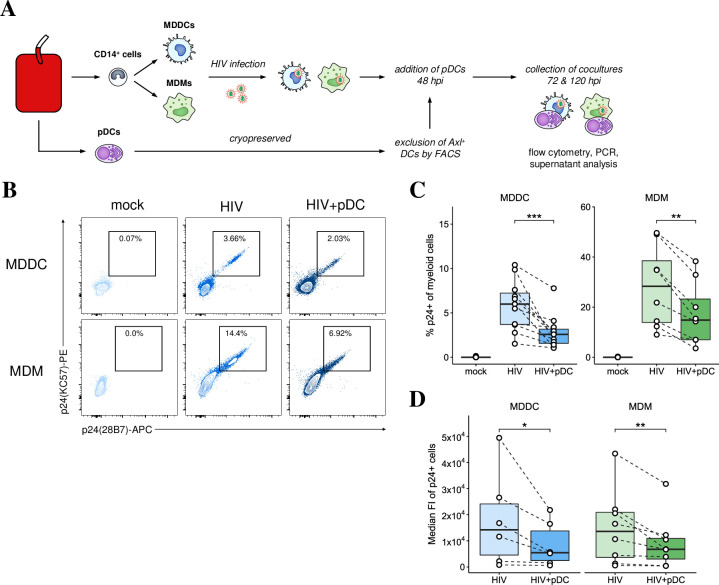
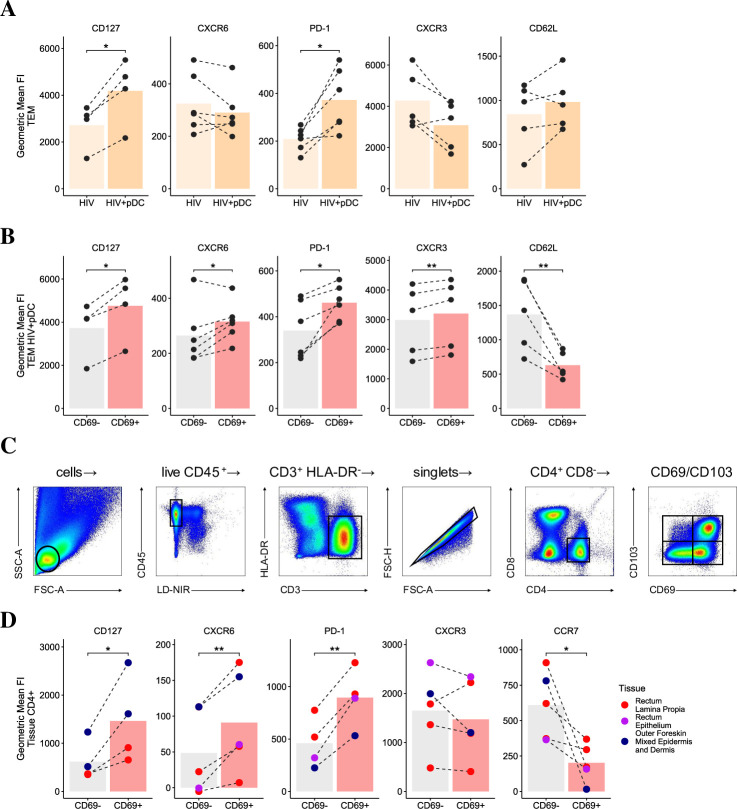
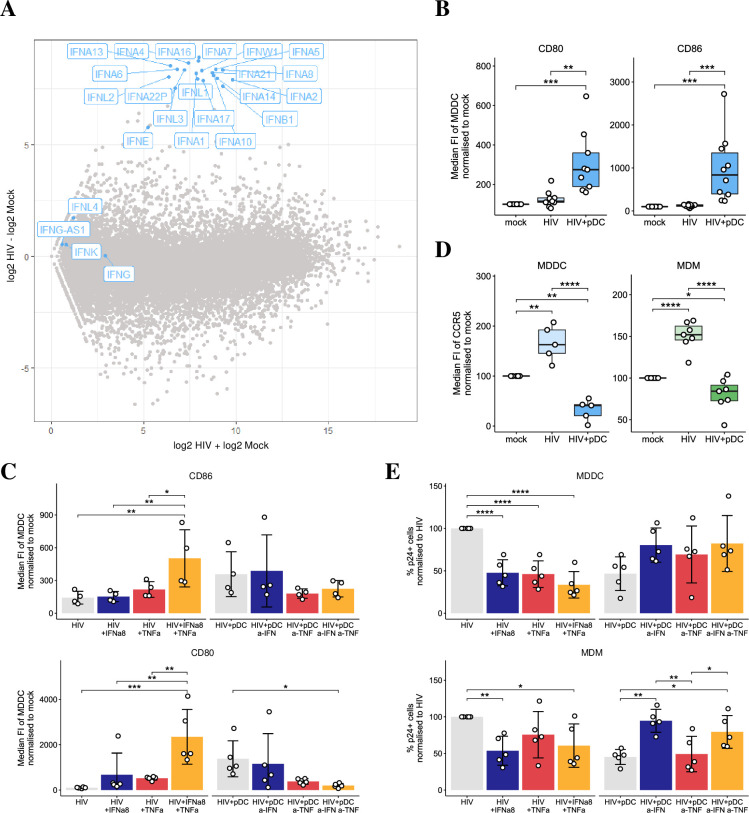
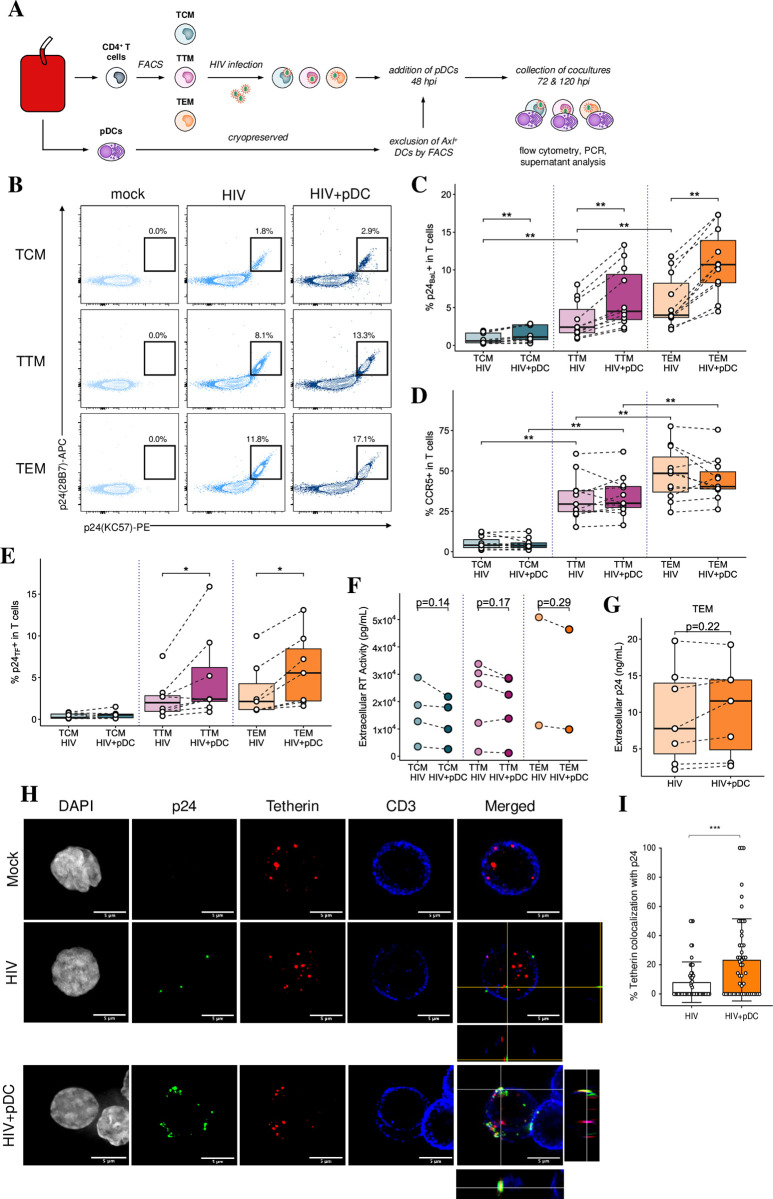
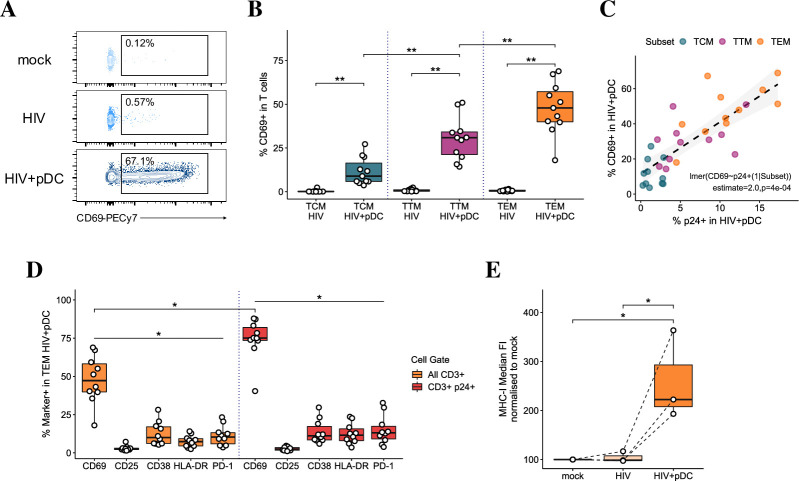
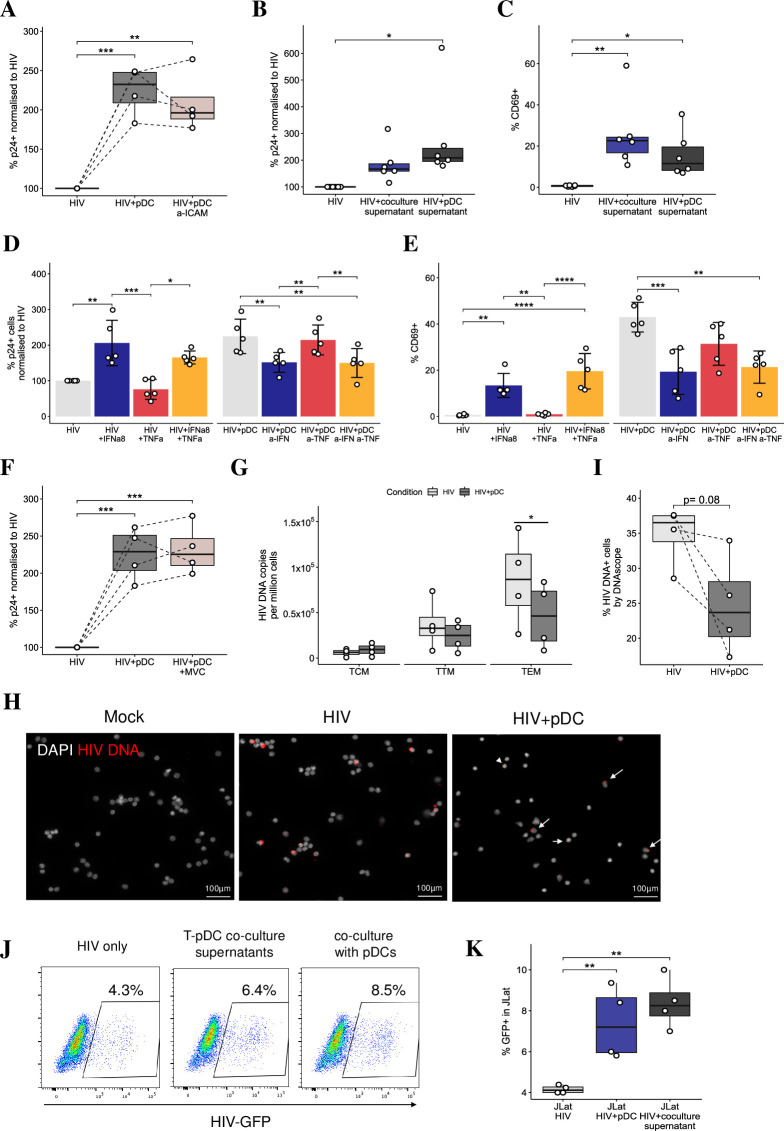
Although HIV infection inhibits interferon responses in its target cells in vitro, interferon signatures can be detected in vivo soon after sexual transmission, mainly attributed to plasmacytoid dendritic cells (pDCs). In this study, we examined the physiological contributions of pDCs to early HIV acquisition using coculture models of pDCs with myeloid DCs, macrophages and the resting central, transitional and effector memory CD4 T cell subsets. pDCs impacted infection in a cell-specific manner. In myeloid cells, HIV infection was decreased via antiviral effects, cell maturation and downregulation of CCR5 expression. In contrast, in resting memory CD4 T cells, pDCs induced a subset-specific increase in intracellular HIV p24 protein expression without any activation or increase in CCR5 expression, as measured by flow cytometry. This increase was due to reactivation rather than enhanced viral spread, as blocking HIV entry via CCR5 did not alter the increased intracellular p24 expression. Furthermore, the load and proportion of cells expressing HIV DNA were restricted in the presence of pDCs while reverse transcriptase and p24 ELISA assays showed no increase in particle associated reverse transcriptase or extracellular p24 production. In addition, pDCs also markedly induced the expression of CD69 on infected CD4 T cells and other markers of CD4 T cell tissue retention. These phenotypic changes showed marked parallels with resident memory CD4 T cells isolated from anogenital tissue using enzymatic digestion. Production of IFNα by pDCs was the main driving factor for all these results. Thus, pDCs may reduce HIV spread during initial mucosal acquisition by inhibiting replication in myeloid cells while reactivating latent virus in resting memory CD4 T cells and retaining them for immune clearance.
虽然 HIV 感染会抑制其靶细胞在体外的干扰素反应,但在性传播后不久,体内就能检测到干扰素特征,主要归因于浆细胞样树突状细胞(pDC)。在这项研究中,我们使用 pDC 与髓样树突状细胞、巨噬细胞和静息中央、过渡和效应记忆 CD4 T 细胞亚群的共培养模型,研究了 pDC 对早期 HIV 获得的生理贡献。pDC 以细胞特异性的方式影响感染。在髓样细胞中,通过抗病毒作用、细胞成熟和 CCR5 表达下调来减少 HIV 感染。相比之下,在静息记忆 CD4 T 细胞中,pDC 诱导特定亚群的细胞内 HIV p24 蛋白表达增加,而无需通过流式细胞术检测到任何激活或 CCR5 表达增加。这种增加是由于再激活而不是病毒传播增强所致,因为通过 CCR5 阻断 HIV 进入不会改变增加的细胞内 p24 表达。此外,在存在 pDC 的情况下,HIV DNA 的载量和表达细胞的比例受到限制,而逆转录酶和 p24 ELISA 检测显示,颗粒相关逆转录酶或细胞外 p24 产生没有增加。此外,pDC 还显著诱导感染的 CD4 T 细胞上 CD69 的表达以及其他 CD4 T 细胞组织保留标志物的表达。这些表型变化与使用酶消化从肛门生殖器组织中分离的常驻记忆 CD4 T 细胞非常相似。pDC 产生 IFNα 是所有这些结果的主要驱动因素。因此,pDC 可能通过抑制髓样细胞中的复制,同时激活静息记忆 CD4 T 细胞中的潜伏病毒并保留它们进行免疫清除,从而在初始粘膜获得期间减少 HIV 的传播。