Department of Physiology and Pharmacology, University of Toledo College of Medicine and Life Sciences, Toledo, OH, USA.
Department of Physiology and Pharmacology, University of Toledo College of Medicine and Life Sciences, Toledo, OH, USA.
Vascul Pharmacol. 2021 Oct;140:106862. doi: 10.1016/j.vph.2021.106862. Epub 2021 Apr 16.
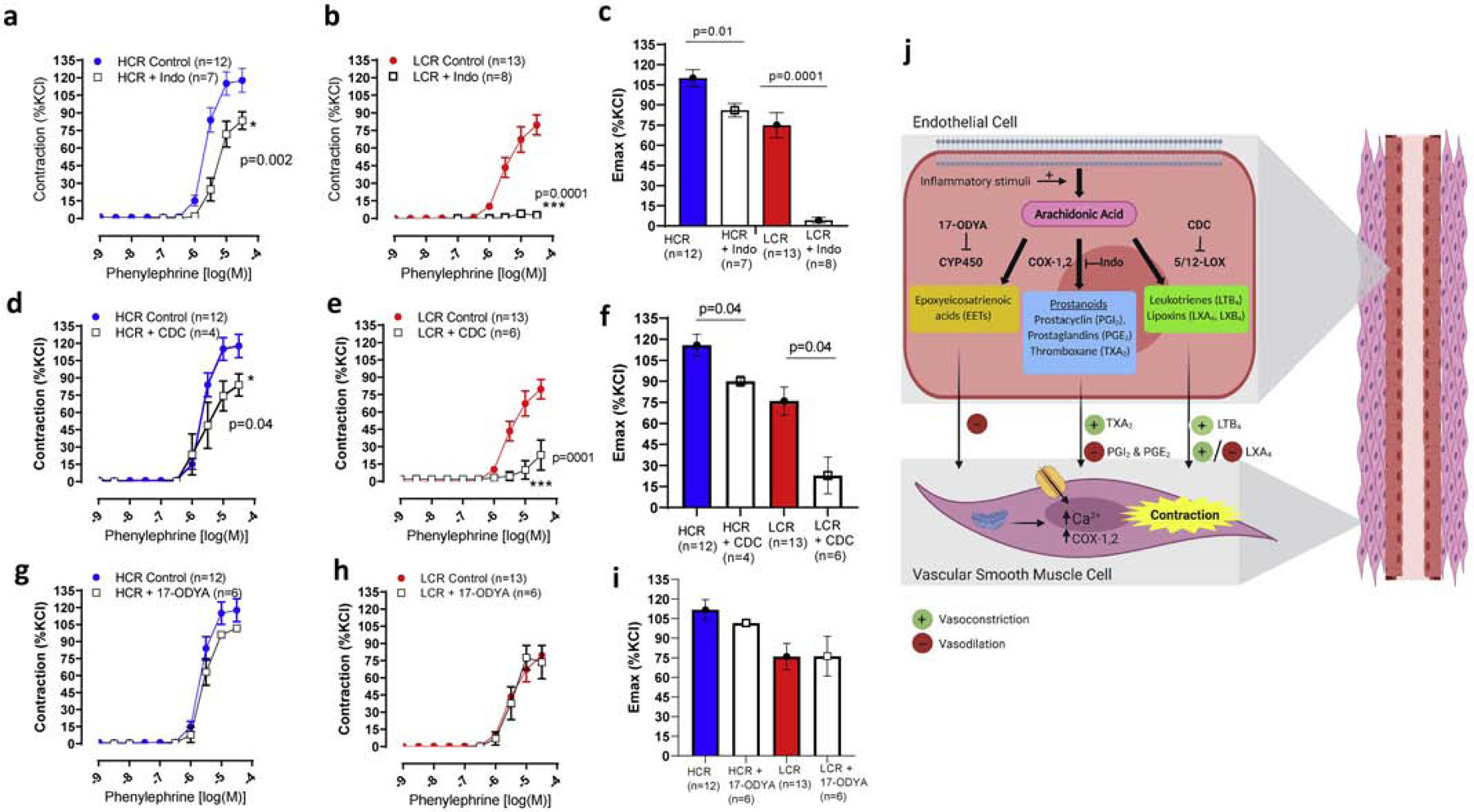
Metabolic syndrome prevalence has increased among US adults, particularly among non-hispanic white and black women. Sedentary behavior often leads to chronic inflammation, a triggering factor of metabolic syndrome. Given that intrinsic exercise capacity is genetically inherited, we questioned if low-grade chronic inflammation would be present in a female rat model of low intrinsic exercise capacity-induced metabolic syndrome, while beneficial increase of resolution of inflammation would be present in a female rat model of high intrinsic exercise capacity. In the vascular system, two primary markers for inflammation and resolution of inflammation are cyclooxygenase (COX) and lipoxygenase (LOX), respectively. Our study focused on the novel hypothesis that untrained, inherited exercise capacity induces divergent vascular plasticity via changes in the delicate balance between COX and LOX inflammatory mediators. We used divergent rat strains with low (LCR) and high (HCR) aerobic running capacity. By using animals with contrasting intrinsic exercise capacities, it is possible to determine the exact triggers that lead to inherited vascular plasticity in female rats. We observed that female LCR displayed increased periovarian fat pad and body weight, which is congruent with their obesity-presenting phenotype. Furthermore, LCR presented with vascular hypocontractility and increased COX and LOX-derived pro-inflammatory factors. On the other hand, HCR presented with a "shutdown" of COX-induced vasoconstriction and enhanced resolution of inflammation to maintain vascular tone and homeostasis. In conclusion, LCR display low-grade chronic inflammation via increased COX activity. These results provide mechanistic clues as to why lower intrinsic aerobic capacity correlates with a predisposition to risk of vascular disease. Conversely, being born with higher intrinsic aerobic capacity is a significant factor for improved vascular physiology in female rats.
代谢综合征在美国成年人中患病率上升,尤其是在非西班牙裔白人和黑人女性中。久坐行为常常导致慢性炎症,这是代谢综合征的一个触发因素。鉴于内在运动能力是遗传的,我们质疑低内在运动能力引起的代谢综合征的雌性大鼠模型中是否存在低度慢性炎症,而高内在运动能力的雌性大鼠模型中是否存在有益的炎症消退增加。在血管系统中,两种主要的炎症和炎症消退标志物分别是环加氧酶(COX)和脂加氧酶(LOX)。我们的研究集中在一个新的假设上,即未经训练的遗传运动能力通过 COX 和 LOX 炎症介质之间微妙平衡的变化诱导血管的不同可塑性。我们使用低(LCR)和高(HCR)有氧跑步能力的不同大鼠品系。通过使用内在运动能力不同的动物,可以确定导致雌性大鼠遗传血管可塑性的确切触发因素。我们观察到,雌性 LCR 显示出卵巢周围脂肪垫和体重增加,这与其肥胖表型一致。此外,LCR 表现出血管收缩功能低下和 COX 和 LOX 衍生的促炎因子增加。另一方面,HCR 表现出 COX 诱导的血管收缩的“关闭”和增强的炎症消退,以维持血管张力和体内平衡。总之,LCR 通过增加 COX 活性显示低度慢性炎症。这些结果为为什么较低的内在有氧能力与血管疾病风险增加相关提供了机制线索。相反,生来就具有较高的内在有氧能力是改善雌性大鼠血管生理学的一个重要因素。