Fröhlich Laura, Wilke Maira, Plontke Stefan K, Rahne Torsten
Department of Otorhinolaryngology, Head and Neck Surgery, Martin Luther University Halle-Wittenberg, University Medicine Halle (Saale), Ernst-Grube-Str. 40, 06120, Halle (Saale), Germany.
Sci Rep. 2021 Apr 19;11(1):8500. doi: 10.1038/s41598-021-87682-1.
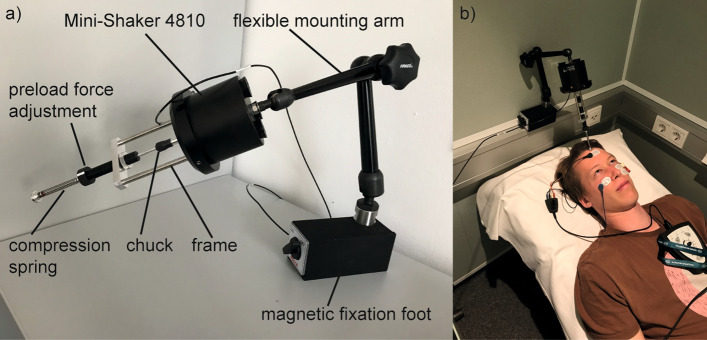
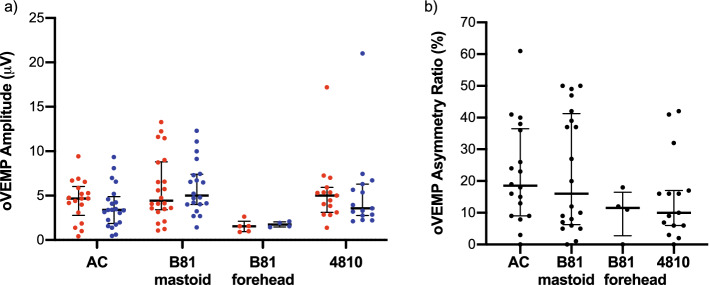
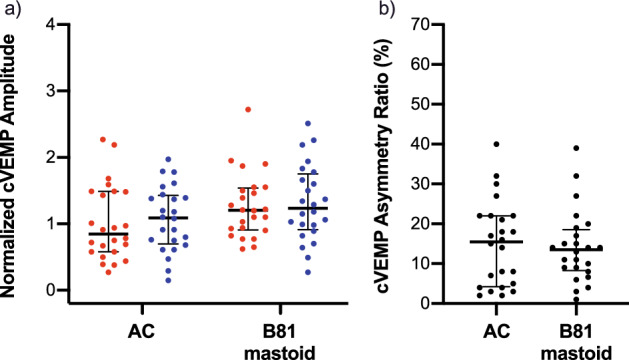
Evaluating the effectiveness of different bone conduction (BC) transducers with controlled coupling force to elicit cervical and ocular vestibular evoked myogenic potentials (cVEMPs, oVEMPs) in healthy subjects by comparing response rates, amplitudes, latencies, thresholds and asymmetry ratios. Prospective experimental study including healthy participants. VEMPs were measured to different stimulation modes; the BC transducer coupling force was controlled to 5.4 (± 0.5) Newton. cVEMPs: to bone conducted vibration (BCV) with the B81 transducer on the mastoid; oVEMPs: to BCV with the B81 on the mastoid, BCV with the B81 on the forehead, and BCV with the Mini-Shaker 4810 on the forehead. Air conducted sound (ACS) with insert earphones was used as reference. Data of 24 normal subjects (mean age 25.3 (± 3.0) years) were analyzed. ACS and BCV with the B81on the mastoid evoked cVEMPs in 100% of ears. The highest oVEMP response rates were obtained with the B81 on the mastoid (83-92%), the lowest with the B81 on the forehead (17-22%). The Mini-Shaker elicited lower response rates (65%) compared to results from the literature without coupling force control and compared to ACS (78-87%). Amplitudes were higher for BCV than ACS. ACS and BCV on the mastoid caused higher asymmetry compared to BCV forehead stimulation. The B81 was feasible to elicit VEMPs with mastoid placement and can be used as an approved medical device to measure BCV VEMPs in a clinical set-up. Normative asymmetry values have to be established due to higher variability for mastoid stimulation.
通过比较反应率、振幅、潜伏期、阈值和不对称率,评估不同骨传导(BC)换能器在控制耦合力的情况下对健康受试者诱发颈肌和眼肌前庭诱发肌源性电位(cVEMPs、oVEMPs)的有效性。包括健康参与者的前瞻性实验研究。对不同刺激模式测量VEMPs;将BC换能器耦合力控制在5.4(±0.5)牛顿。cVEMPs:使用B81换能器在乳突上进行骨传导振动(BCV);oVEMPs:使用B81在乳突上进行BCV、使用B81在前额上进行BCV以及使用Mini-Shaker 4810在前额上进行BCV。使用插入式耳机的气导声音(ACS)作为对照。分析了24名正常受试者(平均年龄25.3(±3.0)岁)的数据。使用B81在乳突上进行的ACS和BCV在100%的耳朵中诱发了cVEMPs。使用B81在乳突上获得的oVEMP反应率最高(83 - 92%),使用B81在前额上获得的反应率最低(17 - 22%)。与未控制耦合力的文献结果以及与ACS(78 - 87%)相比,Mini-Shaker诱发的反应率较低(65%)。BCV的振幅高于ACS。与前额刺激的BCV相比,乳突上的ACS和BCV导致更高的不对称性。B81通过乳突放置诱发VEMPs是可行的,并且可以用作经批准的医疗设备在临床环境中测量BCV VEMPs。由于乳突刺激的变异性较高,必须建立规范的不对称值。