College of Medicine, University of the Philippines Manila, 1000, Manila, Philippines.
University of the Philippines COVID-19 Pandemic Response Team, University of the Philippines Resilience Institute, Manila, Philippines.
Sci Rep. 2021 Apr 19;11(1):8449. doi: 10.1038/s41598-021-87961-x.
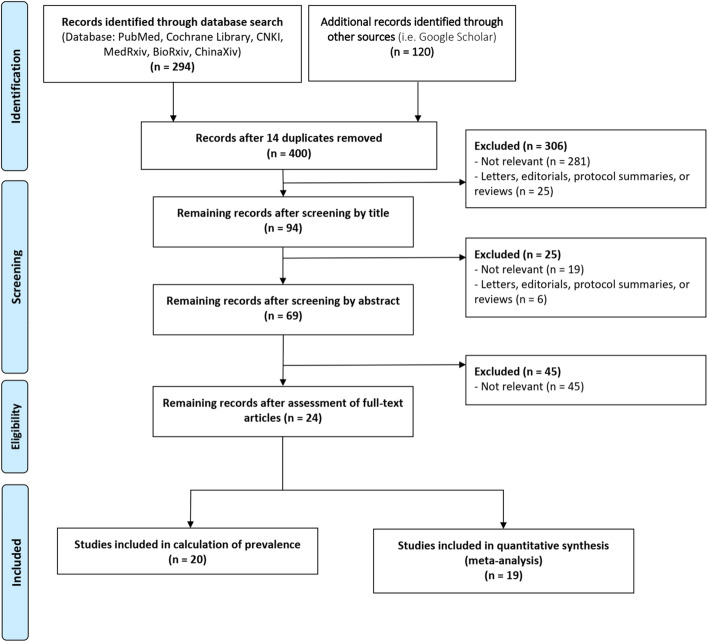
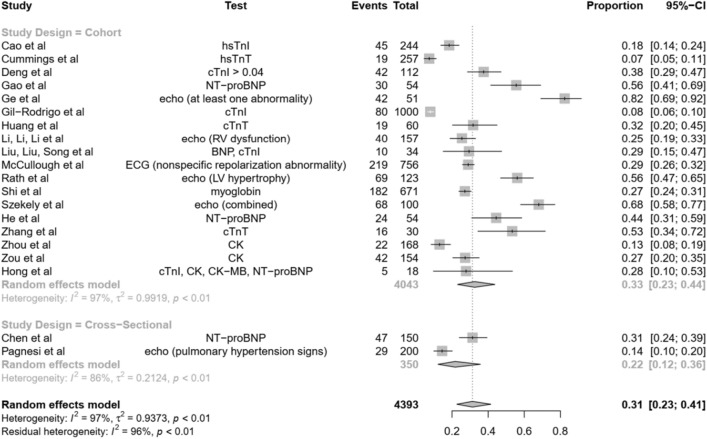
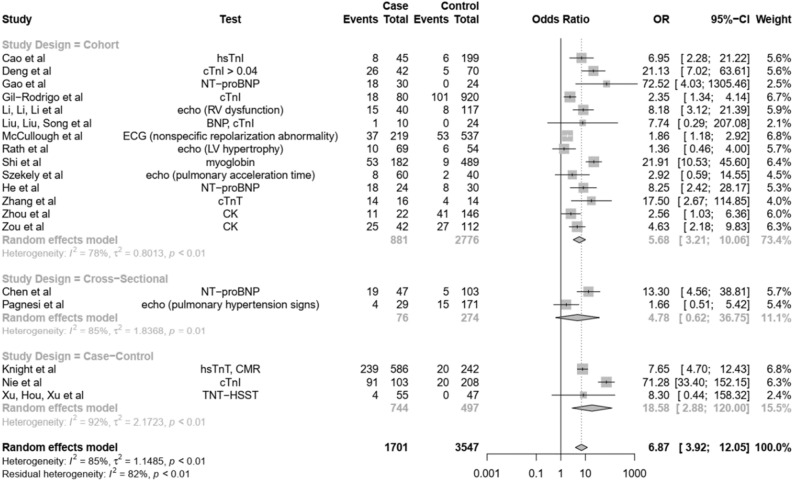
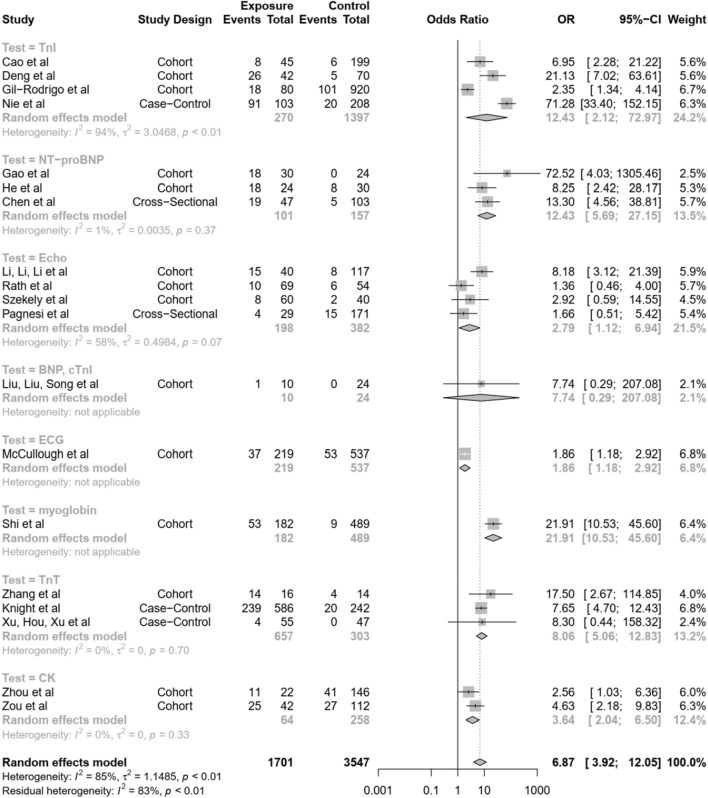
Although most patients recover from COVID-19, it has been linked to cardiac, pulmonary, and neurologic complications. Despite not having formal criteria for its diagnosis, COVID-19 associated cardiomyopathy has been observed in several studies through biomarkers and imaging. This study aims to estimate the proportion of COVID-19 patients with cardiac abnormalities and to determine the association between the cardiac abnormalities in COVID-19 patients and disease severity and mortality. Observational studies published from December 1, 2019 to September 30, 2020 were obtained from electronic databases (PubMed, Embase, Cochrane Library, CNKI) and preprint servers (medRxiv, bioRxiv, ChinaXiv). Studies that have data on prevalence were included in the calculation of the pooled prevalence, while studies with comparison group were included in the calculation of the odds ratio. If multiple tests were done in the same study yielding different prevalence values, the largest one was used as the measure of prevalence of that particular study. Metafor using R software package version 4.0.2 was used for the meta-analysis. A total of 400 records were retrieved from database search, with 24 articles included in the final analysis. Pooled prevalence of cardiac abnormalities in 20 studies was calculated to be 0.31 [95% Confidence Intervals (CI) of (0.23; 0.41)], with statistically significant heterogeneity (percentage of variation or I-squared statistic I = 97%, p < 0.01). Pooled analysis of 19 studies showed an overall odds ratio (OR) of 6.87 [95%-CI (3.92; 12.05)] for cardiac abnormalities associated with disease severity and mortality, with statistically significant heterogeneity (I = 85%, between-study variance or tau-squared statistic τ = 1.1485, p < 0.01). Due to the high uncertainty in the pooled prevalence of cardiac abnormalities and the unquantifiable magnitude of risk (although an increased risk is certain) for severity or mortality among COVID-19 patients, much more long-term prognostic studies are needed to check for the long-term complications of COVID-19 and formalize definitive criteria of "COVID-19 associated cardiomyopathy".
虽然大多数 COVID-19 患者可以康复,但它与心脏、肺部和神经系统并发症有关。尽管没有 COVID-19 相关心肌病的正式诊断标准,但通过生物标志物和影像学检查,在几项研究中已经观察到 COVID-19 相关心肌病。本研究旨在估计 COVID-19 患者中有心脏异常的比例,并确定 COVID-19 患者的心脏异常与疾病严重程度和死亡率之间的关系。从 2019 年 12 月 1 日至 2020 年 9 月 30 日,从电子数据库(PubMed、Embase、Cochrane 图书馆、CNKI)和预印本服务器(medRxiv、bioRxiv、ChinaXiv)中获取了观察性研究。纳入了有患病率数据的研究以计算汇总患病率,而纳入了有比较组的研究以计算比值比。如果在同一项研究中进行了多次测试,产生了不同的患病率值,则使用最大的患病率值作为该特定研究的患病率测量值。使用 R 软件包版本 4.0.2 的 Metafor 用于荟萃分析。从数据库搜索中检索到 400 条记录,最终有 24 篇文章纳入了最终分析。对 20 项研究的汇总患病率进行了计算,结果为 0.31 [95%置信区间(CI)为(0.23;0.41)],具有统计学显著的异质性(变异百分比或 I-平方统计量 I=97%,p<0.01)。对 19 项研究的汇总分析显示,与疾病严重程度和死亡率相关的心脏异常的总体比值比(OR)为 6.87 [95%-CI(3.92;12.05)],具有统计学显著的异质性(I=85%,研究间方差或 tau-平方统计量 τ=1.1485,p<0.01)。由于心脏异常的汇总患病率存在高度不确定性,以及 COVID-19 患者严重程度或死亡率的风险(尽管风险肯定增加)无法量化,因此需要进行更多的长期预后研究,以检查 COVID-19 的长期并发症,并正式确定“COVID-19 相关心肌病”的明确标准。