Division of Endocrinology, Department of General and Specialty Medicine, Diabetology and Metabolic Diseases, Molinette Hospital, University of Turin, Cso Dogliotti, 14, 10126, Turin, Italy.
Division of Endocrinology, Diabetology, Osteology and Metabolic Diseases, Kantonsspital St.Gallen, Rorschacher Strasse, 95, 9007, St.Gallen, CH, Switzerland.
Calcif Tissue Int. 2021 Oct;109(4):383-392. doi: 10.1007/s00223-021-00848-x. Epub 2021 Apr 19.
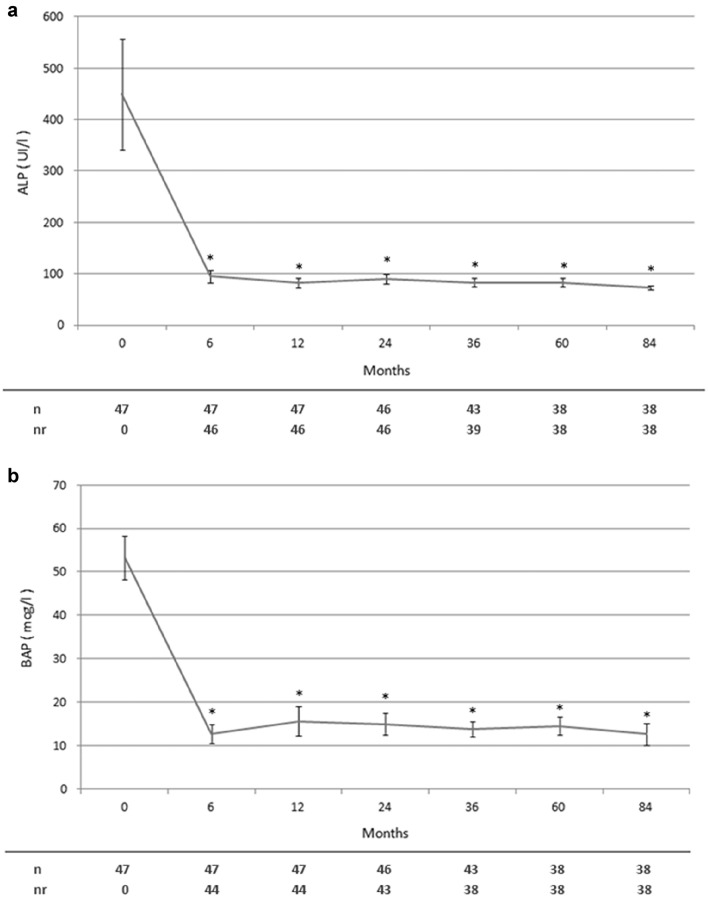
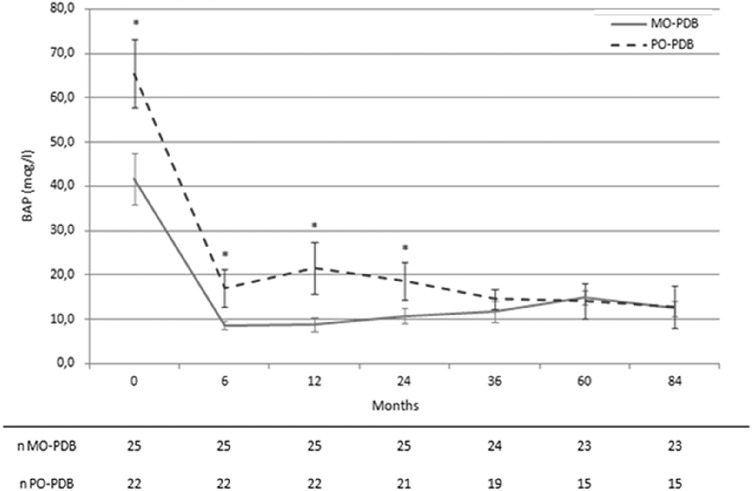
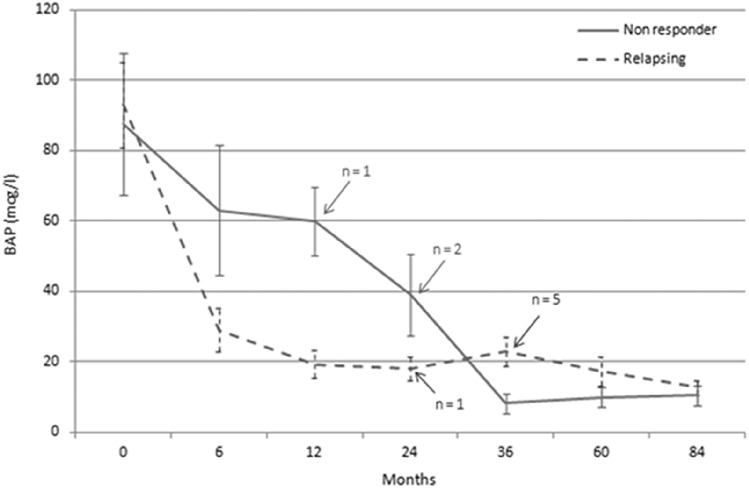
Despite the current debate on the best therapeutic approach, i.e. symptomatic vs intensive strategy, one zoledronate (Zol) infusion is effective in most patients with Paget's disease of bone (PDB), whereas few need retreatment, whose predictors are not well established. We aimed to evaluate long-term efficacy of intensive Zol therapy and predictors of retreatment in PDB. Pagetic complications, clinical and biochemical response to Zol together with frequency of retreatment were retrospectively assessed in forty-seven PDB patients (age, mean ± SD: 72.5 ± 8.9 years, M/F: 24/23; symptomatic/asymptomatic: 16/31). Statistical analysis for retreatment prediction were based on Mann-Whitney U test, Pearson's Χ2 and ROC curve analysis. During seven-year follow-up, all patients achieved pain relief and only one underwent arthroplasty. Bone alkaline phosphatase (BAP) detected three non-responder (6%) and six relapsing (13%) patients needing retreatment. Retreated patients had less old age (66.1 ± 11.2 vs 74.0 ± 7.7 years), higher frequency of polyostotic disease (78% vs 40%) and higher baseline (96.5 ± 24.8 vs 44.9 ± 27.7 mcg/l) and post-Zol nadir BAP levels (24.7 ± 24.1 vs 8.1 ± 4.1 mcg/l) than patients treated once (p < 0.05 for all comparisons). In multivariate analysis both serum baseline and post-Zol nadir BAP significantly predicted retreatment (OR 1.09, 95%CI 1.01-1.17 and 1.29, 1.03-1.62, respectively), with ROC curve analysis showing the greatest accuracies for threshold values of 75.6 and 9.9 mcg/l (sensitivity 88 and 90%, specificity 94 and 86%, AUC 0.92 and 0.93, respectively). Our data in mostly asymptomatic, metabolically active PDB patients treated with intensive Zol therapy show a negligible incidence of pagetic complications and long-term optimal disease control, with BAP being the best predictor of retreatment.
尽管目前对于最佳治疗方法存在争议,即对症治疗与强化治疗策略,但大多数患有 Pagetic 骨病 (PDB) 的患者只需接受一次唑来膦酸 (Zol) 输注即可有效治疗,而只有少数患者需要再次治疗,但目前尚不清楚其预测因素。我们旨在评估强化 Zol 治疗的长期疗效以及 PDB 再次治疗的预测因素。我们回顾性评估了 47 例 PDB 患者(年龄,均值±标准差:72.5±8.9 岁,男/女:24/23;有症状/无症状:16/31)的 Pagetic 并发症、Zol 治疗的临床和生化反应以及再次治疗的频率。基于 Mann-Whitney U 检验、Pearson's Χ2 和 ROC 曲线分析进行再次治疗预测的统计学分析。在 7 年的随访期间,所有患者均缓解了疼痛,仅有 1 例患者进行了关节置换。骨碱性磷酸酶 (BAP) 检测出 3 例无反应(6%)和 6 例复发(13%)患者需要再次治疗。接受再次治疗的患者年龄较小(66.1±11.2 岁 vs 74.0±7.7 岁),多发病灶(78% vs 40%)和较高的基线(96.5±24.8 mcg/l vs 44.9±27.7 mcg/l)和 Zol 后最低点 BAP 水平(24.7±24.1 mcg/l vs 8.1±4.1 mcg/l)高于单次治疗患者(所有比较的 p 值均<0.05)。多变量分析显示,血清基线和 Zol 后最低点 BAP 水平均显著预测了再次治疗(OR 1.09,95%CI 1.01-1.17 和 1.29,1.03-1.62),ROC 曲线分析显示,75.6 和 9.9 mcg/l 的阈值值具有最佳准确性(敏感性 88%和 90%,特异性 94%和 86%,AUC 0.92 和 0.93)。我们的数据表明,在接受强化 Zol 治疗的大多数无症状、代谢活跃的 PDB 患者中,Pagetic 并发症发生率较低,长期疾病控制效果较好,BAP 是再次治疗的最佳预测因素。