MRC Centre for Reproductive Health, University of Edinburgh, Edinburgh, UK.
Faculty of Psychology, Technische Universität Dresden, Dresden, Germany.
Psychoneuroendocrinology. 2021 Jun;128:105223. doi: 10.1016/j.psyneuen.2021.105223. Epub 2021 Apr 10.
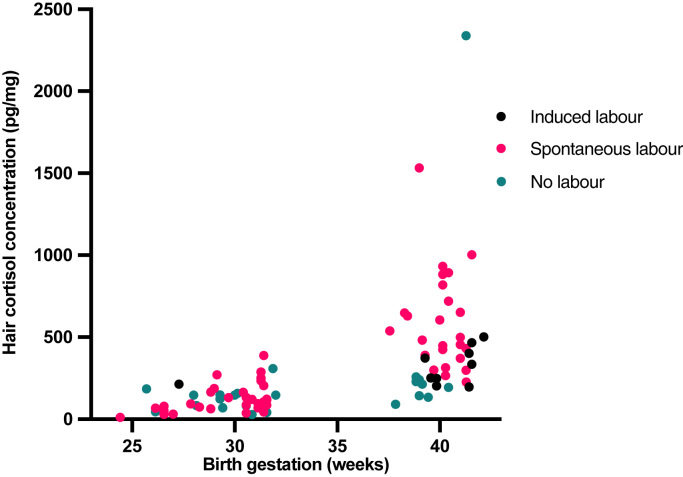
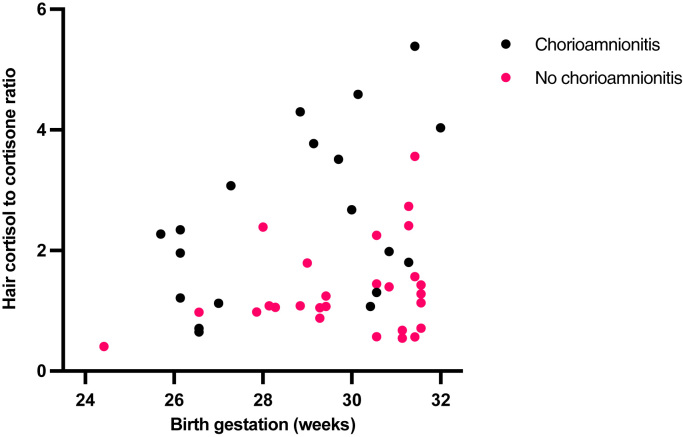
Adult hair glucocorticoid concentrations reflect months of hypothalamic-pituitary-adrenal axis activity. However, little is known about the determinants of neonatal hair glucocorticoids. We tested associations between perinatal exposures and neonatal hair glucocorticoids. Cortisol and cortisone were measured by LC-MS/MS in paired maternal and infant hair samples collected within 10 days of birth (n = 49 term, n = 47 preterm), with neonatal samples collected at 6-weeks in n = 54 preterm infants. We demonstrate cortisol accumulation in hair increases with fetal maturity, with hair cortisol being higher in term than preterm born infants after delivery (median 401 vs 106 pg/mg; p < 0.001). In term born infants, neonatal hair cortisol is positively associated with maternal hair cortisol concentration (β = 0.240, p = 0.045) and negatively associated with birthweight z-score (β = -0.340, p = 0.006). Additionally, being born without maternal labour is associated with lower hair cortisol concentrations (β = -0.489, p < 0.001) and a lower ratio of cortisol to cortisone (β = -0.484, p = 0.001). In preterm infants, histological chorioamnionitis is associated with a higher cortisol to cortisone ratio in hair (β = 0.459, p = 0.001). In samples collected 6 weeks after preterm birth, hair cortisol concentration is associated with cortisol hair concentrations measured after birth (β = 0.523, p < 0.001), chorioamnionitis (β = 0.250, p = 0.049) and postnatal exposures including intravenous hydrocortisone therapy (β = 0.343, p < 0.007) and neonatal sepsis (β = 0.290, p = 0.017). In summary, neonatal hair cortisol is associated with birth gestation, maternal hair cortisol concentration and fetal growth. Additionally, exposures at delivery are important determinants of hair cortisol, and should be considered in the design of future research investigating how neonatal hair cortisol relates to prenatal exposures or fetal development.
成人头发中的糖皮质激素浓度反映了数月的下丘脑-垂体-肾上腺轴活动。然而,关于新生儿头发糖皮质激素的决定因素知之甚少。我们测试了围产期暴露与新生儿头发糖皮质激素之间的关联。在出生后 10 天内采集了 49 名足月和 47 名早产儿的母婴配对头发样本,并用 LC-MS/MS 测量了皮质醇和可的松,其中 54 名早产儿在 6 周时采集了新生儿样本。我们证明,头发中皮质醇的积累随着胎儿成熟而增加,出生后足月婴儿的头发皮质醇高于早产儿(中位数 401 比 106 pg/mg;p < 0.001)。在足月出生的婴儿中,新生儿头发皮质醇与母亲头发皮质醇浓度呈正相关(β=0.240,p=0.045),与出生体重 z 评分呈负相关(β=-0.340,p=0.006)。此外,没有母体分娩的婴儿头发皮质醇浓度较低(β=-0.489,p < 0.001),皮质醇与可的松的比值也较低(β=-0.484,p=0.001)。在早产儿中,组织学绒毛膜羊膜炎与头发中更高的皮质醇与可的松比值相关(β=0.459,p=0.001)。在早产儿出生后 6 周采集的样本中,头发皮质醇浓度与出生后测量的皮质醇头发浓度(β=0.523,p < 0.001)、绒毛膜羊膜炎(β=0.250,p=0.049)和包括静脉注射氢化可的松治疗(β=0.343,p < 0.007)在内的产后暴露有关,以及新生儿败血症(β=0.290,p=0.017)。总之,新生儿头发皮质醇与出生胎龄、母亲头发皮质醇浓度和胎儿生长有关。此外,分娩时的暴露是头发皮质醇的重要决定因素,在设计未来研究时应考虑这些因素,以调查新生儿头发皮质醇与产前暴露或胎儿发育的关系。