School of Medicine and Public Health, University of Wisconsin-Madison, Madison, WI, USA.
University of Pittsburgh School of Medicine, Pittsburgh, PA, USA.
J Neurodev Disord. 2021 Apr 20;13(1):17. doi: 10.1186/s11689-021-09366-1.
Nearly all persons with Down syndrome will show pathology of Alzheimer's disease in their 40s. There is a critical need for studies to identify early biomarkers of these various pathological changes of Alzheimer's disease in the Down syndrome population and understand the relationship of these biomarkers to cognitive symptoms in order to inform clinical trials. Although Alzheimer's disease is often considered a disease of gray matter, white matter degeneration has been documented during the preclinical stage of Alzheimer's disease. The current study examined the association between diffusion tensor imaging (DTI) measures of white matter microstructure and episodic memory performance in 52 adults with Down syndrome.
Seventy (N = 70) participants (M = 40.13, SD = 7.77 years) received baseline scans as part of the Neurodegeneration in Aging Down Syndrome (NiAD) study at two imaging facilities (36 at the University of Wisconsin-Madison [UW-Madison] and 34 at the University of Pittsburgh Medical Center [UPMC]). All participants had genetically confirmed trisomy 21. Fifty-two (N = 52) participants remained after QC. The DTI measures, fractional anisotropy (FA) and mean diffusivity (MD), were calculated for each participant. A combined measure of episodic memory was generated by summing the z-scores of (1) Free and Cued Recall test and (2) Rivermead Behavioural Memory Test for Children Picture Recognition. The DTI data were projected onto a population-derived FA skeleton and tract-based spatial statistics analysis was conducted using the FSL tool PALM to calculate Pearson's r values between FA and MD with episodic memory.
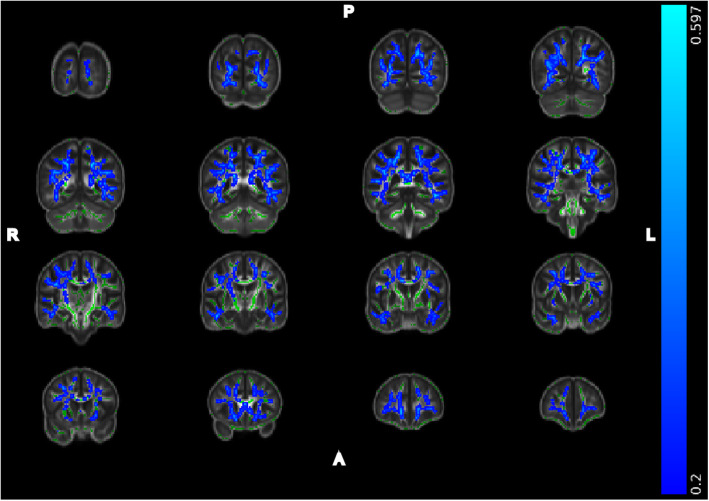
A positive correlation of episodic memory with FA and a negative correlation of episodic memory and MD in the major association white matter tracts were observed. Results were significant (p < 0.05) after correction for chronological age, imaging site, and premorbid cognitive ability.
These findings suggest that white matter degeneration may be implicated in early episodic memory declines prior to the onset of dementia in adults with Down syndrome. Further, our findings suggest a coupling of episodic memory and white matter microstructure independent of chronological age.
几乎所有唐氏综合征患者在 40 多岁时都会出现阿尔茨海默病的病理学表现。因此,迫切需要开展研究以鉴定唐氏综合征人群中阿尔茨海默病各种病理变化的早期生物标志物,并了解这些生物标志物与认知症状之间的关系,以便为临床试验提供信息。尽管阿尔茨海默病通常被认为是一种灰质疾病,但在阿尔茨海默病的临床前阶段已经有白质退化的记录。本研究通过弥散张量成像(DTI)检查了 52 名唐氏综合征成年人的白质微观结构与情景记忆表现之间的关联。
作为神经退行性变在衰老唐氏综合征(Neurodegeneration in Aging Down Syndrome,NiAD)研究的一部分,70 名参与者(M = 40.13,SD = 7.77 岁)在两个影像设施(威斯康星大学麦迪逊分校[UW-Madison]的 36 名和匹兹堡大学医学中心[UPMC]的 34 名)接受了基线扫描。所有参与者均经基因确认为三体 21。经过 QC 后,52 名参与者(N = 52)保留下来。为每位参与者计算了弥散张量成像(DTI)指标,各向异性分数(FA)和平均弥散度(MD)。通过将(1)自由回忆测试和(2)Rivermead 行为记忆测试儿童图片识别的 z 分数相加,生成情景记忆的综合指标。将 DTI 数据投射到基于人群的 FA 骨架上,并使用 FSL 工具 PALM 进行基于束的空间统计学分析,以计算 FA 与 MD 与情景记忆之间的 Pearson r 值。
观察到情景记忆与 FA 呈正相关,与主要关联白质束的 MD 呈负相关。在对年龄、影像部位和发病前认知能力进行校正后,结果具有统计学意义(p < 0.05)。
这些发现表明,在唐氏综合征成年人痴呆症发作之前,白质退化可能与情景记忆的早期下降有关。此外,我们的发现表明,情景记忆与白质微观结构之间存在关联,而与年龄无关。