Medical Physics Department, Institut Jules Bordet - Université Libre de Bruxelles, Brussels, Belgium.
Radiation Oncology Department, Institut Jules Bordet - Université Libre de Bruxelles, Brussels, Belgium.
Radiat Oncol. 2021 Apr 20;16(1):77. doi: 10.1186/s13014-021-01800-x.
To improve split-VMAT technique by optimizing treatment delivery time for deep-inspiration breath hold (DIBH) radiotherapy in left-sided breast cancer patients, when automatic beam-interruption devices are not available.
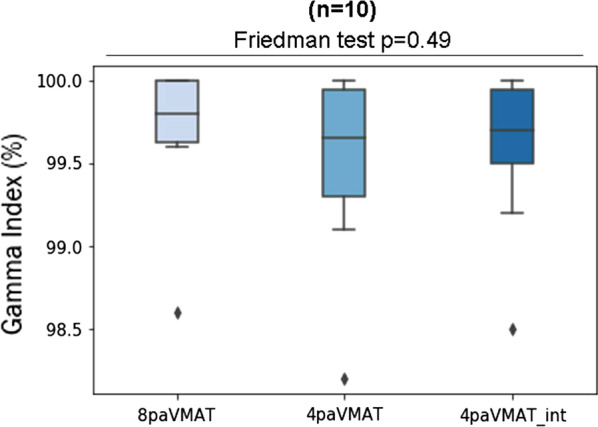
Ten consecutive patients were treated with an eight partial arcs (8paVMAT) plan, standard of care in our center. A four partial arcs (4paVMAT) plan was also created and actual LINAC outputs were measured, to evaluate whether there was a dosimetric difference between both techniques and potential impact on the delivered dose. Subsequently, ten other patients were consecutively treated with a 4paVMAT plan to compare the actual treatment delivery time between both techniques. The prescribed dose was 40.05 Gy/15 fractions on the PTV breast (breast or thoracic wall), lymph nodes (LN) and intramammary lymph node chain (IMN). Treatment delivery time, PTVs coverage, conformity index (CI), organs at risk (OAR) dose, monitor units (MU), and gamma index were compared.
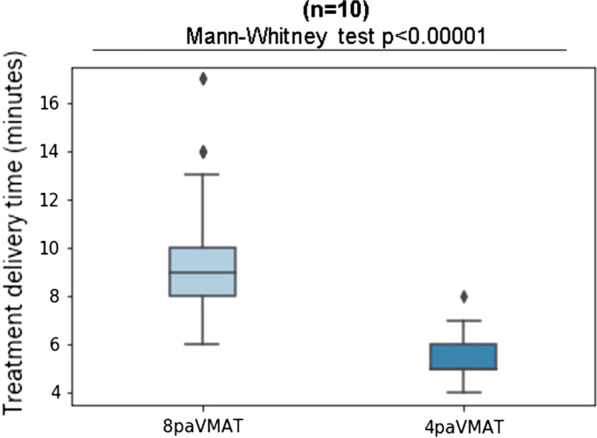
Both split-VMAT techniques resulted in similar dose coverage for the PTV Breast and LN, and similar CI. For PTV IMN we observed a 5% increased coverage for the volume receiving ≥ 36 Gy with 4paVMAT, with an identical volume receiving ≥ 32 Gy. There was no difference for the OAR sparing, with the exception of the contralateral organs: there was a 0.6 Gy decrease for contralateral breast mean (p ≤ 0.01) and 1% decrease for the volume of right lung receiving ≥ 5 Gy (p = 0.024). Overall, these results indicate a modest clinical benefit of using 4paVMAT in comparison to 8paVMAT. An increase in the number of MU per arc was observed for the 4paVMAT technique, as expected, while the total number of MU remained comparable for both techniques. All the plans were measured with the Delta phantom and passed the gamma index criteria with no significant differences. Finally, the main difference was seen for the treatment delivery time: there was a significant decrease from 8.9 to 5.4 min for the 4paVMAT plans (p < .05).
This study is mainly of interest for centers who are implementing the DIBH technique without automatic beam-holding devices and who therefore may require to manually switch the beam on and off during breast DIBH treatment. Split-VMAT technique with 4 partial arcs significantly reduces the treatment delivery time compared to 8 partial arcs, without compromising the target coverage and the OAR sparing. The technique decreases the number of breath holds per fraction, resulting in a shorter treatment session.
为了提高左侧乳腺癌患者深吸气屏气(DIBH)放疗的分割 VMAT 技术,当没有自动光束中断设备时。
10 例连续患者接受 8 个部分弧(8paVMAT)计划治疗,这是我们中心的标准治疗方法。还创建了 4 个部分弧(4paVMAT)计划,并测量了实际 LINAC 输出,以评估两种技术之间是否存在剂量差异以及对所给予剂量的潜在影响。随后,另外 10 例连续患者接受 4paVMAT 计划治疗,以比较两种技术的实际治疗时间。PTV 乳房(乳房或胸壁)、淋巴结(LN)和乳腺内淋巴结链(IMN)的规定剂量为 40.05Gy/15 个分数。比较了治疗时间、PTV 覆盖率、适形指数(CI)、危及器官(OAR)剂量、监测单位(MU)和伽马指数。
两种分割 VMAT 技术均导致 PTV 乳房和 LN 的相似剂量覆盖,以及相似的 CI。对于 PTV IMN,我们观察到 4paVMAT 使体积接受≥36Gy 的覆盖增加了 5%,而体积接受≥32Gy 的覆盖保持不变。OAR 保护没有差异,除了对侧器官:对侧乳房平均剂量降低 0.6Gy(p≤0.01),右侧肺接受≥5Gy 的体积降低 1%(p=0.024)。总体而言,与 8paVMAT 相比,使用 4paVMAT 具有适度的临床益处。4paVMAT 技术的每个弧 MU 数增加,这是预期的,而两种技术的总 MU 数保持可比。所有计划均使用 Delta 体模进行测量,并通过伽马指数标准,无显著差异。最后,治疗时间的差异最为明显:4paVMAT 计划的治疗时间从 8.9 分钟显著减少到 5.4 分钟(p<.05)。
本研究主要适用于正在实施 DIBH 技术且没有自动光束保持设备的中心,因此可能需要在乳腺 DIBH 治疗期间手动打开和关闭光束。与 8 个部分弧相比,4 个部分弧的分割 VMAT 技术可显著减少治疗时间,而不影响靶区覆盖率和 OAR 保护。该技术减少了每个分数的呼吸暂停次数,从而缩短了治疗时间。