Institute for Neuro-Immune Medicine, Nova Southeastern University, Fort Lauderdale, FL, USA.
Department of Psychology and Neuroscience, Nova Southeastern University, Fort Lauderdale, FL, USA.
BMC Psychol. 2021 Apr 20;9(1):57. doi: 10.1186/s40359-021-00561-2.
Gulf War Illness (GWI) is a chronic, multi-symptomatic disorder affecting an estimated 25-32% of the returning military veterans of the 1990-1991 Persian Gulf War. GWI presents with a wide range of symptoms including fatigue, muscle pain, cognitive problems, insomnia, rashes and gastrointestinal issues and continues to be a poorly understood illness. This heterogeneity of GWI symptom presentation complicates diagnosis as well as the identification of effective treatments. Defining subgroups of the illness may help alleviate these complications. Our aim is to determine if GWI can be divided into distinct subgroups based on PTSD symptom presentation.
Veterans diagnosed with GWI (n = 47) and healthy sedentary veteran controls (n = 52) were recruited through the Miami Affairs (VA) Medical Health Center. Symptoms were assessed via the RAND short form health survey (36), the multidimensional fatigue inventory, and the Davidson trauma scale. Hierarchal regression modeling was performed on measures of health and fatigue with PTSD symptoms as a covariate. This was followed by univariate analyses conducted with two separate GWI groups based on a cut-point of 70 for their total Davidson Trauma Scale value and performing heteroscedastic t-tests across all measures.
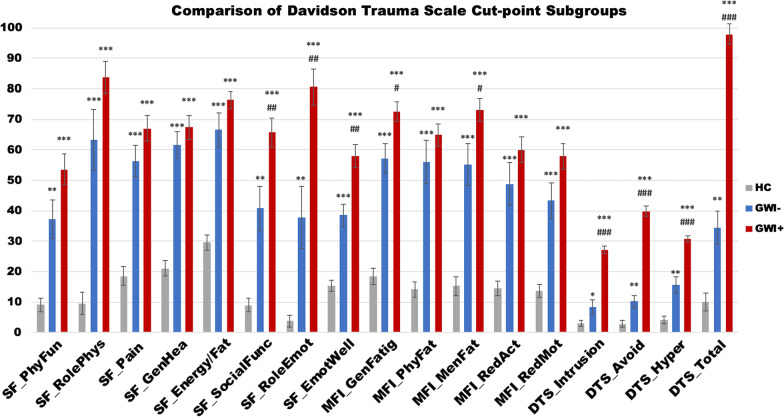
Overall analyses returned two symptom-based subgroups differing significantly across all health and trauma symptoms. These subgroups supported PTSD symptomatology as a means to subgroup veterans. Hierarchical models showed that GWI and levels of PTSD symptoms both impact measures of physical, social, and emotional consequences of poor health (ΔR= 0.055-0.316). However, GWI appeared to contribute more to fatigue measures. Cut-point analysis retained worse health outcomes across all measures for GWI with PTSD symptoms compared to those without PTSD symptoms, and healthy controls. Significant differences were observed in mental and emotional measures.
Therefore, this research supports the idea that comorbid GWI and PTSD symptoms lead to worse health outcomes, while demonstrating how GWI and PTSD symptoms may uniquely contribute to clinical presentation.
海湾战争综合征(Gulf War Illness,GWI)是一种慢性、多症状疾病,估计影响了 1990-1991 年波斯湾战争中返回的 25-32%的退伍军人。GWI 表现出广泛的症状,包括疲劳、肌肉疼痛、认知问题、失眠、皮疹和胃肠道问题,并且仍然是一种未被充分理解的疾病。GWI 症状表现的这种异质性使诊断和确定有效治疗方法变得复杂。定义疾病的亚组可能有助于缓解这些并发症。我们的目的是确定 GWI 是否可以根据 PTSD 症状表现分为不同的亚组。
通过迈阿密事务(VA)医疗保健中心招募被诊断患有 GWI(n=47)的退伍军人和健康的久坐不动的退伍军人对照组(n=52)。通过 RAND 短形式健康调查(36)、多维疲劳量表和戴维森创伤量表评估症状。使用 PTSD 症状作为协变量对健康和疲劳指标进行层次回归建模。然后,根据他们的戴维森创伤量表总得分值为 70 进行了两个单独的 GWI 组的单变量分析,并在所有测量指标上进行了异方差 t 检验。
总体分析返回了两个基于症状的亚组,这两个亚组在所有健康和创伤症状上都有显著差异。这些亚组支持 PTSD 症状表现作为亚组退伍军人的一种手段。层次模型表明,GWI 和 PTSD 症状水平都影响健康不良的身体、社会和情感后果的衡量标准(ΔR=0.055-0.316)。然而,GWI 似乎对疲劳测量的影响更大。临界点分析保留了与没有 PTSD 症状的 GWI 相比,GWI 伴有 PTSD 症状的退伍军人和健康对照组在所有测量指标上的更差的健康结果。在心理和情感指标上观察到显著差异。
因此,这项研究支持这样一种观点,即合并 GWI 和 PTSD 症状会导致更差的健康结果,同时表明 GWI 和 PTSD 症状如何可能对临床表现有独特的贡献。