Zhang Linbo, Huang Ping, Huang Chunxia, Jiang Lingmei, Lu Zhijie, Wang Peng
Department of Health Management and Division of Physical Examination, the First Affiliated Hospital of Guangxi Medical University, Nanning, Guangxi Province, China.
Medicine (Baltimore). 2021 Apr 23;100(16):e25246. doi: 10.1097/MD.0000000000025246.
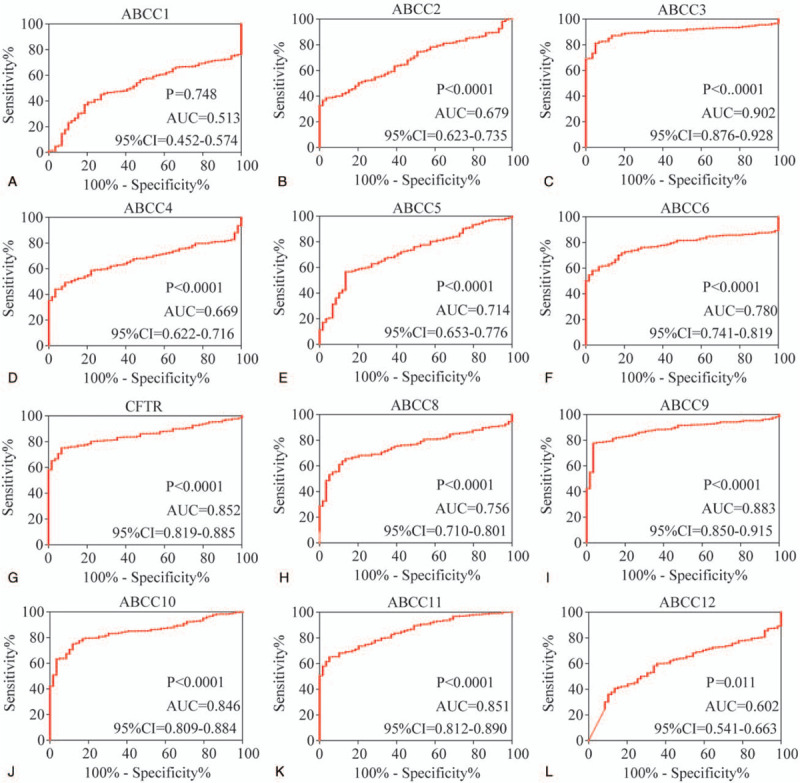
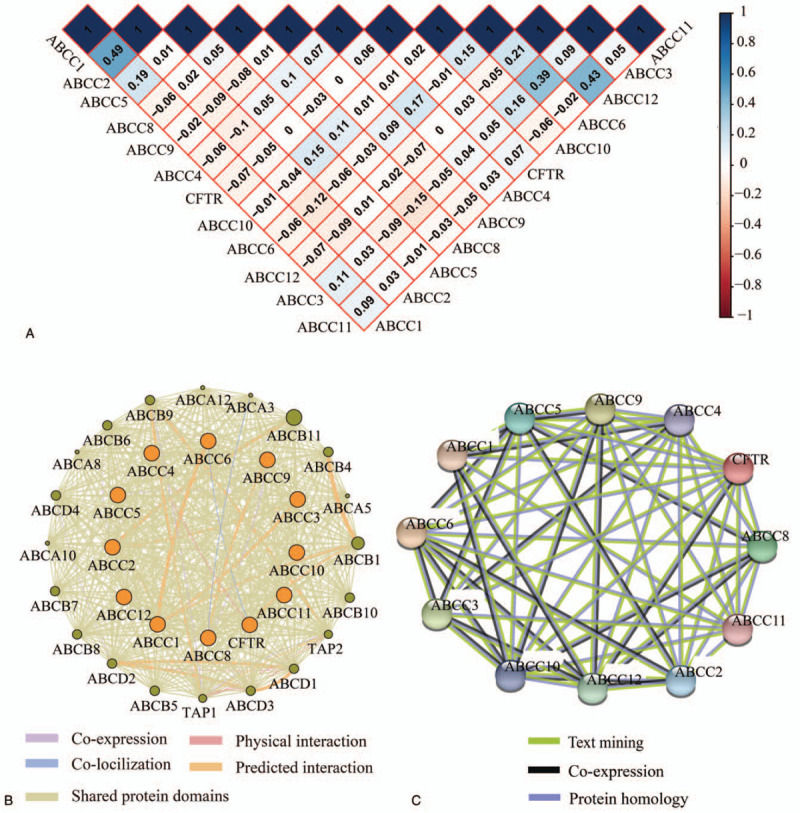
Lung adenocarcinoma (LUAD) is a lethal malignancy worldwide and a major public health concern. We explored the potential clinical significance for LUAD of ATP-binding cassette (ABC), sub-family C, consisting of ABCC1-6, 8-12, and cystic fibrosis transmembrane conductance regulator (CFTR).Five hundred LUAD patients from The Cancer Genome Atlas database were used for analysis, including differential expression and diagnostic and prognostic significance. Oncomine and MERAV databases were used to validate differential expression and diagnostic significance. A risk score model was constructed using prognosis-related ABCC members. Prognosis-related genes were further explored to correlate their expression with tumor stage progression. Interaction networks, including biological processes and metabolic pathways, were constructed using Cytoscape software and STRING website.ABCC1-3 consistently showed high expression in tumor tissues (all P ≤ 0.05). Most datasets indicated that ABCC5, 10, and 11 were highly expressed in tumor tissues whereas ABCC6, 9, and CFTR were highly expressed in nontumor tissues (all P ≤ 0.05). Diagnostic significance of ABCC3 and ABCC5 was consistently assessed and validated in three datasets (all area under the curve > 0.700) whereas ABCC6, 8, 10, 11, and CFTR were assessed in The Cancer Genome Atlas dataset and validated in one dataset (all area under the curve > 0.700). Prognostic analysis indicated that ABCC2, 6, and 8 mRNA expression was associated with survival of LUAD (all adjusted P ≤ .037). The risk score model constructed using ABCC2, 6, and 8 suggested prognostic significance for survival predictions. ABCC2 expression was associated with tumor stage, whereas ABCC6 and 8 were not. Interaction networks indicated that they were involved in establishment of localization, ion transport, plasma membrane, apical plasma membrane, adenylyl nucleotide binding, ABC transporters, ABC transporter disorders, ABC-family-protein-mediated transport, and bile secretion.Differentially expressed ABCC2 and ABCC5 might be diagnostic whereas ABCC2, 6, and 8 may be prognostic biomarkers for LUAD, possibly through ABC-family-mediated transporter disorders.
肺腺癌(LUAD)是一种在全球范围内具有致死性的恶性肿瘤,也是一个主要的公共卫生问题。我们探讨了由ABCC1 - 6、8 - 12组成的ATP结合盒(ABC)亚家族C以及囊性纤维化跨膜传导调节因子(CFTR)对LUAD的潜在临床意义。使用来自癌症基因组图谱数据库的500例LUAD患者进行分析,包括差异表达以及诊断和预后意义。利用Oncomine和MERAV数据库验证差异表达和诊断意义。使用与预后相关的ABCC成员构建风险评分模型。进一步探索与预后相关的基因,以使其表达与肿瘤分期进展相关联。使用Cytoscape软件和STRING网站构建包括生物过程和代谢途径在内的相互作用网络。
ABCC1 - 3在肿瘤组织中始终显示高表达(所有P≤0.05)。大多数数据集表明,ABCC5、10和11在肿瘤组织中高表达,而ABCC6、9和CFTR在非肿瘤组织中高表达(所有P≤0.05)。在三个数据集中对ABCC3和ABCC5的诊断意义进行了一致评估和验证(所有曲线下面积>0.700),而在癌症基因组图谱数据集中对ABCC6、8、10、11和CFTR进行了评估,并在一个数据集中进行了验证(所有曲线下面积>0.700)。预后分析表明,ABCC2、6和8的mRNA表达与LUAD的生存相关(所有校正P≤0.037)。使用ABCC2、6和8构建的风险评分模型对生存预测具有预后意义。ABCC2的表达与肿瘤分期相关,而ABCC6和8则不然。相互作用网络表明,它们参与定位的建立、离子转运、质膜、顶端质膜、腺苷酸结合、ABC转运蛋白、ABC转运蛋白紊乱、ABC家族蛋白介导的转运和胆汁分泌。
差异表达的ABCC2和ABCC5可能具有诊断意义,而ABCC2、6和8可能是LUAD的预后生物标志物,可能通过ABC家族介导的转运蛋白紊乱发挥作用。