Hepatobiliary Division, Department of Internal Medicine and Hepatitis Center, Kaohsiung Medical University Hospital, Kaohsiung Medical University, Kaohsiung, Taiwan, ROC.
Division of Gastroenterology and Hepatology, Department of Internal Medicine, Tri-Service General Hospital, National Defense Medical Center, Taipei, Taiwan, ROC.
Sci Rep. 2021 Apr 20;11(1):8554. doi: 10.1038/s41598-021-87975-5.
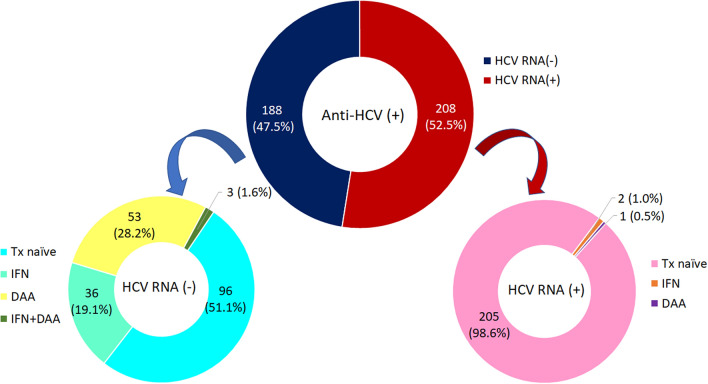
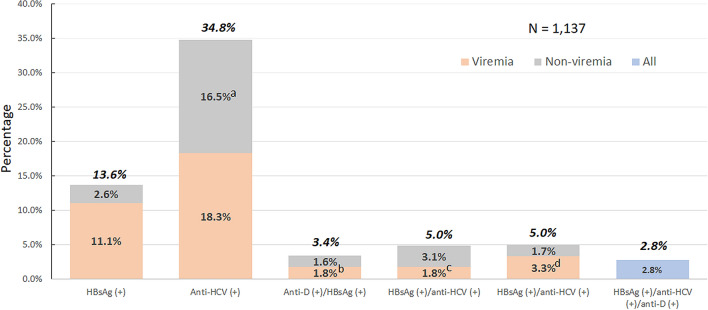
The spreading of viral hepatitis among injecting drug users (IDU) is an emerging public health concern. This study explored the prevalence and the risks of hepatitis B virus (HBV), hepatitis C virus (HCV) and hepatitis D virus (HDV) among IDU-dominant prisoners in Taiwan. HBV surface antigen (HBsAg), antibodies to HCV (anti-HCV) and HDV (anti-HDV), viral load and HCV genotypes were measured in 1137(67.0%) of 1697 prisoners. 89.2% of participants were IDUs and none had HIV infection. The prevalence of HBsAg, anti-HCV, dual HBsAg/anti-HCV, HBsAg/anti-HDV, and triple HBsAg/anti-HCV/anti-HDV was 13.6%, 34.8%, 4.9%, 3.4%, and 2.8%, respectively. HBV viremia rate was significantly lower in HBV/HCV-coinfected than HBV mono-infected subjects (66.1% versus 89.9%, adjusted odds ratio/95% confidence intervals [aOR/CI] = 0.27/0.10-0.73). 47.5% anti-HCV-seropositive subjects (n = 396) were non-viremic, including 23.2% subjects were antivirals-induced. The predominant HCV genotypes were genotype 6(40.9%), 1a(24.0%) and 3(11.1%). HBsAg seropositivity was negatively correlated with HCV viremia among the treatment naïve HCV subjects (44.7% versus 72.4%, aOR/CI = 0.27/0.13-0.58). Anti-HCV seropositivity significantly increased the risk of anti-HDV-seropositivity among HBsAg carriers (57.1% versus 7.1%, aOR/CI = 15.73/6.04-40.96). In conclusion, IUDs remain as reservoirs for multiple hepatitis viruses infection among HIV-uninfected prisoners in Taiwan. HCV infection increased the risk of HDV infection but suppressed HBV replication in HBsAg carriers. An effective strategy is mandatory to control the epidemic in this high-risk group.
在注射吸毒者(IDU)中传播病毒性肝炎是一个新出现的公共卫生问题。本研究旨在探讨台湾 IDU 占主导地位的囚犯中乙型肝炎病毒(HBV)、丙型肝炎病毒(HCV)和丁型肝炎病毒(HDV)的流行率和感染风险。在 1697 名囚犯中,有 1137 名(67.0%)检测了 HBV 表面抗原(HBsAg)、抗 HCV(抗-HCV)和抗 HDV(抗-HDV)、病毒载量和 HCV 基因型。89.2%的参与者为 IDU,且均无 HIV 感染。HBsAg、抗-HCV、HBsAg/抗-HCV、HBsAg/抗-HDV 和 HBsAg/抗-HCV/抗-HDV 的流行率分别为 13.6%、34.8%、4.9%、3.4%和 2.8%。HBV/HCV 合并感染患者的 HBV 病毒血症率明显低于 HBV 单感染患者(66.1%比 89.9%,调整后比值比/95%置信区间[aOR/CI] = 0.27/0.10-0.73)。47.5%抗-HCV 阳性(n=396)患者无病毒血症,其中 23.2%患者接受了抗病毒治疗。主要的 HCV 基因型为 6 型(40.9%)、1a 型(24.0%)和 3 型(11.1%)。HBsAg 阳性与 HCV 病毒血症在未经治疗的 HCV 患者中呈负相关(44.7%比 72.4%,aOR/CI=0.27/0.13-0.58)。抗-HCV 阳性显著增加了 HBsAg 携带者抗-HDV 阳性的风险(57.1%比 7.1%,aOR/CI=15.73/6.04-40.96)。总之,IDU 仍是台湾未感染 HIV 的囚犯中多种肝炎病毒感染的储主。HCV 感染增加了 HDV 感染的风险,但抑制了 HBsAg 携带者的 HBV 复制。对于这一高危人群,必须采取有效的策略来控制疫情。