All India Institute of Medical Sciences, New Delhi.
Influenza Division, Centers for Disease Control and Prevention- India Country Office, New Delhi, India.
J Glob Health. 2021 Apr 3;11:04027. doi: 10.7189/jogh.11.04027.
There are limited data on incidence, risk factors and etiology of acute lower respiratory tract infection (LRTI) among older adults in low- and middle-income countries.
We established a cohort of community dwelling older adults ≥60 years and conducted weekly follow-up for acute respiratory infections (ARI) during 2015-2017. Nurses assessed ARI cases for LRTI, collecting combined nasal/throat swabs from all LRTI cases and an equal number of age- and sex-matched asymptomatic neighbourhood controls. Swabs were tested for influenza viruses, respiratory syncytial virus (RSV), human metapneumovirus (hMPV), and parainfluenza viruses (PIV) using polymerase chain reaction. LRTI and virus-specific LRTI incidence was calculated per 1000 person-years. We estimated adjusted incidence rate ratios (IRR) for risk factors using Poisson regression and calculated etiologic fractions (EF) using adjusted odds ratios for detection of viral pathogens in LRTI cases vs controls.
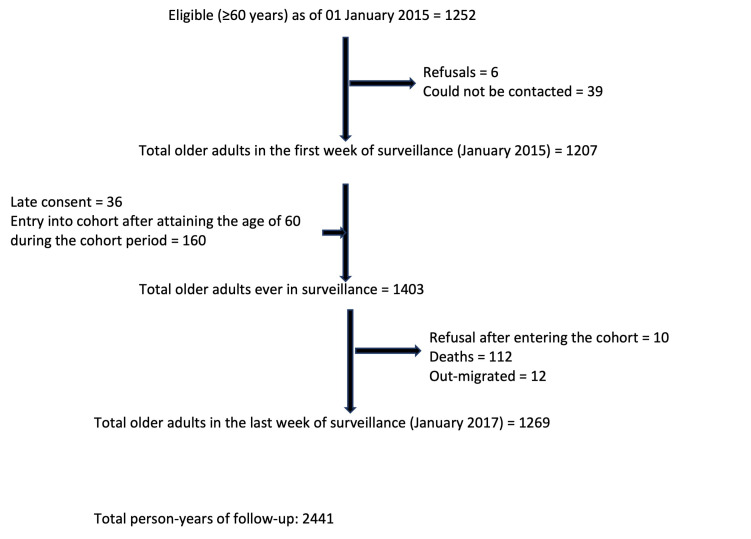
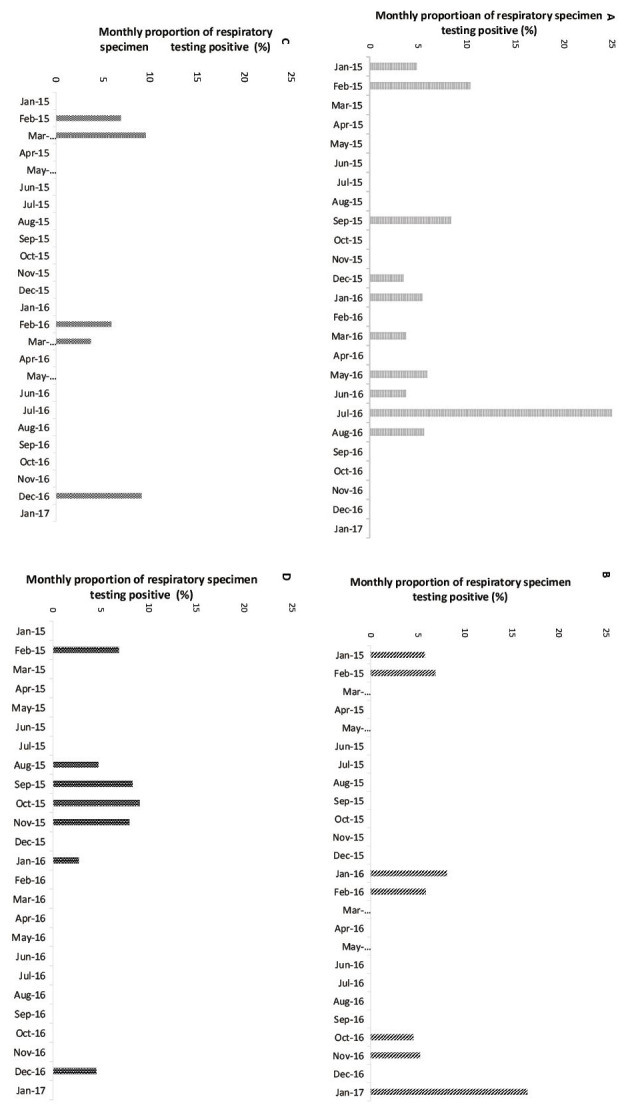
We followed 1403 older adults for 2441 person-years. LRTI and LRTI-associated hospitalization incidences were 248.3 (95% confidence interval (CI) = 229.3-268.8) and 12.7 (95% CI = 8.9-18.1) per 1000 person-years. Persons with pre-existing chronic bronchitis as compared to those without (incidence rate ratio (IRR) = 4.7, 95% CI = 3.9-5.6); aged 65-74 years (IRR = 1.6, 95% CI = 1.3-2.0) and ≥75 years (IRR = 1.8, 95% CI = 1.4-2.4) as compared to 60-64 years; and persons in poorest wealth quintile (IRR = 1.4, 95% CI = 1.11.8); as compared to those in wealthiest quintile were at higher risk for LRTI. Virus was detected in 10.1% of LRTI cases, most commonly influenza (3.8%) and RSV (3.0%). EF for RSV and influenza virus was 83.9% and 83.6%, respectively.
In this rural cohort of older adults, the incidence of LRTI was substantial. Chronic bronchitis was an important risk factor; influenza virus and RSV were major viral pathogens.
在中低收入国家,老年人急性下呼吸道感染(LRTI)的发病率、危险因素和病因学数据有限。
我们建立了一个≥60 岁的社区居住老年人队列,并在 2015-2017 年期间每周对急性呼吸道感染(ARI)进行随访。护士对所有 LRTI 病例和数量相等的年龄和性别匹配的无症状邻居对照进行 LRTI 病例评估。所有 LRTI 病例均采集鼻/咽拭子,使用聚合酶链反应检测流感病毒、呼吸道合胞病毒(RSV)、人偏肺病毒(hMPV)和副流感病毒(PIV)。每 1000 人年计算 LRTI 和病毒特异性 LRTI 的发病率。我们使用泊松回归估计危险因素的调整发病率比(IRR),并使用病毒感染的 LRTI 病例与对照的调整比值比计算病因分数(EF)。
我们对 1403 名老年人进行了 2441 人年的随访。LRTI 和 LRTI 相关住院的发病率分别为 248.3(95%置信区间[CI] = 229.3-268.8)和 12.7(95%CI = 8.9-18.1)/1000 人年。与无慢性支气管炎者相比,有慢性支气管炎者的发病率更高(IRR=4.7,95%CI=3.9-5.6);65-74 岁(IRR=1.6,95%CI=1.3-2.0)和≥75 岁(IRR=1.8,95%CI=1.4-2.4)与 60-64 岁者相比;以及最贫困五分位数(IRR=1.4,95%CI=1.11.8)的人比最富裕五分位数的人发生 LRTI 的风险更高。在 10.1%的 LRTI 病例中检测到病毒,最常见的是流感(3.8%)和 RSV(3.0%)。RSV 和流感病毒的 EF 分别为 83.9%和 83.6%。
在这个农村老年人队列中,LRTI 的发病率很高。慢性支气管炎是一个重要的危险因素;流感病毒和 RSV 是主要的病毒病原体。