Zhong Xi, Ma Aijia, Zhang Zhongwei, Liu Yong, Liang Guopeng
Department of Critical Care Medicine, West China Hospital of Sichuan University, Chengdu, China.
Department of Gastroenterological Surgery, West China Hospital of Sichuan University, Chengdu, China.
Transl Pediatr. 2021 Mar;10(3):657-665. doi: 10.21037/tp-21-47.
Although neutrophil-to-lymphocyte ratio (NLR) has been extensively studied in several diseases, its role in pediatric sepsis remains unclear. Our study aimed to assess the predictive significance of NLR for severe pediatric sepsis in the pediatric intensive care unit (PICU).
We retrospectively recruited critically ill children in the PICU with severe pediatric sepsis from January 2019 to January 2020 in West China Hospital of Sichuan University. Univariate and multivariable logistic regression analysis was used to assess the risk factors of severe pediatric sepsis. Receiver operating characteristic (ROC) curves were plotted for the comparison of the prediction significance of NLR.
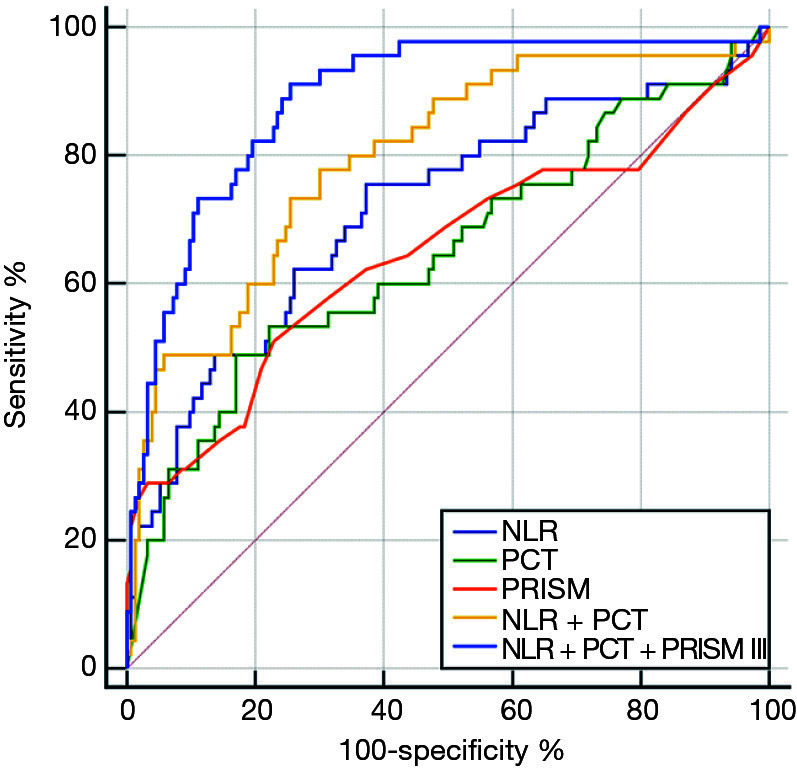
Overall, 202 patients (severe sepsis 45; non-severe sepsis 157) were included. In the severe sepsis group, the levels of NLR (P<0.001), procalcitonin (PCT; P<0.001), and the Pediatric Risk of Mortality score (PRISM III) were higher than those in the nonsevere sepsis group (P<0.001). The PICU stay time (P<0.001), mechanical ventilation length (P=0.004), and hospital stay time (P<0.001) in the severe sepsis patients were noticeably more extended than those in the control patients. The area under the ROC curve (AUC) of NLR was 0.715 (P<0.001), which was higher than that of the PRISM III score (AUC =0.651, P<0.001) and PCT (AUC =0.647, P<0.001). Furthermore, the constructed predictive model of NLR + PCT + PRISM III showed a better prediction significance than they alone (AUC =0.888, P<0.001).
Results indicated that the initial NLR value was a significant biomarker for predicting severe pediatric sepsis. The combined NLR and PCT improved the evaluation for further early identification of severe sepsis in children.
尽管中性粒细胞与淋巴细胞比值(NLR)已在多种疾病中得到广泛研究,但其在儿童脓毒症中的作用仍不明确。我们的研究旨在评估NLR对儿科重症监护病房(PICU)中儿童严重脓毒症的预测意义。
我们回顾性招募了2019年1月至2020年1月在四川大学华西医院PICU中患有严重儿童脓毒症的危重症患儿。采用单因素和多因素逻辑回归分析来评估儿童严重脓毒症的危险因素。绘制受试者工作特征(ROC)曲线以比较NLR的预测意义。
总共纳入了202例患者(严重脓毒症45例;非严重脓毒症157例)。在严重脓毒症组中,NLR水平(P<0.001)、降钙素原(PCT;P<0.001)和儿科死亡风险评分(PRISM III)高于非严重脓毒症组(P<0.001)。严重脓毒症患者的PICU住院时间(P<0.001)、机械通气时长(P=0.004)和住院时间(P<0.001)明显长于对照组患者。NLR的ROC曲线下面积(AUC)为0.715(P<0.001),高于PRISM III评分(AUC =0.651,P<0.001)和PCT(AUC =0.647,P<0.001)。此外,构建的NLR + PCT + PRISM III预测模型显示出比单独使用它们更好的预测意义(AUC =0.888,P<0.001)。
结果表明,初始NLR值是预测儿童严重脓毒症的重要生物标志物。NLR与PCT联合使用可改善评估,有助于进一步早期识别儿童严重脓毒症。