Department of Pediatric Rheumatology and Immunology, University Children's Hospital Muenster, Muenster, Germany.
Department of Gastroenterology, Hepatology, Endocrinology and Clinical Infectiology, University Hospital Muenster, Muenster, Germany.
Arthritis Rheumatol. 2021 Oct;73(10):1791-1799. doi: 10.1002/art.41763. Epub 2021 Sep 3.
Infection with the novel coronavirus SARS-CoV-2 triggers severe illness with high mortality in a subgroup of patients. Such a critical course of COVID-19 is thought to be associated with the development of cytokine storm, a condition seen in macrophage activation syndrome (MAS) and secondary hemophagocytic lymphohistiocytosis (HLH). However, specific data demonstrating a clear association of cytokine storm with severe COVID-19 are still lacking. The aim of this study was to directly address whether immune activation in COVID-19 does indeed mimic the conditions found in these classic cytokine storm syndromes.
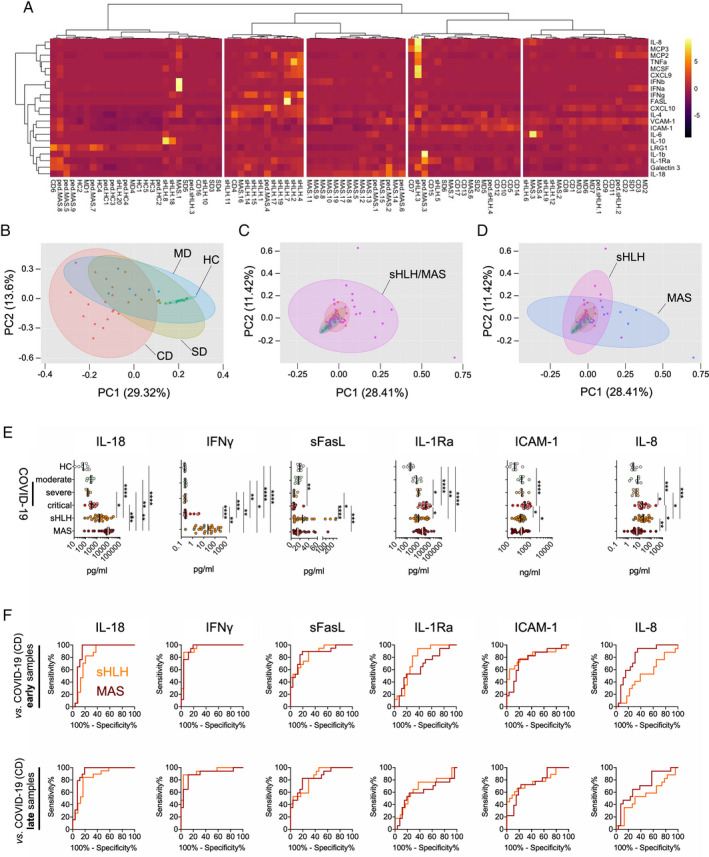
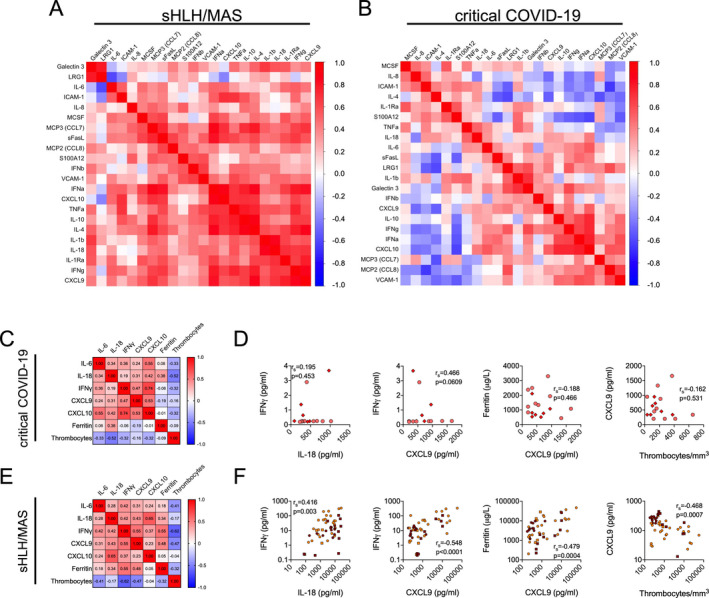
Levels of 22 biomarkers were quantified in serum samples from patients with COVID-19 (n = 30 patients, n = 83 longitudinal samples in total), patients with secondary HLH/MAS (n = 50), and healthy controls (n = 9). Measurements were performed using bead array assays and single-marker enzyme-linked immunosorbent assay. Serum biomarker levels were assessed for correlations with disease outcome.
In patients with secondary HLH/MAS, we observed pronounced activation of the interleukin-18 (IL-18)-interferon-γ axis, increased serum levels of IL-1 receptor antagonist, intercellular adhesion molecule 1, and IL-8, and strongly reduced levels of soluble Fas ligand in the course of SARS-CoV-2 infection. These observations appeared to discriminate immune dysregulation in critical COVID-19 from the well-recognized characteristics of other cytokine storm syndromes.
Serum biomarker profiles clearly separate COVID-19 from MAS or secondary HLH in terms of distinguishing the severe systemic hyperinflammation that occurs following SARS-CoV-2 infection. These findings could be useful in determining the efficacy of drugs targeting key molecules and pathways specifically associated with systemic cytokine storm conditions in the treatment of COVID-19.
新型冠状病毒 SARS-CoV-2 的感染会引发一小部分患者出现严重疾病和高死亡率。这种 COVID-19 的严重病程被认为与细胞因子风暴的发展有关,这种情况可见于巨噬细胞活化综合征 (MAS) 和继发性噬血细胞性淋巴组织细胞增多症 (HLH)。然而,目前仍缺乏明确表明细胞因子风暴与严重 COVID-19 之间存在关联的具体数据。本研究旨在直接探讨 COVID-19 中的免疫激活是否确实类似于这些经典细胞因子风暴综合征中所发现的情况。
我们对 COVID-19 患者(n=30 例患者,总共 83 个纵向样本)、继发性 HLH/MAS 患者(n=50 例)和健康对照者(n=9 例)的血清样本中 22 种生物标志物的水平进行了定量检测。采用珠阵列分析和单标志物酶联免疫吸附试验进行测量。评估血清生物标志物水平与疾病结局的相关性。
在继发性 HLH/MAS 患者中,我们观察到 SARS-CoV-2 感染过程中白细胞介素-18(IL-18)-干扰素-γ 轴显著激活,白细胞介素-1 受体拮抗剂、细胞间黏附分子 1 和 IL-8 的血清水平升高,以及可溶性 Fas 配体水平明显降低。这些观察结果似乎将 COVID-19 中的免疫失调与其他细胞因子风暴综合征的公认特征区分开来。
就区分 SARS-CoV-2 感染后发生的严重全身炎症反应而言,血清生物标志物谱可明确将 COVID-19 与 MAS 或继发性 HLH 区分开来。这些发现可能有助于确定针对特定与全身细胞因子风暴相关的关键分子和途径的药物在 COVID-19 治疗中的疗效。