Department of Public Health, U.O. Prevenzione e Sicurezza Ambienti di Lavoro AUSL della Romagna, U.O. Prevenzione e Sicurezza Ambienti di Lavoro AUSL della Romagna.
Department of Cardiac, Thoracic, Vascular Sciences and Public Health, University of Padova.
Med Lav. 2021 Apr 20;112(2):130-140. doi: 10.23749/mdl.v112i2.10194.
Workplace physical aggressions determine severe consequences for people and organizations. Previous studies reported their spread in organizations and described factors related to their occurrence (e.g. aggressor within/outside the organization, type of activity, etc.). However, such data are not available in the Italian work contexts, limiting the possibility of intervention.
This study aims to provide a description of workplace physical aggressions in the Italian context and the Emilia-Romagna region, considering the main variables described in the literature.
We used data available from the "Flussi informativi" database, containing national data provided by INAIL (National Institute for Insurance against Accidents at Work), which concern all injuries, occupational illness and insured companies' information, from 2000 to 2018. Information about aggressions in the workplace in Italy and Emilia-Romagna are derived from a subset of these data, coded according to ESAW (European Statistics for Accidents at Work) requirements. The number of events per year per 100,000 estimated insured employees by INAIL is considered as an indicator.
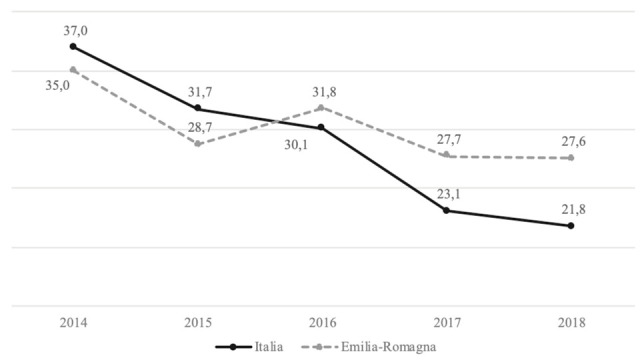
In the period 2014-2018, 23,084 injures from aggression were registered in Italy (an average of 28.7 events per 100,000 employees) and 2,308 in Emilia Romagna (30.2). Aggressions by people outside the organization accounted for 85.14 % in Italy and 87.87% in Emilia-Romagna region. "Health and social services", "Offices and other activities" and "Transportation" were the sectors that showed the highest numbers of events and rates. Furthermore, we reported detailed results about the variation of the events between professions, the site and nature of the lesion and gravity of events.
The study provides a description of workplace physical aggressions in the Italian context and we discuss the implication of these results for primary, secondary and tertiary prevention strategies of intervention.
工作场所身体侵犯对个人和组织都造成严重后果。以往的研究报告了这些侵犯在组织中的传播情况,并描述了与侵犯发生相关的因素(例如,侵犯者在组织内/外、活动类型等)。然而,意大利的工作环境中没有此类数据,限制了干预的可能性。
本研究旨在描述意大利和艾米利亚-罗马涅地区的工作场所身体侵犯情况,并考虑文献中描述的主要变量。
我们使用了“信息流”数据库中的现有数据,其中包含 INAIL(国家意外保险研究所)提供的全国性数据,这些数据涉及 2000 年至 2018 年期间的所有伤害、职业病和参保公司的信息。意大利和艾米利亚-罗马涅地区工作场所侵犯的信息是从这些数据的一个子集中得出的,根据 ESAW(欧洲工作场所事故统计)要求进行编码。INAIL 每年每 10 万名参保员工估计的事件数被视为一个指标。
在 2014 年至 2018 年期间,意大利共记录了 23084 起侵犯性伤害事件(平均每 10 万名员工 28.7 起事件),艾米利亚-罗马涅地区为 2308 起。在意大利,85.14%的侵犯来自组织外的人,而在艾米利亚-罗马涅地区,这一比例为 87.87%。“卫生和社会服务”、“办公室和其他活动”以及“运输”是事件数量和发生率最高的部门。此外,我们还报告了关于不同职业、损伤部位和性质以及事件严重程度之间的事件变化的详细结果。
本研究提供了意大利工作场所身体侵犯的描述,并讨论了这些结果对初级、二级和三级预防干预策略的影响。