Department of Biomedical & Health Information Sciences, College of Applied Health Sciences, University of Illinois at Chicago, Chicago, IL, United States.
Department of Neurology, Massachusetts General Hospital, Boston, MA, United States.
J Med Internet Res. 2021 May 19;23(5):e25446. doi: 10.2196/25446.
The COVID-19 pandemic has broader geographic spread and potentially longer lasting effects than those of previous disasters. Necessary preventive precautions for the transmission of COVID-19 has resulted in delays for in-person health care services, especially at the outset of the pandemic.
Among a US sample, we examined the rates of delays (defined as cancellations and postponements) in health care at the outset of the pandemic and characterized the reasons for such delays.
As part of an internet-based survey that was distributed on social media in April 2020, we asked a US-based convenience sample of 2570 participants about delays in their health care resulting from the COVID-19 pandemic. Participant demographics and self-reported worries about general health and the COVID-19 pandemic were explored as potent determinants of health care delays. In addition to all delays, we focused on the following three main types of delays, which were the primary outcomes in this study: dental, preventive, and diagnostic care delays. For each outcome, we used bivariate statistical tests (t tests and chi-square tests) and multiple logistic regression models to determine which factors were associated with health care delays.
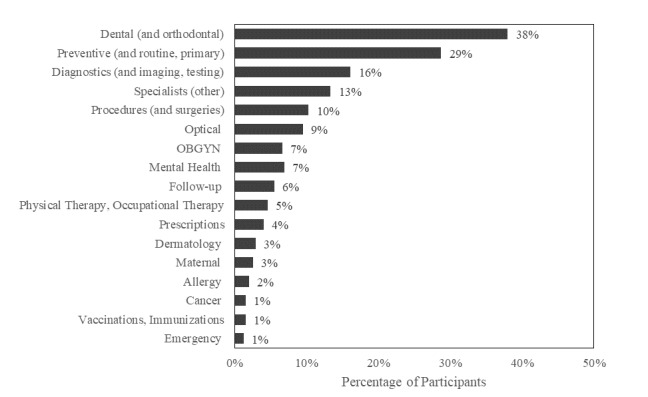
The top reported barrier to receiving health care was the fear of SARS-CoV-2 infection (126/374, 33.6%). Almost half (1227/2570, 47.7%) of the participants reported experiencing health care delays. Among those who experienced health care delays and further clarified the type of delay they experienced (921/1227, 75.1%), the top three reported types of care that were affected by delays included dental (351/921, 38.1%), preventive (269/921, 29.2%), and diagnostic (151/921, 16.4%) care. The logistic regression models showed that age (P<.001), gender identity (P<.001), education (P=.007), and self-reported worry about general health (P<.001) were significantly associated with experiencing health care delays. Self-reported worry about general health was negatively related to experiencing delays in dental care. However, this predictor was positively associated with delays in diagnostic testing based on the logistic regression model. Additionally, age was positively associated with delays in diagnostic testing. No factors remained significant in the multiple logistic regression for delays in preventive care, and although there was trend between race and delays (people of color experienced fewer delays than White participants), it was not significant (P=.06).
The lessons learned from the initial surge of COVID-19 cases can inform systemic mitigation strategies for potential future disruptions. This study addresses the demand side of health care delays by exploring the determinants of such delays. More research on health care delays during the pandemic is needed, including research on their short- and long-term impacts on patient-level outcomes such as mortality, morbidity, mental health, people's quality of life, and the experience of pain.
新冠疫情的地理传播范围更广,潜在影响时间更长,超过了以往的灾害。为了预防新冠病毒的传播,有必要采取预防措施,这导致了面对面的医疗服务延迟,尤其是在疫情初期。
我们在美国的样本中,研究了疫情初期医疗保健延迟(定义为取消和推迟)的发生率,并对这些延迟的原因进行了描述。
作为 2020 年 4 月在社交媒体上发布的一项基于互联网的调查的一部分,我们向美国的 2570 名方便参与者询问了因新冠疫情而导致的医疗保健延迟情况。参与者的人口统计学特征和对一般健康和新冠疫情的自我报告担忧被认为是医疗保健延迟的潜在决定因素。除了所有的延迟之外,我们还重点关注以下三种主要类型的延迟,这是本研究的主要结果:牙科、预防和诊断护理延迟。对于每种结果,我们使用了双变量统计检验(t 检验和卡方检验)和多逻辑回归模型来确定哪些因素与医疗保健延迟有关。
报告的接受医疗保健的最大障碍是对 SARS-CoV-2 感染的恐惧(126/374,33.6%)。近一半(1227/2570,47.7%)的参与者报告经历了医疗保健延迟。在那些经历了医疗保健延迟并进一步明确了他们经历的延迟类型的人中(1227/921,75.1%),报告受影响的三种主要类型的护理包括牙科(351/921,38.1%)、预防(269/921,29.2%)和诊断(151/921,16.4%)护理。逻辑回归模型显示,年龄(P<.001)、性别认同(P<.001)、教育程度(P=.007)和自我报告的一般健康担忧(P<.001)与医疗保健延迟显著相关。自我报告的一般健康担忧与牙科护理延迟呈负相关。然而,根据逻辑回归模型,该预测因素与诊断检测的延迟呈正相关。年龄与诊断检测的延迟呈正相关。种族与预防保健延迟之间存在趋势,但没有达到统计学意义(P=.06)。
从最初的新冠疫情病例激增中吸取的教训可以为潜在未来干扰提供系统缓解策略。本研究通过探讨医疗保健延迟的决定因素,解决了医疗保健延迟的需求方问题。需要对大流行期间的医疗保健延迟进行更多研究,包括研究其对患者水平结果(如死亡率、发病率、心理健康、生活质量和疼痛体验)的短期和长期影响。
