Graduate Program in Bioinformatics, Boston University, Boston, MA, USA.
Biological Design Center, Boston University, Boston, MA, USA.
Nat Commun. 2021 Apr 22;12(1):2365. doi: 10.1038/s41467-021-22426-3.
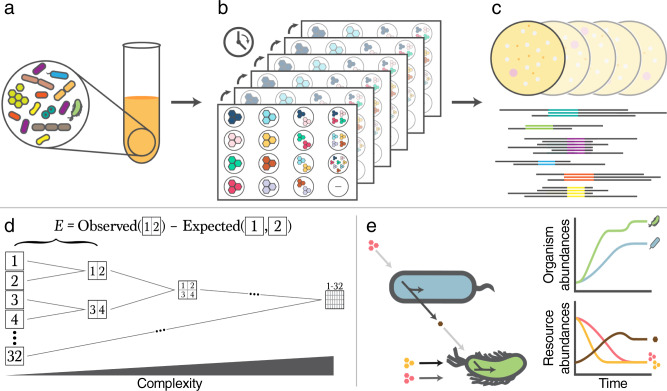
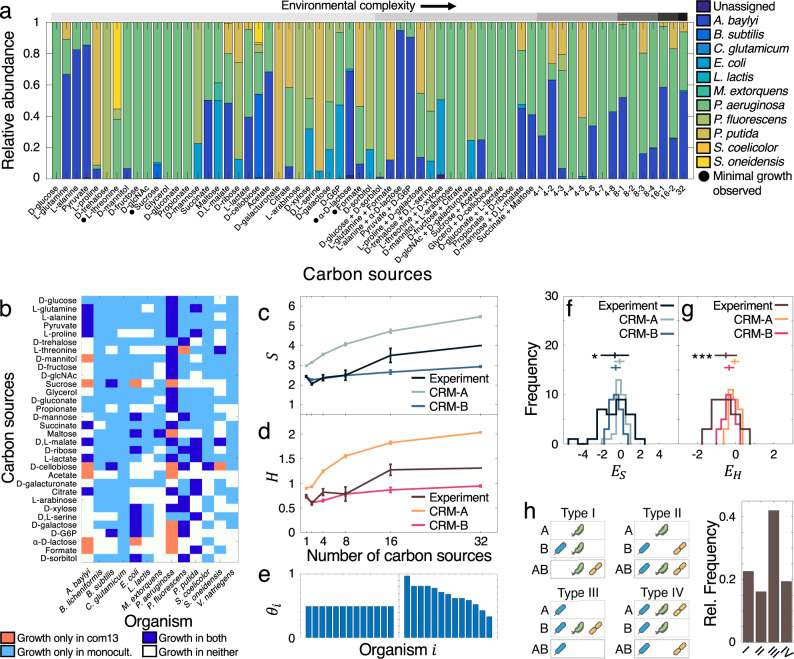
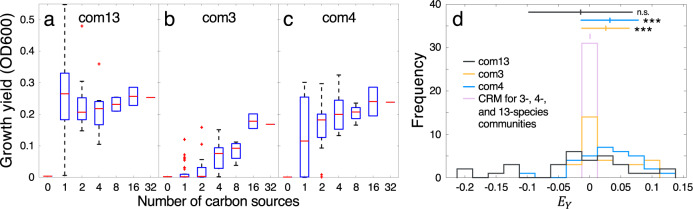
Environmental composition is a major, though poorly understood, determinant of microbiome dynamics. Here we ask whether general principles govern how microbial community growth yield and diversity scale with an increasing number of environmental molecules. By assembling hundreds of synthetic consortia in vitro, we find that growth yield can remain constant or increase in a non-additive manner with environmental complexity. Conversely, taxonomic diversity is often much lower than expected. To better understand these deviations, we formulate metrics for epistatic interactions between environments and use them to compare our results to communities simulated with experimentally-parametrized consumer resource models. We find that key metabolic and ecological factors, including species similarity, degree of specialization, and metabolic interactions, modulate the observed non-additivity and govern the response of communities to combinations of resource pools. Our results demonstrate that environmental complexity alone is not sufficient for maintaining community diversity, and provide practical guidance for designing and controlling microbial ecosystems.
环境组成是微生物组动态的一个主要但尚未被充分理解的决定因素。在这里,我们想知道是否有一般的原则来支配微生物群落的生长产量和多样性如何随着环境分子数量的增加而扩大。通过在体外组装数百个合成共生体,我们发现生长产量可以保持不变或以非加性的方式随着环境复杂性的增加而增加。相反,分类多样性通常远低于预期。为了更好地理解这些偏差,我们制定了环境之间的上位相互作用的度量标准,并将其用于将我们的结果与使用实验参数化消费者资源模型模拟的群落进行比较。我们发现,关键的代谢和生态因素,包括物种相似性、专业化程度和代谢相互作用,调节了观察到的非加性,并控制了群落对资源库组合的反应。我们的结果表明,仅环境复杂性不足以维持群落多样性,并为设计和控制微生物生态系统提供了实际指导。