Kofod Linette Marie, Nielsen Jeschke Klaus, Kristensen Morten Tange, Krogh-Madsen Rikke, Monefeldt Albek Carsten, Hansen Ejvind Frausing
Department of Physio- and Occupational Therapy, Copenhagen University Hospital- Hvidovre&Physical Medicine and Rehabilitation Research - Copenhagen, Denmark.
Department of Pulmonology, Copenhagen University Hospital - Hvidovre, Denmark.
Eur Clin Respir J. 2021 Apr 11;8(1):1910191. doi: 10.1080/20018525.2021.1910191.
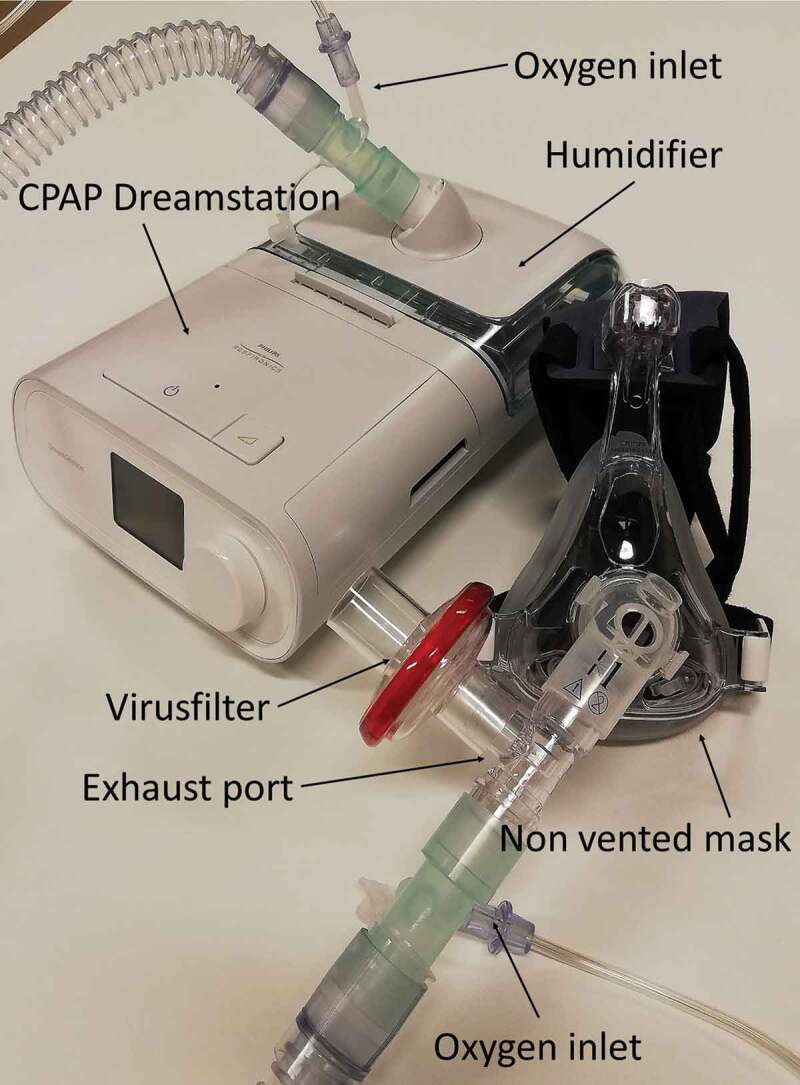
Patients admitted with COVID-19 often have severe hypoxemic respiratory insufficiency and it can be difficult to maintain adequate oxygenation with oxygen supplementation alone. There is a physiological rationale for the use of Continuous Positive Airway Pressure (CPAP), and CPAP could keep some patients off mechanical ventilation. We aimed to examine the physiological response to CPAP and the outcome of this treatment. : Data from all patients admitted with COVID-19 and treated with CPAP, from March to July 2020 were collected retrospectively. CPAP was initiated on a medical ward when oxygen supplementation exceeded 10 liters/min to maintain oxygen saturation (SpO) ≥92%. CPAP was administered with full face masks on a continuous basis until stable improvement in oxygenation or until intubation or death. CPAP was initiated in 53 patients (35 men, 18 women) with a median (IQR) age of 68 (57-78) years. Nine patients were not able to tolerate the CPAP treatment. Median duration for the 44 patients receiving CPAP was 3 (2-6) days. The PaO/FiO ratio was severely reduced to an average of 101 mmHg at initiation of treatment. A positive response of CPAP was seen on respiratory rate (p = 0.002) and on oxygenation (p < 0.001). Of the 44 patients receiving CPAP, 12 (27%) avoided intubation,13 (29%) were intubated, and 19 (43%) died. Of the patients with a ceiling of treatment in the ward (26 of 53) only 2 survived. Older age and high initial oxygen demand predicted treatment failure. CPAP seems to have positive effect on oxygenation and respiratory rate in most patients with severe respiratory failure caused by COVID-19. Treatment with CPAP to severely hypoxemic patients in a medical ward is possible, but the prognosis for especially elderly patients with high oxygen requirement and with a ceiling of treatment in the ward is poor.
新冠肺炎确诊患者常伴有严重的低氧性呼吸功能不全,仅靠吸氧往往难以维持充足的氧合。持续气道正压通气(CPAP)的使用有其生理依据,且CPAP可使部分患者避免接受机械通气。我们旨在研究CPAP的生理反应及该治疗方法的效果。:回顾性收集了2020年3月至7月间所有确诊新冠肺炎且接受CPAP治疗的患者的数据。当吸氧流量超过10升/分钟以维持血氧饱和度(SpO)≥92%时,在普通病房开始使用CPAP。使用全面罩持续给予CPAP,直至氧合情况稳定改善,或直至插管或死亡。共有53例患者(35例男性,18例女性)开始使用CPAP,年龄中位数(四分位间距)为68(57 - 78)岁。9例患者无法耐受CPAP治疗。44例接受CPAP治疗的患者的治疗持续时间中位数为3(2 - 6)天。治疗开始时,动脉血氧分压/吸入氧分数值(PaO/FiO)严重降低,平均为101 mmHg。CPAP对呼吸频率(p = 0.002)和氧合情况(p < 0.001)有积极影响。44例接受CPAP治疗患者中,12例(27%)避免了插管,13例(29%)接受了插管,19例(43%)死亡。在病房中有治疗上限的患者(53例中的26例)中,仅两例存活。高龄和初始高氧需求预示着治疗失败。CPAP似乎对大多数由新冠肺炎导致严重呼吸衰竭的患者的氧合和呼吸频率有积极作用。在普通病房对严重低氧血症患者使用CPAP治疗是可行的,但对于尤其是高氧需求且在病房中有治疗上限的老年患者,预后较差。