Centre for Human Health and Performance, Institute of Sport, Exercise and Health, Division of Medicine, University College London, London, UK.
Bloomsbury Institute of Intensive Care Medicine, Division of Medicine, University College London, London, UK; University College London Hospitals NHS Foundation Trust, London, UK.
Lancet Respir Med. 2022 Feb;10(2):199-213. doi: 10.1016/S2213-2600(21)00414-8. Epub 2021 Nov 9.
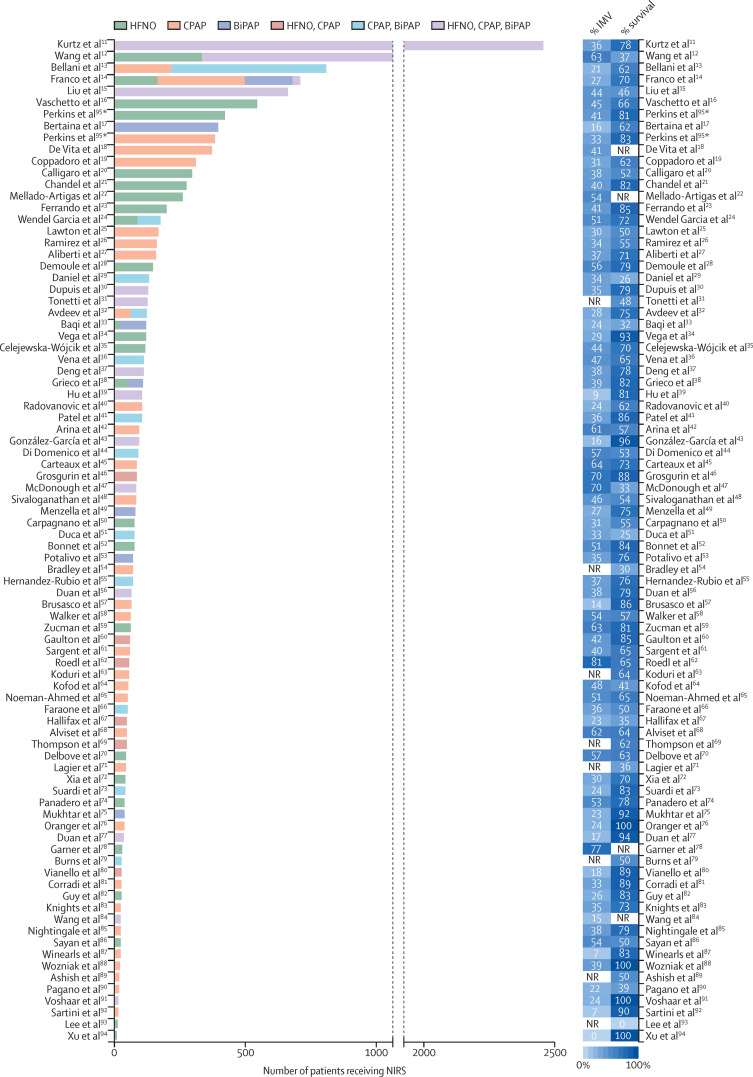
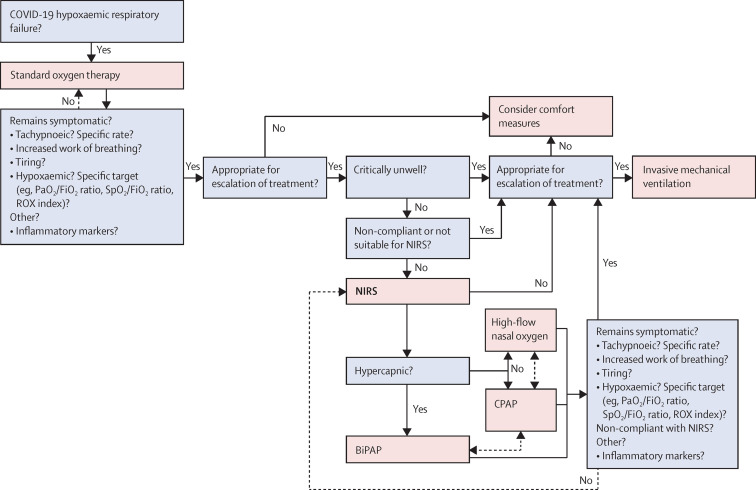
Non-invasive respiratory support (NIRS) has increasingly been used in the management of COVID-19-associated acute respiratory failure, but questions remain about the utility, safety, and outcome benefit of NIRS strategies. We identified two randomised controlled trials and 83 observational studies, compromising 13 931 patients, that examined the effects of NIRS modalities-high-flow nasal oxygen, continuous positive airway pressure, and bilevel positive airway pressure-on patients with COVID-19. Of 5120 patients who were candidates for full treatment escalation, 1880 (37%) progressed to invasive mechanical ventilation and 3658 of 4669 (78%) survived to study end. Survival was 30% among the 1050 patients for whom NIRS was the stated ceiling of treatment. The two randomised controlled trials indicate superiority of non-invasive ventilation over high-flow nasal oxygen in reducing the need for intubation. Reported complication rates were low. Overall, the studies indicate that NIRS in patients with COVID-19 is safe, improves resource utilisation, and might be associated with better outcomes. To guide clinical decision making, prospective, randomised studies are needed to address timing of intervention, optimal use of NIRS modalities-alone or in combination-and validation of tools such as oxygenation indices, response to a trial of NIRS, and inflammatory markers as predictors of treatment success.
无创呼吸支持(NIRS)在 COVID-19 相关急性呼吸衰竭的治疗中越来越多地被使用,但关于 NIRS 策略的效用、安全性和结果获益仍存在疑问。我们确定了两项随机对照试验和 83 项观察性研究,共纳入 13931 名患者,这些研究检查了 NIRS 模式(高流量鼻氧、持续气道正压通气和双水平气道正压通气)对 COVID-19 患者的影响。在 5120 名有充分治疗升级机会的患者中,1880 名(37%)进展为有创机械通气,4669 名中有 3658 名(78%)存活到研究结束。在 1050 名以 NIRS 为治疗上限的患者中,生存率为 30%。两项随机对照试验表明,与高流量鼻氧相比,无创通气可降低插管需求,具有优势。报告的并发症发生率较低。总体而言,这些研究表明,NIRS 在 COVID-19 患者中是安全的,可改善资源利用,并可能与更好的结果相关。为了指导临床决策,需要前瞻性、随机研究来解决干预时机、NIRS 模式的最佳使用(单独或联合使用),以及氧合指数、对 NIRS 试验的反应以及炎症标志物等工具的验证,以预测治疗成功。