Department of Clinical Science, University of Bergen, Bergen, Norway.
Department of Heart Disease, Haukeland University Hospital, N-5021, Bergen, Norway.
J Interv Card Electrophysiol. 2022 Aug;64(2):333-339. doi: 10.1007/s10840-021-00990-4. Epub 2021 Apr 23.
This study aimed to clarify the interrelationship and additive effects of contact force (CF), power and application time in both conventional and high-power short-duration (HPSD) settings.
Among 38 patients with paroxysmal atrial fibrillation who underwent first-time pulmonary vein isolation, 787 ablation points were collected at the beginning of the procedure at separate sites. Energy was applied for 60 s under power outputs of 25, 30 or 35 W (conventional group), or 10 s when using 50 W (HPSD group). An impedance drop (ID) of 10 Ω was regarded as a marker of adequate lesion formation.
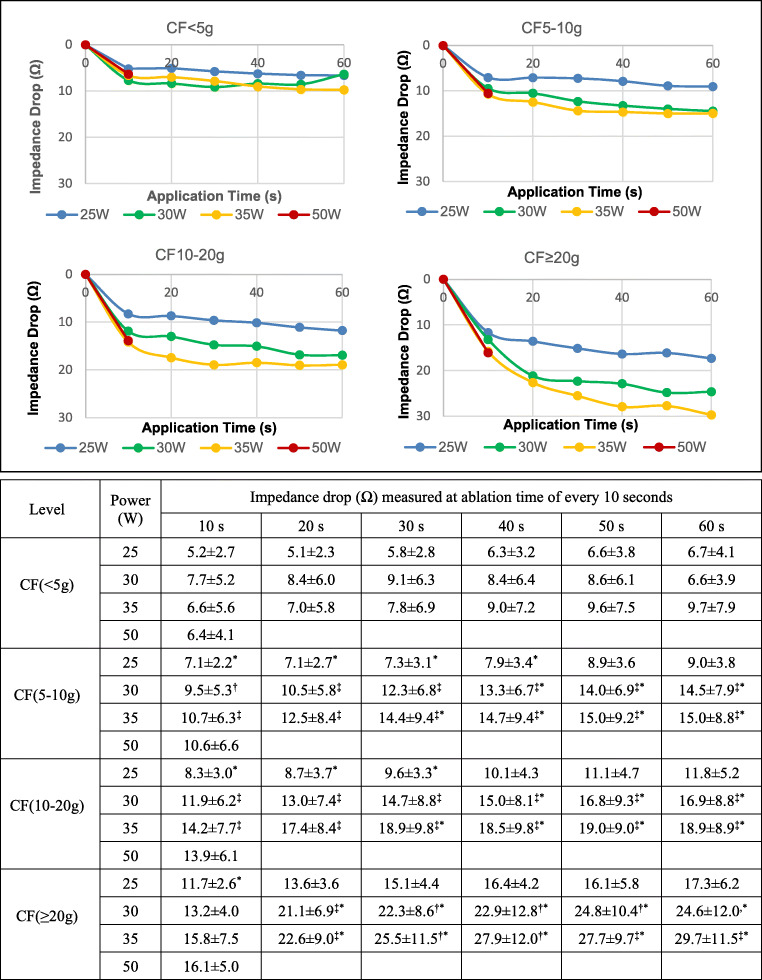
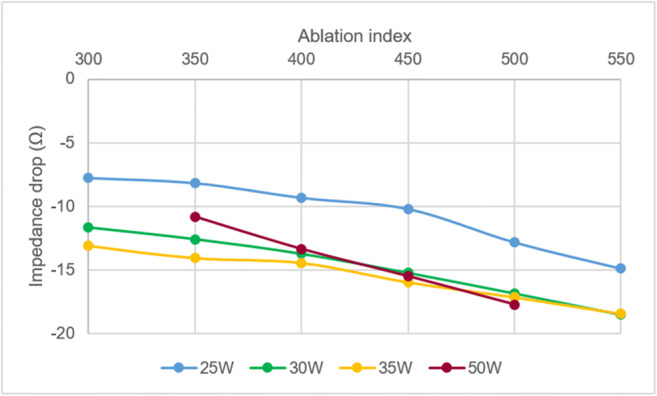
ID ≥ 10 Ω could not be achieved with CF < 5 g under any power setting. With CF ≥ 5 g, ID could be enhanced by increasing power output or prolonging ablation time. ID for 30 and 35 W was greater than for 25 W (p < 0.05). Ablation with 35 W resulted in greater ID than with 30 W only when CF of 10-20 g was applied for 20-40 s (p < 0.05). Under the same power output, ID increased with CF level at different time points. The higher the CF, the shorter the time needed to reach ID of 10 Ω and maximal ID. ID correlated well with ablation index under each power, except for lower ID values at 25 W. ID with 50 W for 10 s was equivalent to that with 25 W for 40 s, but lower than that with 30 W for 40 s or 35 W for 30 s.
CF of at least 5 g is required for adequate ablation effect. With CF ≥ 5g, CF, power output, and ablation time can compensate for each other. Time to reach maximal ablation effect can be shortened by increasing CF or power. The effect of HPSD ablation with 50 W for 10 s is equivalent to conventional ablation with 25 W for 40 s and 30-35 W for 20-30 s in terms of ID.
本研究旨在阐明接触力(CF)、功率和应用时间在常规和高功率短时间(HPSD)设置中的相互关系和累加效应。
在首次接受肺静脉隔离的 38 例阵发性心房颤动患者中,在程序开始时分别在不同部位采集了 787 个消融点。在 25、30 或 35 W 的功率输出下应用 60 s(常规组),或在 50 W 时应用 10 s(HPSD 组)。将 10 Ω 的阻抗下降(ID)视为适当病变形成的标志物。
在任何功率设置下,当 CF<5 g 时,无法达到 ID≥10 Ω。当 CF≥5 g 时,通过增加功率输出或延长消融时间可以增强 ID。30 和 35 W 的 ID 大于 25 W(p<0.05)。仅当应用 10-20 g 的 CF 20-40 s 时,35 W 的消融产生的 ID 大于 30 W(p<0.05)。在相同的功率输出下,ID 随 CF 水平在不同时间点增加。CF 越高,达到 10 Ω ID 和最大 ID 的时间越短。除了在 25 W 时较低的 ID 值外,ID 与每个功率下的消融指数相关性良好。50 W 作用 10 s 的 ID 与 25 W 作用 40 s 的 ID 相当,但低于 30 W 作用 40 s 或 35 W 作用 30 s 的 ID。
至少 5 g 的 CF 是获得足够消融效果所必需的。当 CF≥5 g 时,CF、功率输出和消融时间可以相互补偿。通过增加 CF 或功率可以缩短达到最大消融效果的时间。50 W 作用 10 s 的 HPSD 消融在 ID 方面等效于常规消融 25 W 作用 40 s 和 30-35 W 作用 20-30 s。