Department of Cardiology, Daegu Catholic University Medical Center, Daegu, Korea.
Severance Cardiovascular Hospital, Yonsei University College of Medicine, Seoul, Korea.
PLoS One. 2021 Apr 23;16(4):e0247359. doi: 10.1371/journal.pone.0247359. eCollection 2021.
The prognosis of stented lesions differs according to in-stent neointimal characteristics on optical coherence tomography (OCT). In particular, patients who show in-stent heterogeneous neointima are associated with a higher incidence of target lesion revascularization (TLR) compared with those who show in-stent non-heterogeneous neointima. However, the relationship between in-stent neointimal characteristics and native coronary atherosclerosis progression has not been clearly elucidated. The study aimed to investigate the relationship between in-stent neointimal characteristics and progression of native atherosclerosis.
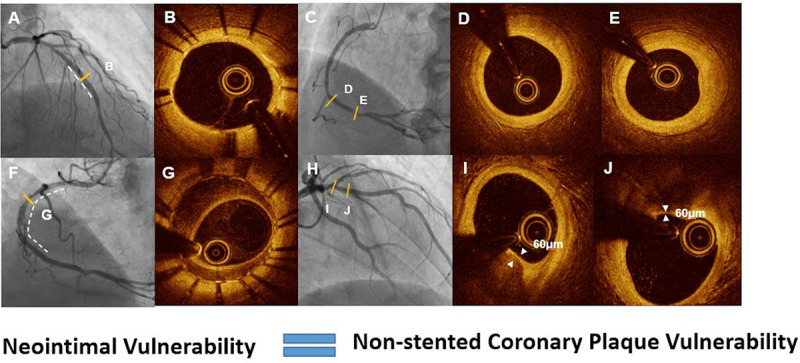
The neointimal characteristics of 377 patients with 377 drug-eluting stents (DESs) were quantitatively and qualitatively assessed using OCT. The OCT-based neointima was categorized as homogeneous (n = 207), heterogeneous (n = 93), and layered (n = 77). The relationship of non-target lesion revascularization (non-TLR) with neointimal characteristics was evaluated after OCT examination of the stents.
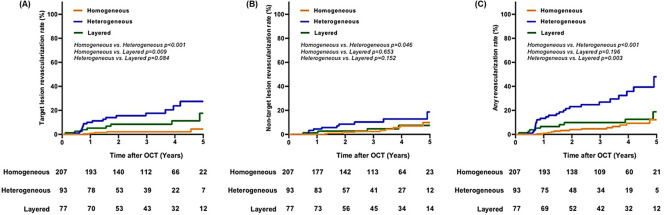
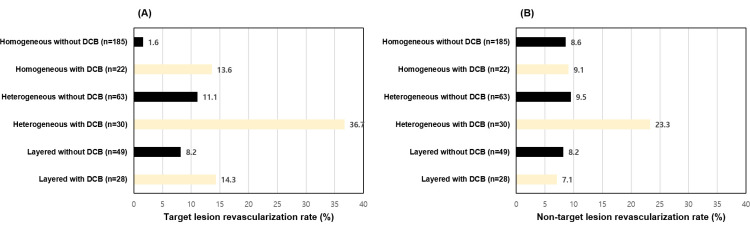
After a median follow-up duration of 40.0 months, patients with heterogeneous neointima showed significantly higher non-TLR rates than those with homogeneous neointima and tended to have higher non-TLR rates than those with layered neointima (heterogeneous vs. homogeneous:14.0% vs. 8.7%, p = 0.046; heterogeneous vs. layered neointima:14.0% vs. 7.8%, p = 0.152). Multivariate analysis showed that the independent determinants for non-TLR were heterogeneous neointima (HR: 2.237, 95% CI: 1.023-4.890, p = 0.044) and chronic kidney disease (hazard ratio [HR]: 8.730, 95% CI: 2.175-35.036, p = 0.002).
The heterogeneous neointima in DES-treated lesions was associated with a higher incidence of non-TLR and target lesion failure. This finding suggests that the neointimal pattern may reflect the progression of the native lesion.
光学相干断层扫描(OCT)显示的支架内新生内膜特征可影响支架内病变的预后。特别是,与支架内非异质性新生内膜患者相比,支架内异质性新生内膜患者的靶病变血运重建(TLR)发生率更高。然而,支架内新生内膜特征与原发性冠状动脉粥样硬化进展之间的关系尚未明确。本研究旨在探讨支架内新生内膜特征与原发性动脉粥样硬化进展之间的关系。
对 377 例 377 个药物洗脱支架(DES)患者的支架内新生内膜特征进行定量和定性 OCT 评估。OCT 基于支架内新生内膜分为同质(n = 207)、异质(n = 93)和分层(n = 77)。在 OCT 检查支架后,评估非靶病变血运重建(non-TLR)与新生内膜特征的关系。
中位随访时间为 40.0 个月后,异质新生内膜患者的 non-TLR 发生率明显高于同质新生内膜患者,且异质新生内膜患者的 non-TLR 发生率高于分层新生内膜患者(异质 vs 同质:14.0% vs 8.7%,p = 0.046;异质 vs 分层新生内膜:14.0% vs 7.8%,p = 0.152)。多变量分析显示,non-TLR 的独立预测因素为异质新生内膜(HR:2.237,95%CI:1.023-4.890,p = 0.044)和慢性肾脏病(HR:8.730,95%CI:2.175-35.036,p = 0.002)。
DES 治疗后病变的异质新生内膜与较高的 non-TLR 和靶病变失败发生率相关。这一发现表明,新生内膜模式可能反映了原发性病变的进展。