Institute of Pulmonary Medicine, Sheba Medical Center, Tel Hashomer, Israel.
Sackler Faculty of Medicine, Tel-Aviv University, Tel-Aviv, Israel.
PLoS One. 2021 Apr 23;16(4):e0250178. doi: 10.1371/journal.pone.0250178. eCollection 2021.
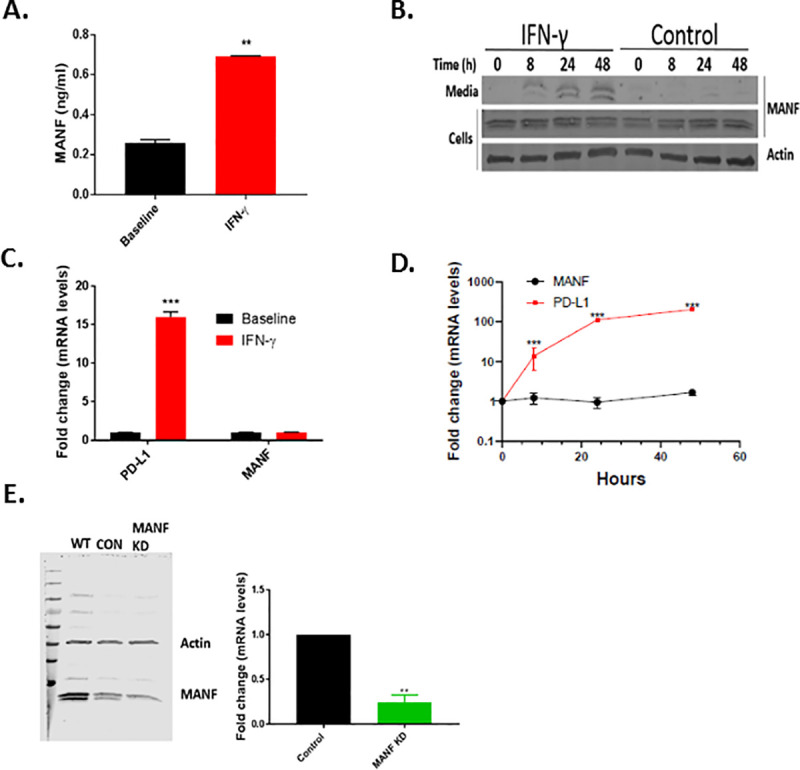
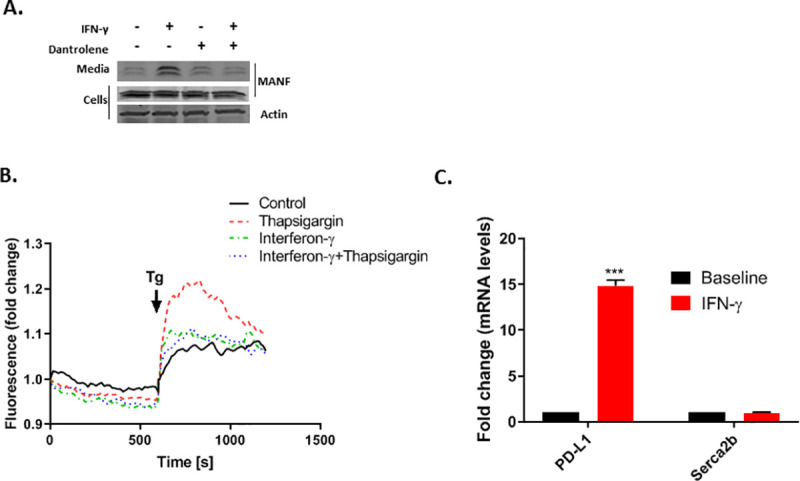
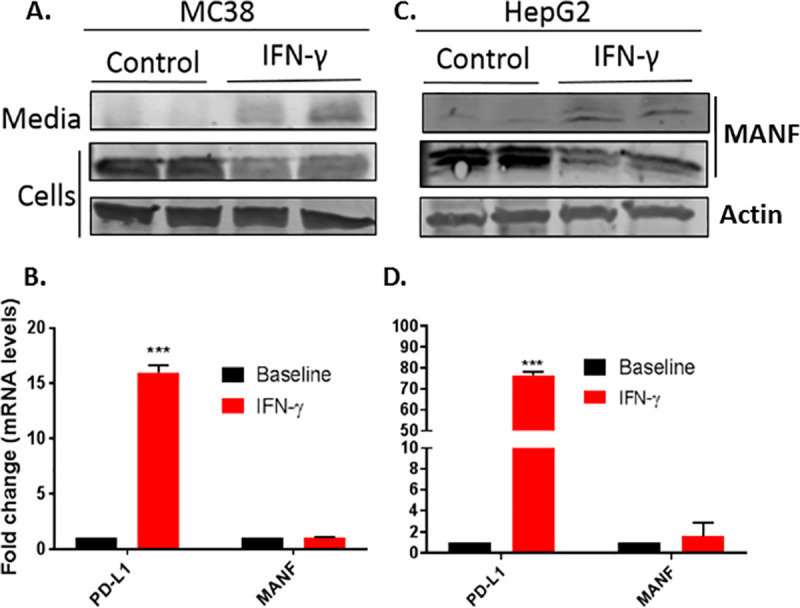
The most successful immunotherapeutic agents are blocking antibodies to either programmed cell death-1 (PD-1), an inhibitory receptor expressed on T lymphocytes, or to its ligand, programmed cell death-ligand 1 (PD-L1). Nevertheless, many patients do not respond, and additional approaches, specifically blocking other inhibitory receptors on T cells, are being explored. Importantly, the source of the ligands for these receptors are often the tumor cells. Indeed, cancer cells express high levels of PD-L1 upon stimulation with interferon-γ (IFN-γ), a major cytokine in the tumor microenvironment. The increase in PD-L1 expression serves as a negative feedback towards the immune system, and allows the tumor to evade the attack of immune cells. A potential novel immunoregulator is mesencephalic astrocyte-derived neurotrophic factor (MANF), an endoplasmic reticulum (ER)-resident protein that is secreted from pancreatic beta cells upon cytokines activation, and can induce an alternatively activated macrophage phenotype (M2), and thus may support tumor growth. While MANF was shown to be secreted from pancreatic beta cells, its IFN-γ-induced secretion from tumor cells has never been assessed. Here we found that IFN-γ induced MANF secretion from diverse tumor cell-lines-melanoma cells, colon carcinoma cells and hepatoma cells. Mechanistically, there was no increase in MANF RNA or intracellular protein levels upon IFN-γ stimulation. However, IFN-γ induced ER calcium depletion, which was necessary for MANF secretion, as Dantrolene, an inhibitor of ER calcium release, prevented its secretion. Thus, MANF is secreted from IFN-γ-stimulated tumor cells, and further studies are required to assess its potential as a drug target for cancer immunotherapy.
最成功的免疫治疗药物是针对程序性细胞死亡蛋白-1(PD-1)或其配体程序性细胞死亡配体 1(PD-L1)的阻断抗体。然而,许多患者对此没有反应,因此正在探索其他方法,特别是阻断 T 细胞上的其他抑制性受体。重要的是,这些受体的配体来源通常是肿瘤细胞。事实上,癌细胞在受到干扰素-γ(IFN-γ)刺激时会表达高水平的 PD-L1,IFN-γ 是肿瘤微环境中的一种主要细胞因子。PD-L1 表达的增加是对免疫系统的负反馈,使肿瘤能够逃避免疫细胞的攻击。一种潜在的新型免疫调节剂是脑星形胶质细胞衍生的神经营养因子(MANF),它是一种内质网(ER)驻留蛋白,在细胞因子激活时从胰腺β细胞分泌,可以诱导一种替代激活的巨噬细胞表型(M2),从而可能支持肿瘤生长。虽然已经证明 MANF 从胰腺β细胞分泌,但从未评估过其在 IFN-γ 诱导的肿瘤细胞中的分泌。在这里,我们发现 IFN-γ 诱导多种肿瘤细胞系(黑色素瘤细胞、结肠癌细胞和肝癌细胞)分泌 MANF。从机制上讲,IFN-γ 刺激后 MANF RNA 或细胞内蛋白水平没有增加。然而,IFN-γ 诱导 ER 钙耗竭,这是 MANF 分泌所必需的,因为 ER 钙释放抑制剂 Dantrolene 可阻止其分泌。因此,MANF 从 IFN-γ 刺激的肿瘤细胞中分泌,需要进一步研究评估其作为癌症免疫治疗药物靶点的潜力。