Department of Colorectal Surgery, The Sixth Affiliated Hospital, Sun Yat-Sen University, Guangzhou, 510655, Guangdong, China.
Guangdong Provincial Key Laboratory of Colorectal and Pelvic Floor Diseases, The Sixth Affiliated Hospital, Sun Yat-Sen University, Guangzhou, 510655, Guangdong, China.
Clin Epigenetics. 2021 Apr 23;13(1):90. doi: 10.1186/s13148-021-01076-8.
Colorectal cancer (CRC) is a leading cause of cancer-related deaths worldwide. Early detection of CRC can significantly reduce its mortality rate. Current method of CRC diagnosis relies on the invasive endoscopy. Non-invasive assays including fecal occult blood testing (FOBT) and fecal immunological test (FIT) are compromised by low sensitivity and specificity, especially at early stages. Thus, a non-invasive and accurate approach for CRC screening would be highly desirable.
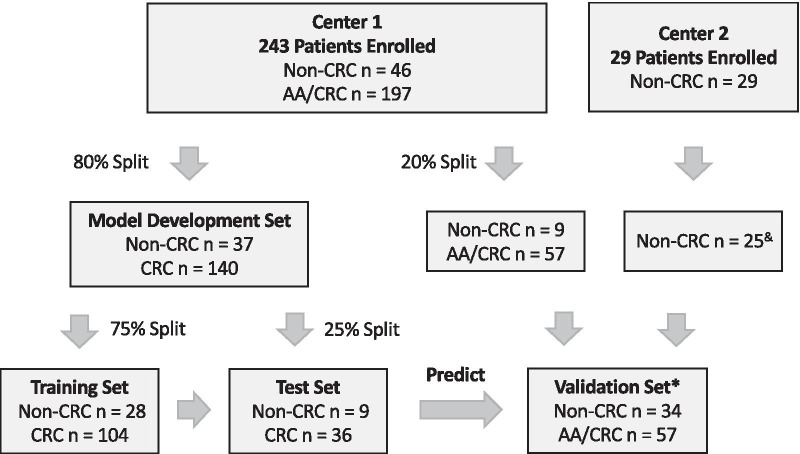
A new qPCR-based assay combining the simultaneous detection of the DNA methylation status of ten candidate genes was used to examine plasma samples from 56 normal controls, 6 hyperplastic polys, 9 non-advanced adenomas (NAAs), 22 advanced adenomas (AAs) and 175 CRC patients, using 10 ng of cfDNA. We further built a logistic regression model for CRC diagnosis. We tested ten candidate methylation markers including twist1, vav3-as1, fbn1, c9orf50, sfmbt2, kcnq5, fam72c, itga4, kcnj12 and znf132. All markers showed moderate diagnostic performance with AUCs ranging from 0.726 to 0.815. Moreover, a 4-marker model, comprised of two previously reported markers (c9orf50 and twist1) and two novel ones (kcnj12 and znf132), demonstrated high performance for detecting colorectal cancer in an independent validation set (N = 69) with an overall AUC of 0.911 [95% confidence interval (CI) 0.834-0.988], sensitivity of 0.800 [95% CI 0.667-0.933] and specificity of 0.971 [95% CI 0.914-1.000]. The stage-stratified sensitivity of the model was 0.455 [95% CI 0.227-0.682], 0.667 [95% CI 0.289-1.000], 0.800 [95% CI 0.449-1.000], 0.800 [95% CI 0.449-1.000] and 0.842 [95% CI 0.678-1.000] for advanced adenoma and CRC stage I-IV, respectively.
kcnj12 and znf132 are two novel methylation biomarkers for CRC diagnosis. The 4-marker methylation model provides a new non-invasive choice for CRC screening and interception.
结直肠癌(CRC)是全球癌症相关死亡的主要原因。CRC 的早期检测可以显著降低其死亡率。目前的 CRC 诊断方法依赖于侵入性内窥镜检查。非侵入性检测,包括粪便潜血检测(FOBT)和粪便免疫检测(FIT),其敏感性和特异性较低,尤其是在早期阶段。因此,一种非侵入性和准确的 CRC 筛查方法将是非常需要的。
我们使用一种新的基于 qPCR 的检测方法,同时检测十个候选基因的 DNA 甲基化状态,使用 10ng 的 cfDNA,对 56 名正常对照、6 名增生性息肉、9 名非进展性腺瘤(NAAs)、22 名进展性腺瘤(AAs)和 175 名 CRC 患者的血浆样本进行了检测。我们进一步建立了用于 CRC 诊断的逻辑回归模型。我们测试了十个候选甲基化标记物,包括 twist1、vav3-as1、fbn1、c9orf50、sfmbt2、kcnq5、fam72c、itga4、kcnj12 和 znf132。所有标记物的诊断性能均为中等,AUC 范围为 0.726 至 0.815。此外,一个由两个先前报道的标记物(c9orf50 和 twist1)和两个新标记物(kcnj12 和 znf132)组成的 4 标记物模型,在独立验证集(N=69)中表现出了用于检测结直肠癌的高性能,总体 AUC 为 0.911[95%置信区间(CI)0.834-0.988],灵敏度为 0.800[95%CI 0.667-0.933],特异性为 0.971[95%CI 0.914-1.000]。该模型的分层敏感性分别为 0.455[95%CI 0.227-0.682]、0.667[95%CI 0.289-1.000]、0.800[95%CI 0.449-1.000]、0.800[95%CI 0.449-1.000]和 0.842[95%CI 0.678-1.000],用于进展性腺瘤和 CRC Ⅰ-IV 期。
kcnj12 和 znf132 是 CRC 诊断的两个新的甲基化生物标志物。四标志物甲基化模型为 CRC 筛查和干预提供了一种新的非侵入性选择。