County of Santa Clara Public Health Department, San Jose, California, USA.
Department of Laboratory Medicine, University of California, San Francisco, San Francisco, California, USA.
J Infect Dis. 2021 Jul 15;224(2):207-217. doi: 10.1093/infdis/jiab199.
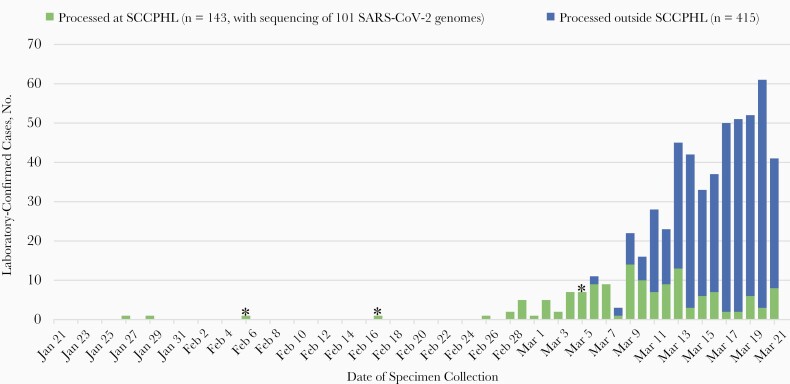
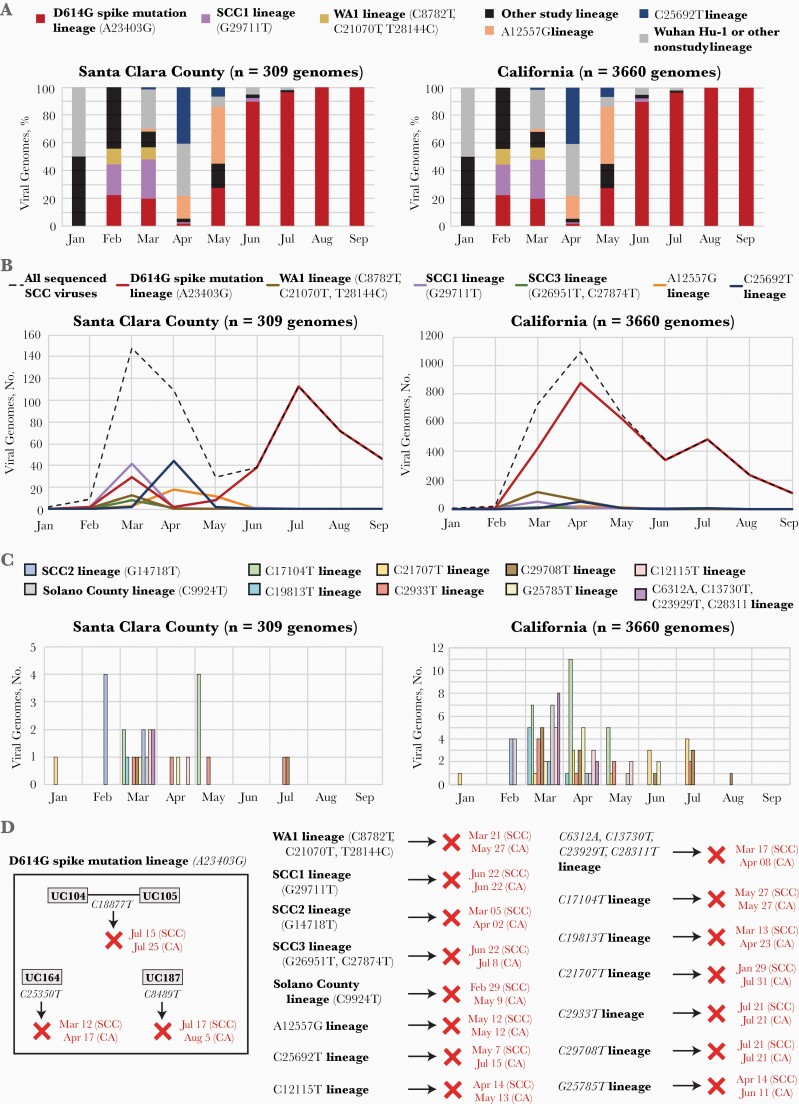
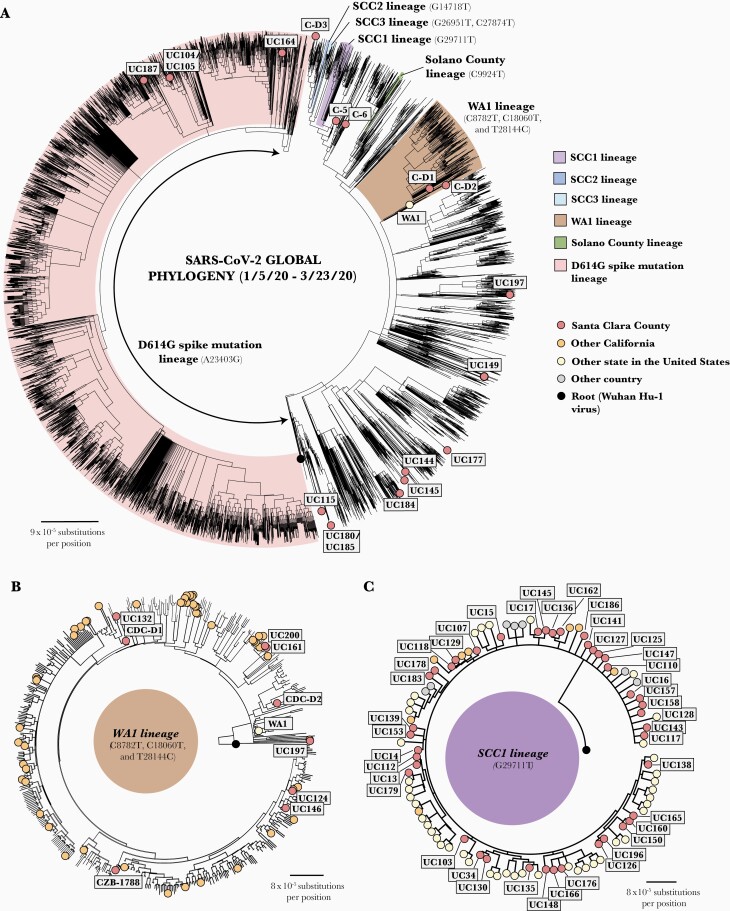
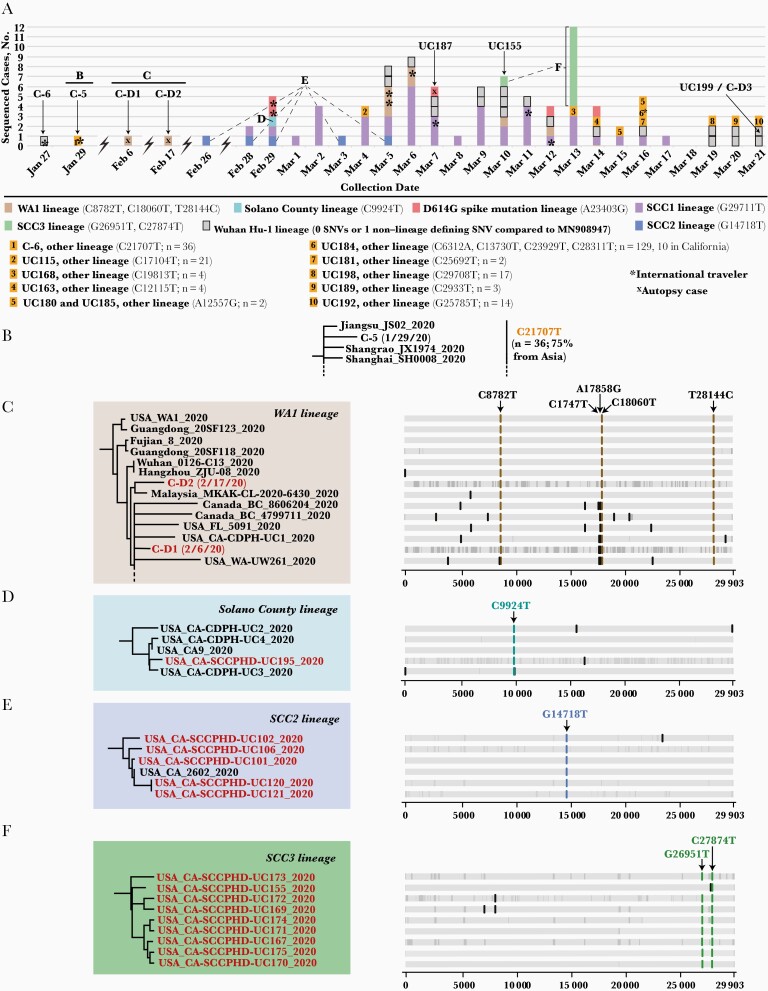
We combined viral genome sequencing with contact tracing to investigate introduction and evolution of severe acute respiratory syndrome coronavirus 2 lineages in Santa Clara County, California, from 27 January to 21 March 2020. From 558 persons with coronavirus disease 2019, 101 genomes from 143 available clinical samples comprised 17 lineages, including SCC1 (n = 41), WA1 (n = 9; including the first 2 reported deaths in the United States, with postmortem diagnosis), D614G (n = 4), ancestral Wuhan Hu-1 (n = 21), and 13 others (n = 26). Public health intervention may have curtailed the persistence of lineages that appeared transiently during February and March. By August, only D614G lineages introduced after 21 March were circulating in Santa Clara County.
我们将病毒基因组测序与接触者追踪相结合,调查了 2020 年 1 月 27 日至 3 月 21 日加利福尼亚州圣克拉拉县严重急性呼吸综合征冠状病毒 2 谱系的传入和进化。在 558 名 2019 年冠状病毒病患者中,从 143 个可用临床样本中获得了 101 个基因组,包括 17 个谱系,包括 SCC1(n = 41)、WA1(n = 9;包括美国前 2 例死亡病例,均为死后诊断)、D614G(n = 4)、祖武汉 Hu-1(n = 21)和其他 13 个谱系(n = 26)。公共卫生干预措施可能已经阻止了 2 月和 3 月期间短暂出现的谱系的持续存在。到 8 月,圣克拉拉县仅循环传播 21 日后传入的 D614G 谱系。