Moores Cancer Center, University of California San Diego, San Diego, 3855 Health Sciences Drive, La Jolla, CA, 92037, USA.
Flatiron Health, Inc., New York, NY, USA.
Target Oncol. 2021 May;16(3):389-399. doi: 10.1007/s11523-021-00815-4. Epub 2021 Apr 24.
Neurotrophic tyrosine receptor kinase (NTRK) gene fusions are oncogenic drivers in various tumor types. While NTRK gene fusions are predictive of benefit from tropomyosin receptor kinase inhibitors regardless of tumor type, the prognostic significance of NTRK gene fusions in a pan-tumor setting remains unclear.
This study evaluated the characteristics and prognosis of tropomyosin receptor kinase fusion cancer in the real-world setting.
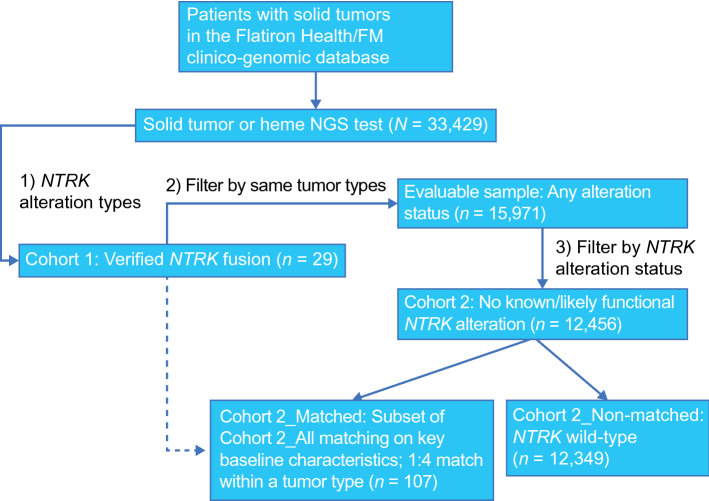
This retrospective study used a de-identified clinico-genomic database and included patients with cancer who had comprehensive genomic profiling between January 2011 and July 2018. Patients were classified as having cancer with NTRK gene fusions or NTRK wild-type genes. Patients were matched with a 1:4 ratio (NTRK fusion:NTRK wild-type) using the Mahalanobis distance method on demographic and clinical characteristics, including age and Eastern Cooperative Oncology Group performance status. Descriptive analysis of clinical and molecular characteristics was conducted. Kaplan-Meier estimator and Cox regression were used for overall survival analysis.
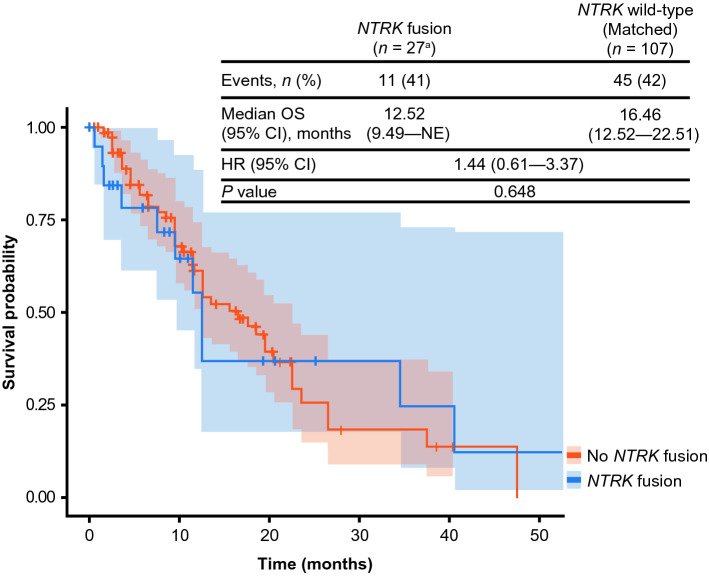
Median overall survival was 12.5 months (95% confidence interval 9.5-not estimable) and 16.5 months (95% confidence interval 12.5-22.5) in the NTRK gene fusion (n = 27) and NTRK wild-type cohorts (n = 107), respectively (hazard ratio 1.44; 95% confidence interval 0.61-3.37; p = 0.648). Co-occurrence of select targetable biomarkers including ALK, BRAF, ERBB2, EGFR, ROS1, and KRAS was lower in cancers with NTRK gene fusions than in NTRK wild-type cancers.
Although the hazard ratio for overall survival suggested a higher risk of death for patients with NTRK gene fusions, the difference was not statistically significant. Co-occurrence of NTRK gene fusions and other actionable biomarkers was uncommon.
神经营养酪氨酸受体激酶(NTRK)基因融合是多种肿瘤类型的致癌驱动因素。尽管 NTRK 基因融合无论肿瘤类型如何,均提示对原肌球蛋白受体激酶抑制剂治疗有效,但 NTRK 基因融合在泛肿瘤环境中的预后意义尚不清楚。
本研究评估了真实环境中原肌球蛋白受体激酶融合癌的特征和预后。
本回顾性研究使用了去标识的临床基因组数据库,纳入了 2011 年 1 月至 2018 年 7 月期间接受全面基因组分析的癌症患者。患者被分为存在 NTRK 基因融合或 NTRK 野生型基因的癌症患者。使用马哈拉诺比斯距离法根据人口统计学和临床特征(包括年龄和东部肿瘤协作组体能状态)对患者进行 1:4 比例(NTRK 融合:NTRK 野生型)匹配。对临床和分子特征进行描述性分析。使用 Kaplan-Meier 估计器和 Cox 回归进行总生存分析。
在 NTRK 基因融合(n=27)和 NTRK 野生型队列(n=107)中,中位总生存期分别为 12.5 个月(95%置信区间 9.5-无法估计)和 16.5 个月(95%置信区间 12.5-22.5)(风险比 1.44;95%置信区间 0.61-3.37;p=0.648)。与 NTRK 野生型癌症相比,存在 NTRK 基因融合的癌症中,其他可靶向生物标志物(包括 ALK、BRAF、ERBB2、EGFR、ROS1 和 KRAS)的共同发生频率较低。
尽管 NTRK 基因融合患者的总生存风险比提示死亡风险更高,但差异无统计学意义。NTRK 基因融合与其他可操作的生物标志物同时存在的情况并不常见。