Department of Surgery, University of Maryland School of Medicine, Baltimore, MD, USA; Surgery Service, Veterans Affairs Medical Center, Baltimore, MD, USA.
Department of Surgery, University of Maryland School of Medicine, Baltimore, MD, USA.
Am J Surg. 2022 Feb;223(2):380-387. doi: 10.1016/j.amjsurg.2021.04.005. Epub 2021 Apr 14.
The COVID-19 pandemic has necessitated the adoption of protocols to minimize risk of periprocedural complications associated with SARS-CoV-2 infection. This typically involves a preoperative symptom screen and nasal swab RT-PCR test for viral RNA. Asymptomatic patients with a negative COVID-19 test are cleared for surgery. However, little is known about the rate of postoperative COVID-19 positivity among elective surgical patients, risk factors for this group and rate of complications.
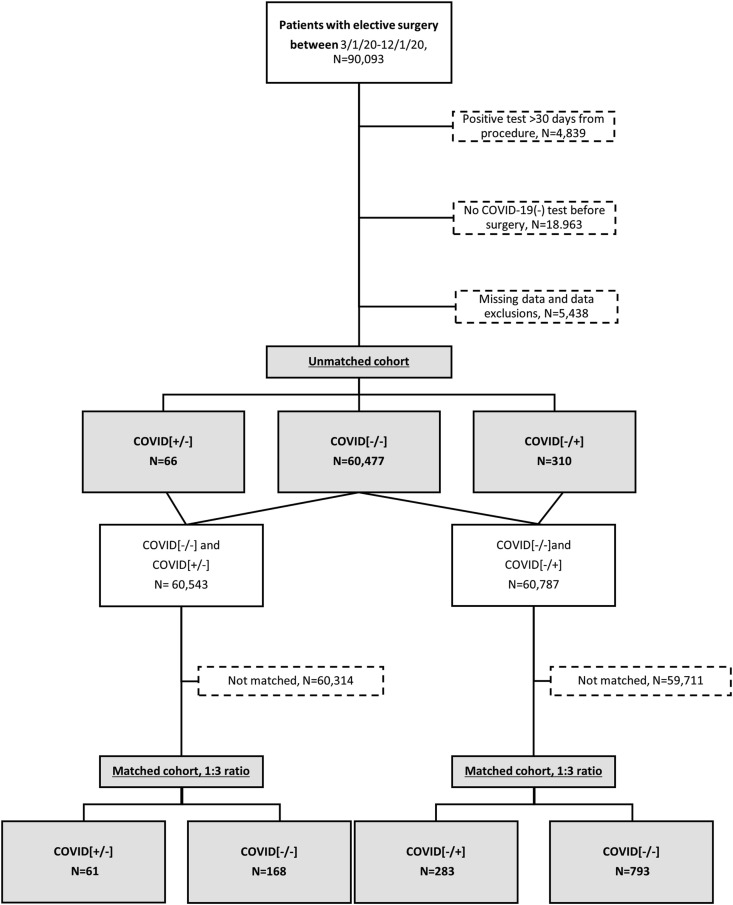
This prospective multicenter study included all patients undergoing elective surgery at 170 Veterans Health Administration (VA) hospitals across the United States. Patients were divided into groups based on first positive COVID-19 test within 30 days after surgery (COVID[-/+]), before surgery (COVID[+/-]) or negative throughout (COVID[-/-]). The cumulative incidence, risk factors for and complications of COVID[-/+], were estimated using univariate analysis, exact matching, and multivariable regression.
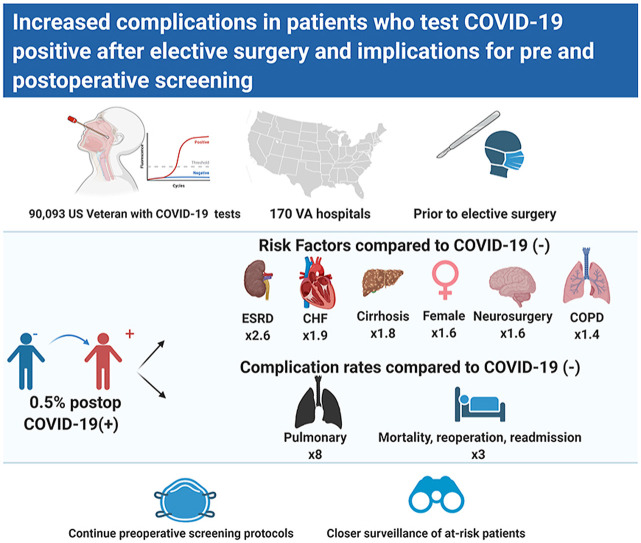
Between March 1 and December 1, 2020 90,093 patients underwent elective surgery. Of these, 60,853 met inclusion criteria, of which 310 (0.5%) were in the COVID[-/+] group. Adjusted multivariable logistic regression identified female sex, end stage renal disease, chronic obstructive pulmonary disease, congestive heart failure, cancer, cirrhosis, and undergoing neurosurgical procedures as risk factors for being in the COVID[-/+] group. After matching on current procedural terminology code and month of procedure, multivariable Poisson regression estimated the complication rate ratio for the COVID[-/+] group vs. COVID[-/-] to be 8.4 (C.I. 4.9-14.4) for pulmonary complications, 3.0 (2.2, 4.1) for major complications, and 2.6 (1.9, 3.4) for any complication.
Despite preoperative COVID-19 screening, there remains a risk of COVID infection within 30 days after elective surgery. This risk is increased for patients with a high comorbidity burden and those undergoing neurosurgical procedures. Higher intensity preoperative screening and closer postoperative monitoring is warranted in such patients because they have a significantly elevated risk of postoperative complications.
COVID-19 大流行促使人们采用各种方案,以尽量降低与 SARS-CoV-2 感染相关的围手术期并发症风险。这通常包括术前症状筛查和鼻拭子 RT-PCR 检测病毒 RNA。对于 COVID-19 检测阴性的无症状患者,可安排手术。然而,对于择期手术患者术后 COVID-19 阳性率、该人群的危险因素以及并发症发生率,我们知之甚少。
本前瞻性多中心研究纳入了美国 170 家退伍军人事务部(VA)医院所有接受择期手术的患者。根据术后 30 天内首次 COVID-19 检测结果(COVID[+/–])、术前(COVID[+/-])或全程阴性(COVID[-/-])将患者分为不同组。采用单变量分析、精确匹配和多变量回归估计 COVID[+/–]的累积发生率、危险因素和并发症。
2020 年 3 月 1 日至 12 月 1 日,共有 90093 例患者接受择期手术。其中,60853 例符合纳入标准,310 例(0.5%)为 COVID[+/–]组。调整后的多变量逻辑回归分析发现,女性、终末期肾病、慢性阻塞性肺疾病、充血性心力衰竭、癌症、肝硬化和神经外科手术是 COVID[+/–]组的危险因素。在按当前程序术语代码和手术月份进行匹配后,多变量泊松回归估计 COVID[+/–]组与 COVID[-/-]组相比,肺部并发症的并发症发生率比为 8.4(95%CI:4.9-14.4),主要并发症为 3.0(2.2-4.1),任何并发症为 2.6(1.9-3.4)。
尽管进行了术前 COVID-19 筛查,但择期手术后 30 天内仍有 COVID 感染的风险。对于合并症负担高的患者和接受神经外科手术的患者,这种风险会增加。对于这些患者,需要进行更强化的术前筛查和更密切的术后监测,因为他们术后并发症风险显著增加。