Department of Cardiology and Internal Intensive Care Medicine, Asklepios Hospital St. Georg, Faculty of Medicine, Semmelweis University Campus Hamburg, Hamburg, Germany.
University Heart Center Hamburg Eppendorf, Hamburg, Germany.
Europace. 2021 Oct 9;23(10):1548-1558. doi: 10.1093/europace/euab122.
Weight management seems to be beneficial for obese atrial fibrillation (AF) patients; however, randomized data are sparse. Thus, this study aimed to investigate the influence of weight reduction on AF ablation outcomes.
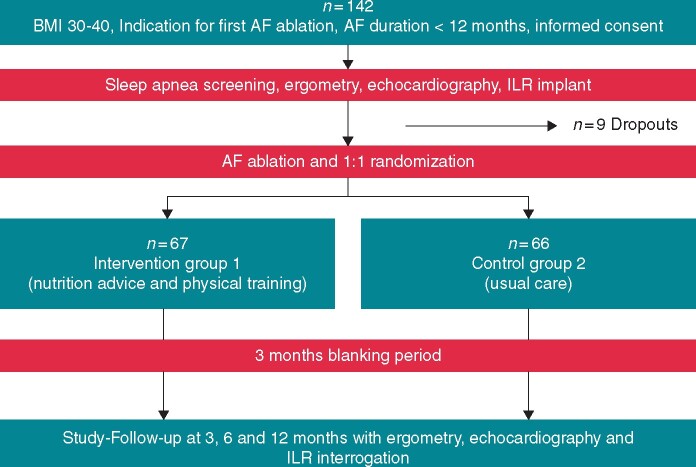
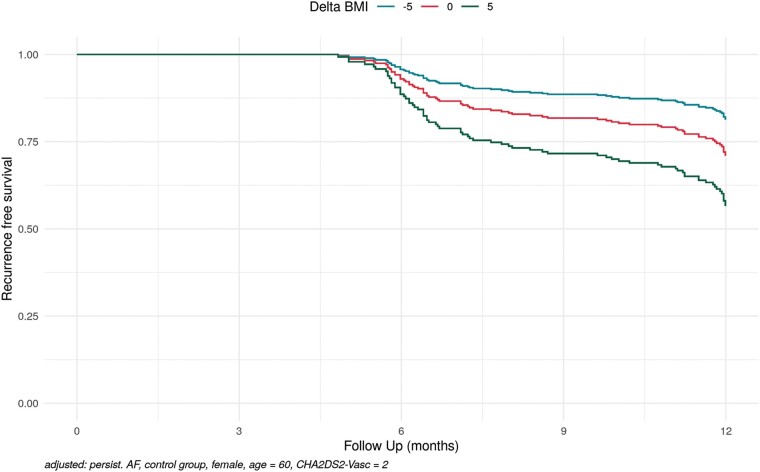
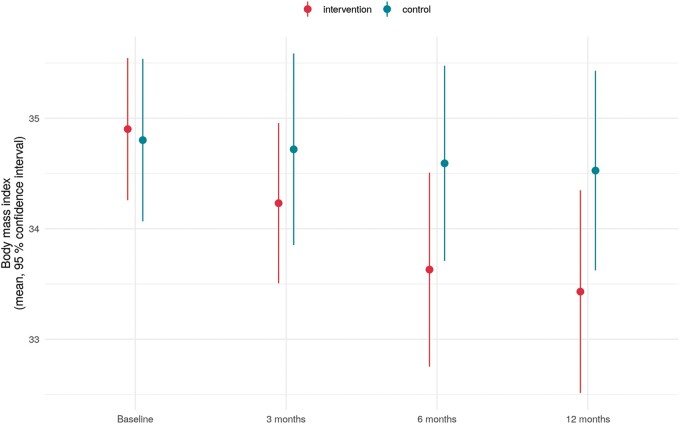
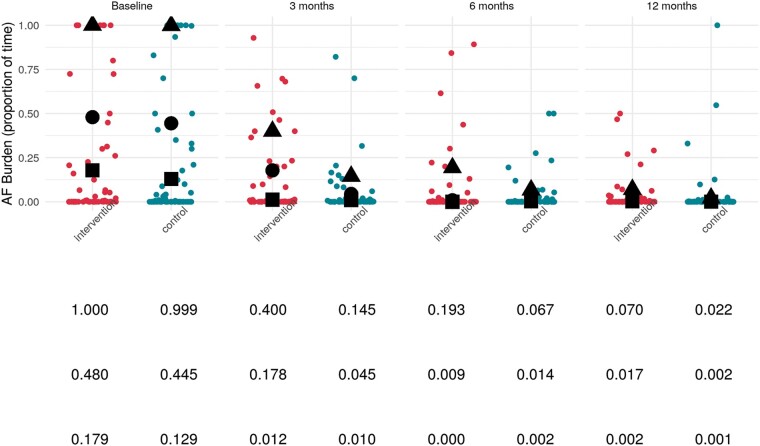
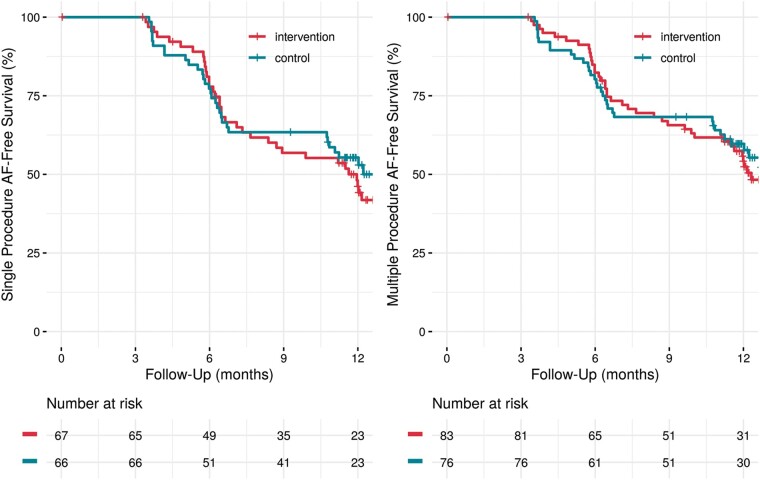
SORT-AF is an investigator-sponsored, prospective, randomized, multicentre, and clinical trial. Patients with symptomatic AF (paroxysmal or persistent) and body mass index (BMI) 30-40 kg/m2 underwent AF ablation and were randomized to either weight-reduction (group 1) or usual care (group 2), after sleep-apnoea-screening and loop recorder (ILR) implantation. The primary endpoint was defined as AF burden between 3 and 12 months after AF ablation. Overall, 133 patients (60 ± 10 years, 57% persistent AF) were randomized to group 1 (n = 67) and group 2 (n = 66), respectively. Complications after AF-ablation were rare (one stroke and no tamponade). The intervention led to a significant reduction of BMI (34.9 ± 2.6-33.4 ± 3.6) in group 1 compared to a stable BMI in group 2 (P < 0.001). Atrial fibrillation burden after ablation decreased significantly (P < 0.001), with no significant difference regarding the primary endpoint between the groups (P = 0.815, odds ratio: 1.143, confidence interval: 0.369-3.613). Further analyses showed a significant correlation between BMI and AF recurrence for patients with persistent AF compared with paroxysmal AF patients (P = 0.032).
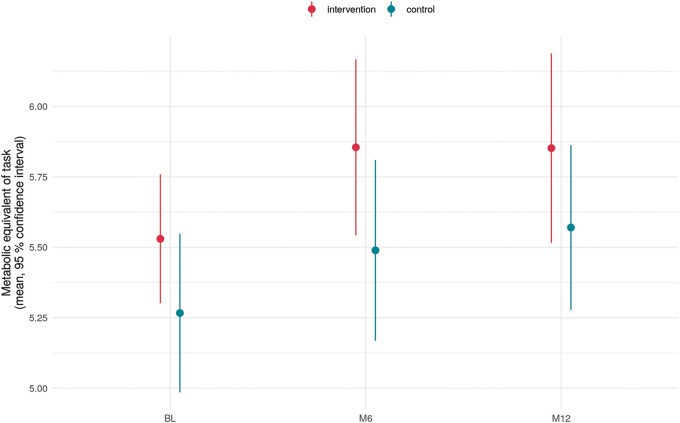
The SORT-AF study shows that AF ablation is safe and successful in obese patients using continuous monitoring via ILR. Although the primary endpoint of AF burden after ablation did not differ between the two groups, the effects of weight loss and improvement of exercise activity were beneficial for obese patients with persistent AF demonstrating the relevance of life-style management as an important adjunct to AF ablation in this setting.
NCT02064114.
体重管理似乎对肥胖的心房颤动(AF)患者有益,但是随机数据很少。因此,本研究旨在探讨减轻体重对 AF 消融治疗结果的影响。
SORT-AF 是一项由研究者发起的、前瞻性的、随机的、多中心的临床试验。患有症状性 AF(阵发性或持续性)和身体质量指数(BMI)30-40kg/m2 的患者接受了 AF 消融治疗,并在睡眠呼吸暂停筛查和环路记录仪(ILR)植入后被随机分为减重组(第 1 组)或常规治疗组(第 2 组)。主要终点定义为 AF 消融后 3-12 个月的 AF 负担。共有 133 例患者(60±10 岁,57%为持续性 AF)被随机分配至第 1 组(n=67)和第 2 组(n=66)。AF 消融后并发症罕见(1 例中风,无心脏压塞)。干预措施使第 1 组的 BMI 显著降低(34.9±2.6-33.4±3.6),而第 2 组 BMI 稳定(P<0.001)。消融后 AF 负担显著降低(P<0.001),两组之间主要终点无显著差异(P=0.815,比值比:1.143,置信区间:0.369-3.613)。进一步分析显示,与阵发性 AF 患者相比,持续性 AF 患者的 BMI 与 AF 复发之间存在显著相关性(P=0.032)。
SORT-AF 研究表明,使用 ILR 连续监测,肥胖患者的 AF 消融治疗是安全且有效的。尽管消融后 AF 负担的主要终点在两组之间没有差异,但体重减轻和运动能力改善的效果对持续性肥胖 AF 患者有益,这表明生活方式管理作为 AF 消融治疗的重要辅助手段在这种情况下具有相关性。
NCT02064114。