Department of Epidemiology, Lazio Regional Health Service, Rome, Italy.
Department of Health Information Systems, Lazio Regional Health Service, Rome, Italy.
Eur J Neurol. 2021 Oct;28(10):3403-3410. doi: 10.1111/ene.14879. Epub 2021 May 14.
Multiple sclerosis (MS) is a complex chronic, autoimmune inflammatory disease involving multidisciplinary assessments and interventions. Access to outpatient specialist and home healthcare services was explored during the pandemic outbreak and the lockdown amongst MS patients in the Lazio region. Adherence to disease-modifying therapies (DMTs) is also described.
A population-based study was conducted using regional healthcare administrative databases. A validated algorithm was used to identify MS cases over the period 2011-2018. The numbers of specialist and home-based services were compared between 2019 and 2020. The medication possession ratio was used to measure adherence to DMTs.
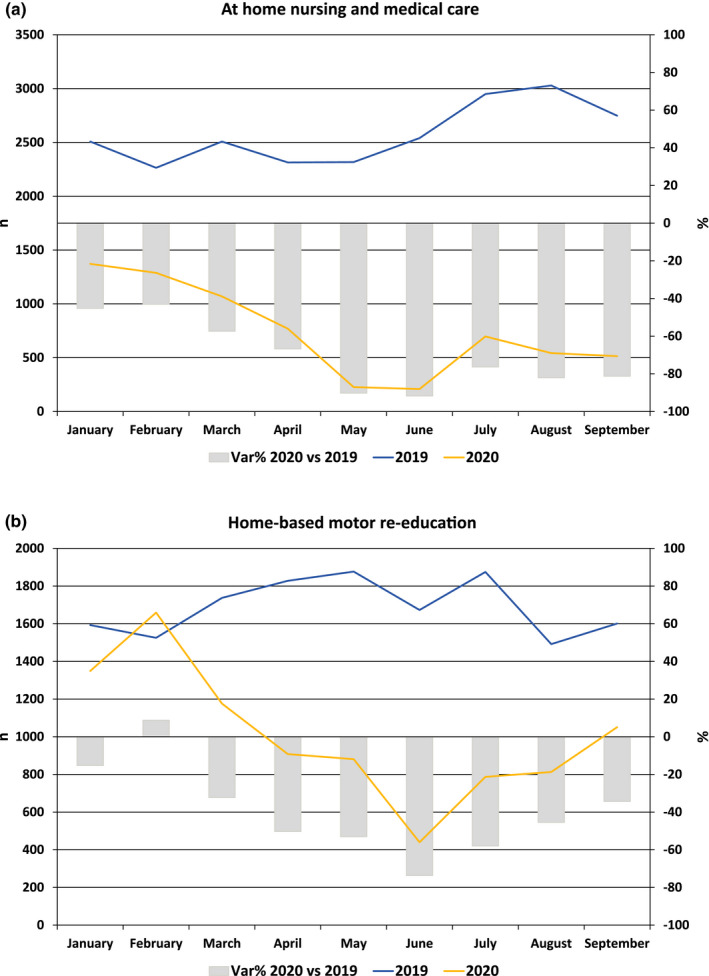
A total of 9380 MS patients were identified (68% women). A decline in the number of outpatient care services between March and June 2020 compared to the previous year was observed, in particular for rehabilitation (-82%), magnetic resonance imaging (-56%) and neurological specialist services (-91%). Important year-to-year variations were observed in May and June 2020 in home-based nursing and medical care (-91%) and motor re-education services (-74%). Adherence to DMTs was higher in the first 4 months of 2019 compared to the same period of 2020 (67.1% vs. 57.0%).
A notable disruption of rehabilitative therapy and home-based services as well as in DMT adherence was observed. Since the pandemic is still ongoing and interruption of healthcare services could have a major impact on MS patients, it is necessary to monitor access of MS patients to healthcare resources in order to ensure adequate treatments, including rehabilitative therapies.
多发性硬化症(MS)是一种复杂的慢性自身免疫性炎症性疾病,涉及多学科评估和干预。在大流行爆发期间和封锁期间,探讨了 MS 患者获得门诊专科和家庭保健服务的机会,并描述了他们对疾病修正治疗(DMT)的依从性。
本研究采用区域医疗保健管理数据库进行了一项基于人群的研究。使用验证后的算法在 2011-2018 年期间确定 MS 病例。比较了 2019 年和 2020 年专科和家庭服务的数量。采用药物持有率来衡量 DMT 的依从性。
共确定了 9380 例 MS 患者(68%为女性)。与前一年相比,2020 年 3 月至 6 月期间门诊护理服务数量下降,特别是康复治疗(-82%)、磁共振成像(-56%)和神经科专科服务(-91%)。2020 年 5 月和 6 月,家庭护理和医疗(-91%)以及运动再教育服务(-74%)的年变化较大。与 2020 年同期相比,2019 年的前 4 个月 DMT 依从性更高(67.1% vs. 57.0%)。
我们观察到康复治疗和家庭服务以及 DMT 依从性明显中断。由于大流行仍在继续,中断医疗服务可能对 MS 患者产生重大影响,因此有必要监测 MS 患者获得医疗资源的机会,以确保他们获得足够的治疗,包括康复治疗。