Pelle Elvira, Zaccarin Susanna, Furfaro Emanuela, Rivellini Giulia
Department of Communication and Economics, University of Modena and Reggio Emilia, Viale Allegri, 9, Reggio Emilia, Italy.
Department of Economics, Business, Mathematics and Statistics, University of Trieste, Trieste, Italy.
Stat Methods Appt. 2022;31(1):133-158. doi: 10.1007/s10260-021-00565-7. Epub 2021 Apr 20.
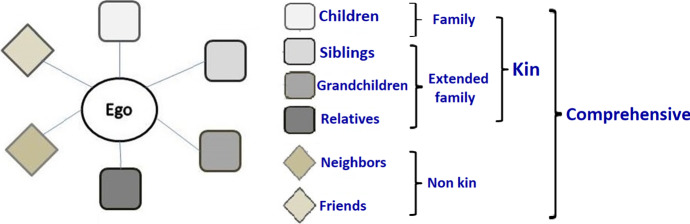
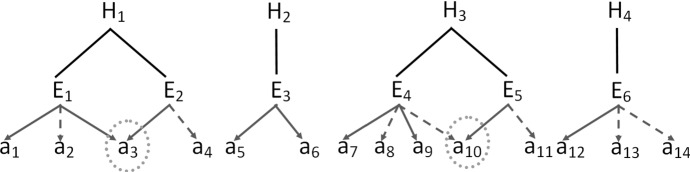
Providing support outside the household can be considered an actual sign of an active social life for the elderly. Adopting an ego-network perspective, we study support Italian elders provide to kin or non-kin. More specifically, using Italian survey data, we build the ego-centered networks of social contacts elders entertain and the ego-networks of support elders provide to other non-cohabitant kin or non-kin. Since ego-network data are inherently multilevel, we use Bayesian multilevel models to analyze variation in support ties, controlling for the characteristics of elders and their contacts. This modeling strategy enables dealing with sparseness and alter-alter overlap in the ego support network data and to disentangle the effects related to the ego (the elder), the dyad ego-alter, the kind of support provided, as well as social contacts and contextual variables. The results suggest that the elderly in Italy who provide support outside their household - compared to all elders in the sample - are younger, healthier, more educated, and embedded in a more diversified ego-network of social contacts. The latter also conveys both the type and the recipient of the support, with the elderly who entertain few relationships with kin being more prone to provide aid to non-kin. Further, a "peer homophily" effect in directing elder support to a non-kin is also found.
为家庭之外的人提供支持可以被视为老年人积极社交生活的一种实际表现。从自我中心网络的角度出发,我们研究了意大利老年人向亲属或非亲属提供的支持。更具体地说,利用意大利的调查数据,我们构建了老年人所拥有的以自我为中心的社交联系网络,以及老年人向其他非同居亲属或非亲属提供支持的自我中心网络。由于自我中心网络数据本质上是多层次的,我们使用贝叶斯多层次模型来分析支持关系的变化,同时控制老年人及其社交联系的特征。这种建模策略能够处理自我支持网络数据中的稀疏性和关系重叠问题,并厘清与自我(老年人)、自我与他人的二元关系、所提供支持的类型以及社交联系和背景变量相关的影响。结果表明,与样本中的所有老年人相比,在家庭之外提供支持的意大利老年人更年轻、更健康、受教育程度更高,并且融入了一个更加多样化的以自我为中心的社交联系网络。后者还传达了支持的类型和接受者,与亲属关系较少的老年人更倾向于向非亲属提供帮助。此外,还发现了一种在将老年人的支持导向非亲属方面的“同质性效应”。