Brych Mareike, Murali Supriya, Händel Barbara
Department of Psychology III, University of Würzburg, Würzburg, Germany.
Front Psychol. 2021 Apr 8;12:647256. doi: 10.3389/fpsyg.2021.647256. eCollection 2021.
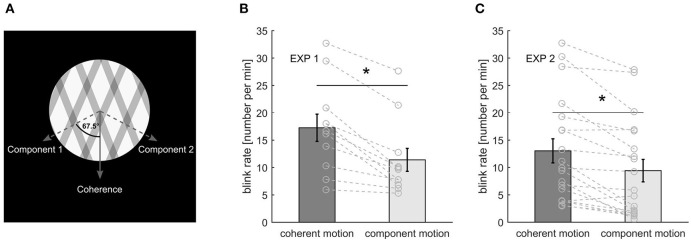
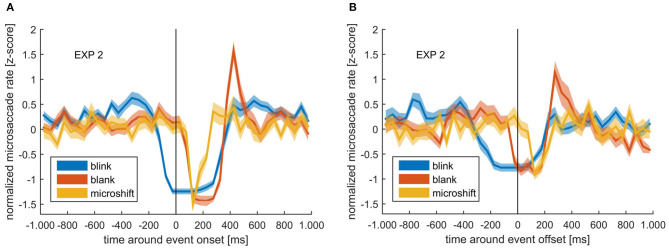
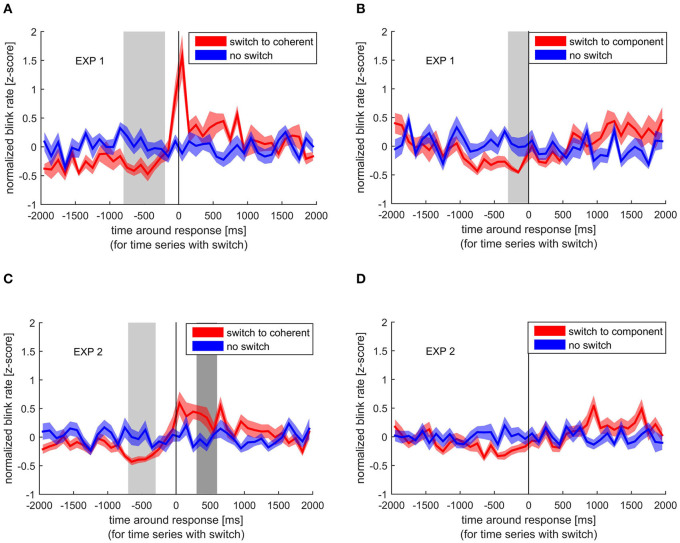
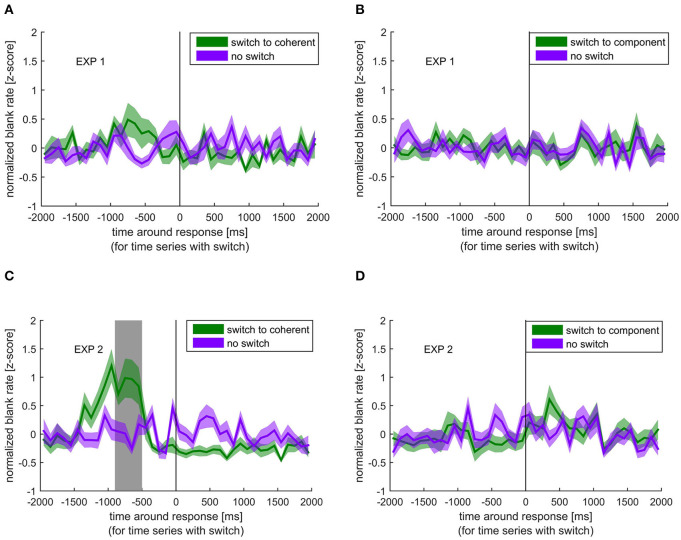
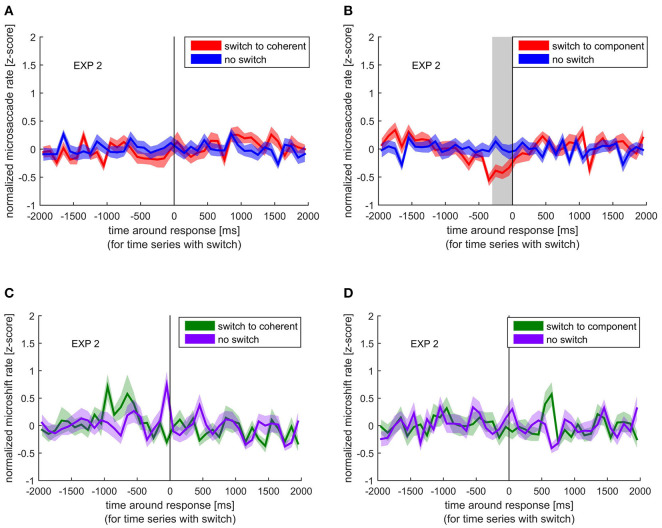
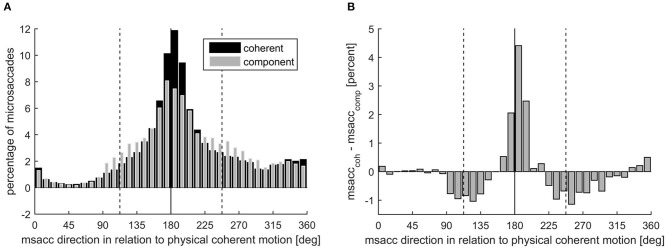
Eye-related movements such as blinks and microsaccades are modulated during bistable perceptual tasks. However, if they play an active role during internal perceptual switches is not known. We conducted two experiments involving an ambiguous plaid stimulus, wherein participants were asked to continuously report their percept, which could consist of either unidirectional coherent or bidirectional component movement. Our main results show that blinks and microsaccades did not facilitate perceptual switches. On the contrary, a reduction in eye movements preceded the perceptual switch. Blanks, on the other hand, thought to mimic the retinal consequences of a blink, consistently led to a switch. Through the timing of the blank-introduced perceptual change, we were able to estimate the delay between the internal switch and the response. This delay further allowed us to evaluate that the reduction in blink probability co-occurred with the internal perceptual switch. Additionally, our results indicate that distinct internal processes underlie the switch to coherent vs. component percept. Blanks exclusively facilitated a switch to the coherent percept, and only the switch to coherent percept was followed by an increase in blink rate. In a second study, we largely replicated the findings and included a microsaccade analysis. Microsaccades only showed a weak relation with perceptual switches, but their direction was correlated with the perceived motion direction. Nevertheless, our data suggests an interaction between microsaccades and blinks by showing that microsaccades were differently modulated around blinks compared with blanks. This study shows that a reduction in eye movements precedes internal perceptual switches indicating that the rate of blinks can set the stage for a reinterpretation of sensory input. While a perceptual switch based on changed sensory input usually leads to an increase in blink rate, such an increase was only present after the perceptual switch to coherent motion but absent after the switch to component percept. This provides evidence of different underlying mechanism or internal consequence of the two perceptual switches and suggests that blinks can uncover differences in internal percept-related processes that are not evident from the percept itself.
在双稳态感知任务中,诸如眨眼和微扫视等与眼睛相关的运动受到调节。然而,它们在内部感知转换过程中是否发挥积极作用尚不清楚。我们进行了两项涉及模糊格子刺激的实验,参与者被要求持续报告他们的感知,感知可能包括单向连贯或双向成分运动。我们的主要结果表明,眨眼和微扫视并没有促进感知转换。相反,在感知转换之前眼睛运动减少。另一方面,被认为模拟眨眼视网膜后果的空白刺激,始终会导致感知转换。通过空白刺激引起的感知变化的时间,我们能够估计内部转换与反应之间的延迟。这种延迟进一步使我们能够评估眨眼概率的降低与内部感知转换同时发生。此外,我们的结果表明,转换到连贯感知与成分感知背后存在不同的内部过程。空白刺激专门促进了向连贯感知的转换,并且只有转换到连贯感知后眨眼频率才会增加。在第二项研究中,我们在很大程度上重复了这些发现,并进行了微扫视分析。微扫视仅与感知转换呈现出微弱的关系,但其方向与感知到的运动方向相关。尽管如此,我们的数据通过表明与空白刺激相比,微扫视在眨眼周围受到不同的调节,提示了微扫视与眨眼之间的相互作用。这项研究表明,在内部感知转换之前眼睛运动减少,这表明眨眼频率可以为重新解释感觉输入奠定基础。虽然基于感觉输入变化的感知转换通常会导致眨眼频率增加,但这种增加仅在感知转换到连贯运动后出现,而在转换到成分感知后则不存在。这为两种感知转换的不同潜在机制或内部结果提供了证据,并表明眨眼可以揭示从感知本身不明显的与内部感知相关过程的差异。