Division of Psychology, School of Humanities and Social Sciences, Nanyang Technological University, 14 Nanyang Drive, Singapore 637332, Singapore; Department of Psychology, University of California, Berkeley, Berkeley, CA 94720, USA.
Laboratoire Psychologie de la Perception, Université Paris Descartes, 45 Rue des Saints-Pères, 75006 Paris, France.
Curr Biol. 2017 Feb 6;27(3):445-450. doi: 10.1016/j.cub.2016.12.029. Epub 2017 Jan 19.
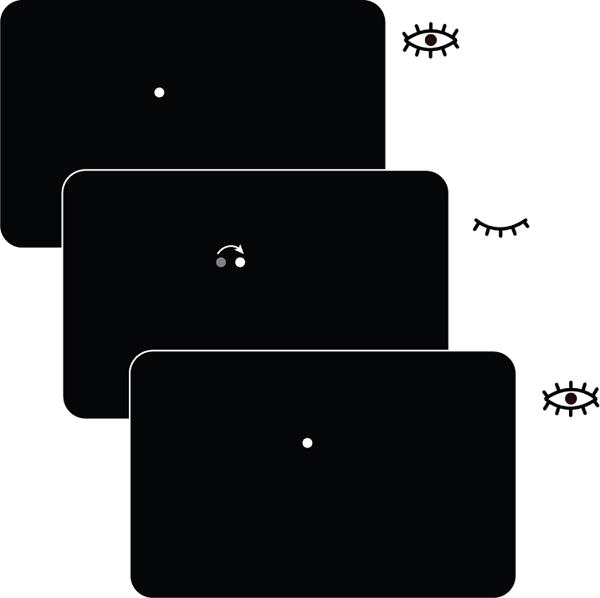
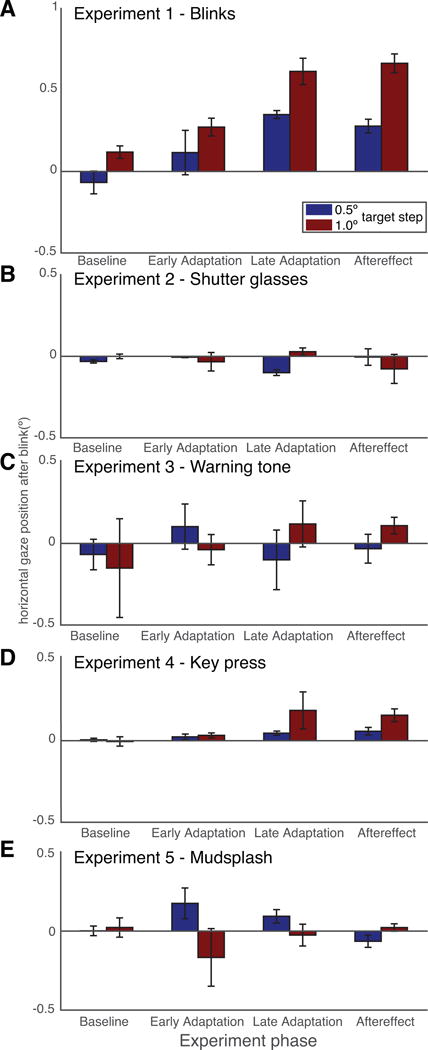
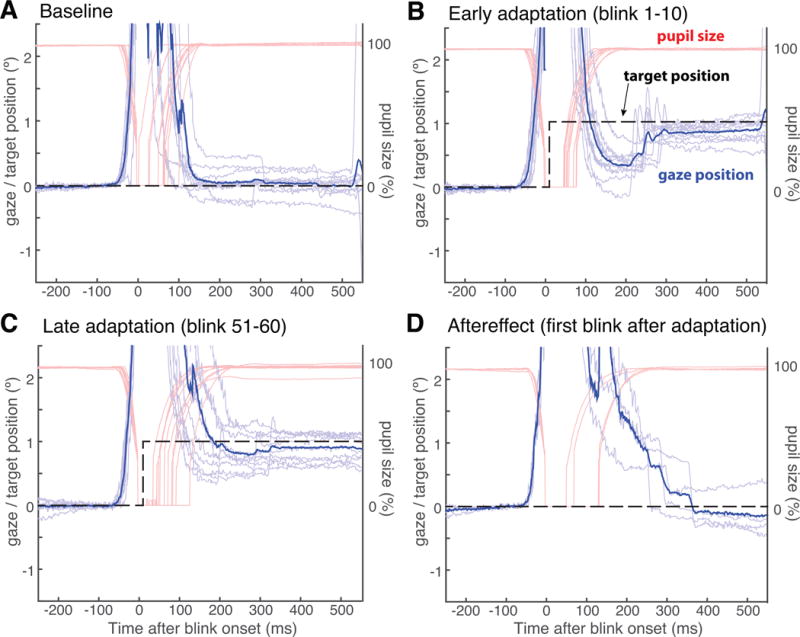
Eye blinks cause disruptions to visual input and are accompanied by rotations of the eyeball [1]. Like every motor action, these eye movements are subject to noise and introduce instabilities in gaze direction across blinks [2]. Accumulating errors across repeated blinks would be debilitating for visual performance. Here, we show that the oculomotor system constantly recalibrates gaze direction during blinks to counteract gaze instability. Observers were instructed to fixate a visual target while gaze direction was recorded and blinks were detected in real time. With every spontaneous blink-while eyelids were closed-the target was displaced laterally by 0.5° (or 1.0°). Most observers reported being unaware of displacements during blinks. After adapting for ∼35 blinks, gaze positions after blinks showed significant biases toward the new target position. Automatic eye movements accompanied each blink, and an aftereffect persisted for a few blinks after target displacements were eliminated. No adaptive gaze shift occurred when blinks were simulated with shutter glasses at random time points or actively triggered by observers, or when target displacements were masked by a distracting stimulus. Visual signals during blinks are suppressed by inhibitory mechanisms [3-6], so that small changes across blinks are generally not noticed [7, 8]. Additionally, target displacements during blinks can trigger automatic gaze recalibration, similar to the well-known saccadic adaptation effect [9-11]. This novel mechanism might be specific to the maintenance of gaze direction across blinks or might depend on a more general oculomotor recalibration mechanism adapting gaze position during intrinsically generated disruptions to visual input.
眨眼会导致视觉输入中断,并伴随着眼球转动[1]。与每一个运动动作一样,这些眼球运动受到噪声的影响,会导致眨眼过程中注视方向不稳定[2]。如果在多次眨眼过程中不断积累误差,将会对视觉表现产生不利影响。在这里,我们表明,在眨眼过程中,眼球运动系统会不断重新校准注视方向,以抵消注视不稳定。实验中,要求观察者在注视一个视觉目标的同时记录眼球运动,并实时检测眨眼。在每次自然眨眼时(即眼皮闭合期间),目标会向侧面移动 0.5°(或 1.0°)。大多数观察者报告说,在眨眼过程中没有察觉到目标的位移。经过约 35 次眨眼的适应后,眨眼后的注视位置明显偏向新目标位置。每次眨眼都会伴随自动眼球运动,并且在消除目标位移后,这种后效会持续几个眨眼。当使用快门眼镜在随机时间点模拟眨眼或由观察者主动触发眨眼,或者当目标位移被分心刺激物掩蔽时,不会发生自适应的注视转移。眨眼过程中的视觉信号受到抑制机制的抑制[3-6],因此通常不会注意到眨眼过程中的微小变化[7,8]。此外,眨眼过程中的目标位移可以触发自动眼球重新校准,类似于众所周知的扫视适应效应[9-11]。这种新的机制可能特定于眨眼过程中保持注视方向,或者可能依赖于更一般的眼球运动重新校准机制,该机制在视觉输入固有中断时自适应地调整注视位置。