Hakiki Bahia, Paperini Anita, Castagnoli Chiara, Hochleitner Ines, Verdesca Sonia, Grippo Antonello, Scarpino Maenia, Maiorelli Antonio, Mosca Irene Eleonora, Gemignani Paola, Borsotti Marco, Gabrielli Maria Assunta, Salvadori Emilia, Poggesi Anna, Lucidi Giulia, Falsini Catiuscia, Gentilini Monica, Martini Monica, Luisi Maria Luisa Eliana, Biffi Barbara, Mainardi Paolo, Barretta Teresa, Pancani Silvia, Mannini Andrea, Campagnini Silvia, Bagnoli Silvia, Ingannato Assunta, Nacmias Benedetta, Macchi Claudio, Carrozza Maria Chiara, Cecchi Francesca
IRCCS Fondazione Don Carlo Gnocchi, Florence, Italy.
NEUROFARBA Department, Neuroscience Section, University of Florence, Florence, Italy.
Front Neurol. 2021 Apr 8;12:632672. doi: 10.3389/fneur.2021.632672. eCollection 2021.
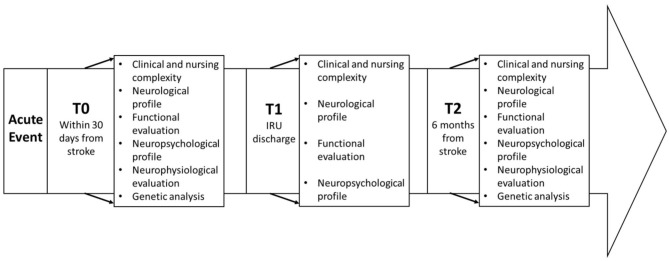
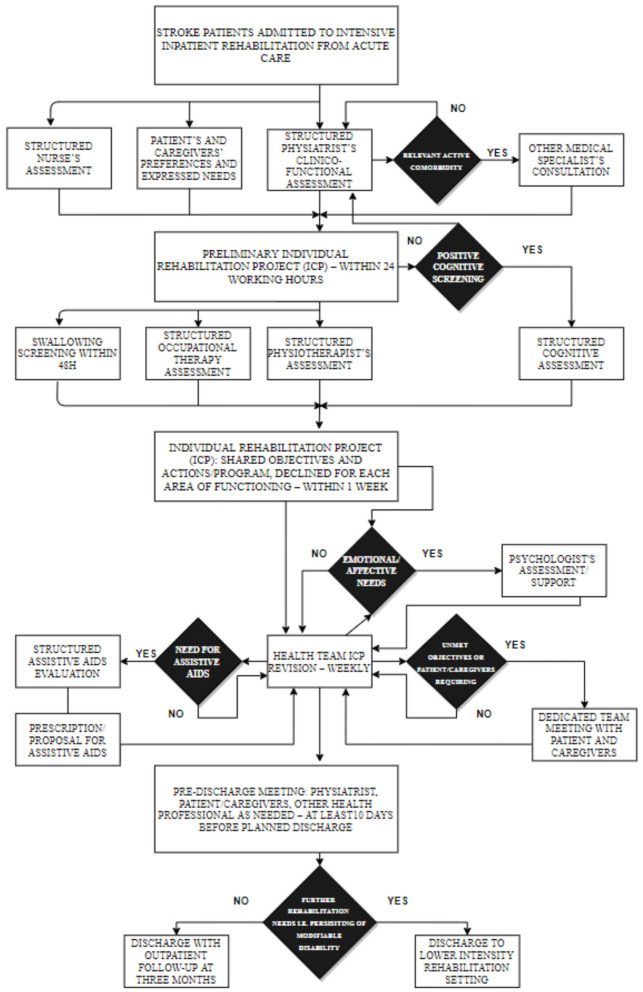
The complex nature of stroke sequelae, the heterogeneity in rehabilitation pathways, and the lack of validated prediction models of rehabilitation outcomes challenge stroke rehabilitation quality assessment and clinical research. An integrated care pathway (ICP), defining a reproducible rehabilitation assessment and process, may provide a structured frame within investigated outcomes and individual predictors of response to treatment, including neurophysiological and neurogenetic biomarkers. Predictors may differ for different interventions, suggesting clues to personalize and optimize rehabilitation. To date, a large representative Italian cohort study focusing on individual variability of response to an evidence-based ICP is lacking, and predictors of individual response to rehabilitation are largely unexplored. This paper describes a multicenter study protocol to prospectively investigate outcomes and predictors of response to an evidence-based ICP in a large Italian cohort of stroke survivors undergoing post-acute inpatient rehabilitation. All patients with diagnosis of ischemic or hemorrhagic stroke confirmed both by clinical and brain imaging evaluation, admitted to four intensive rehabilitation units (adopting the same stroke rehabilitation ICP) within 30 days from the acute event, aged 18+, and providing informed consent will be enrolled (expected sample: 270 patients). Measures will be taken at admission (T0), at discharge (T1), and at follow-up 6 months after a stroke (T2), including clinical data, nutritional, functional, neurological, and neuropsychological measures, electroencephalography and motor evoked potentials, and analysis of neurogenetic biomarkers. In addition to classical multivariate logistic regression analysis, advanced machine learning algorithms will be cross-validated to achieve data-driven prognosis prediction models. By identifying data-driven prognosis prediction models in stroke rehabilitation, this study might contribute to the development of patient-oriented therapy and to optimize rehabilitation outcomes. ClinicalTrials.gov, NCT03968627. https://www.clinicaltrials.gov/ct2/show/NCT03968627?term=Cecchi&cond=Stroke&draw=2&rank=2.
中风后遗症的复杂性、康复途径的异质性以及缺乏经过验证的康复结果预测模型,对中风康复质量评估和临床研究构成了挑战。综合护理途径(ICP)定义了可重复的康复评估和流程,可能会在研究结果以及对治疗反应的个体预测因素(包括神经生理学和神经遗传学生物标志物)方面提供一个结构化框架。不同干预措施的预测因素可能不同,这为个性化和优化康复提供了线索。迄今为止,缺乏一项针对基于循证ICP的个体反应变异性的大型意大利代表性队列研究,对康复个体反应的预测因素也基本未被探索。本文描述了一项多中心研究方案,旨在对意大利一大群接受急性后期住院康复治疗的中风幸存者中,基于循证ICP的反应结果和预测因素进行前瞻性研究。所有经临床和脑成像评估确诊为缺血性或出血性中风、在急性事件发生后30天内入住四个强化康复单元(采用相同的中风康复ICP)、年龄在18岁以上并提供知情同意书的患者将被纳入研究(预期样本:270名患者)。将在入院时(T0)、出院时(T1)以及中风后6个月随访时(T2)进行测量,包括临床数据、营养、功能、神经学和神经心理学测量、脑电图和运动诱发电位,以及神经遗传学生物标志物分析。除了经典的多变量逻辑回归分析外,还将对先进的机器学习算法进行交叉验证,以实现数据驱动的预后预测模型。通过确定中风康复中数据驱动的预后预测模型,本研究可能有助于开发以患者为导向的治疗方法并优化康复结果。ClinicalTrials.gov,NCT03968627。https://www.clinicaltrials.gov/ct2/show/NCT03968627?term=Cecchi&cond=Stroke&draw=2&rank=2