Institute of Molecular Biology and Pathology, National Research Council of Italy (CNR), Rome, Italy.
Department of Medical and Surgical Sciences for Children and Adults, University of Modena and Reggio Emilia, Modena, Italy.
Front Immunol. 2021 Apr 9;12:653974. doi: 10.3389/fimmu.2021.653974. eCollection 2021.
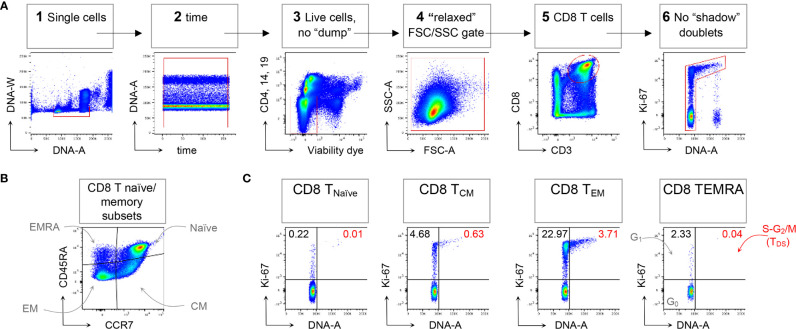
This study discusses substantive advances in T cell proliferation analysis, with the aim to provoke a re-evaluation of the generally-held view that Ki-67 is a reliable proliferation marker , and to offer a more sensitive and effective method for T cell cycle analysis, with informative examples in mouse and human settings. We summarize recent experimental work from our labs showing that, by Ki-67/DNA dual staining and refined flow cytometric methods, we were able to identify T cells in the S-G/M phases of the cell-cycle in the peripheral blood (collectively termed "T Double S" for T cells in S-phase : in short "T" cells). Without our refinement, such cells may be excluded from conventional lymphocyte analyses. Specifically, we analyzed clonal expansion of antigen-specific CD8 T cells in vaccinated mice, and demonstrated the potential of T cells to reflect immune dynamics in human blood samples from healthy donors, and patients with type 1 diabetes, infectious mononucleosis, and COVID-19. The Ki-67/DNA dual staining, or T assay, provides a reliable approach by which human peripheral blood can be used to reflect the dynamics of human lymphocytes, rather than providing mere steady-state phenotypic snapshots. The method does not require highly sophisticated "-omics" capabilities, so it should be widely-applicable to health care in diverse settings. Furthermore, our results argue that the T assay can provide a window on immune dynamics in extra-lymphoid tissues, a long-sought potential of peripheral blood monitoring, for example in relation to organ-specific autoimmune diseases and infections, and cancer immunotherapy.
本研究探讨了 T 细胞增殖分析的实质性进展,旨在重新评估普遍认为 Ki-67 是可靠增殖标志物的观点,并提供一种更敏感和有效的 T 细胞周期分析方法,同时提供了在小鼠和人类研究中的实例。我们总结了最近来自我们实验室的实验工作,表明通过 Ki-67/DNA 双重染色和改良的流式细胞术方法,我们能够在外周血中识别处于细胞周期 S-G/M 期的 T 细胞(统称为 S 期的 T 双 S:简称“T”细胞)。如果没有我们的改进,这些细胞可能会从常规淋巴细胞分析中排除。具体来说,我们分析了疫苗接种小鼠中抗原特异性 CD8 T 细胞的克隆扩增,并证明了 T 细胞在健康供体和 1 型糖尿病、传染性单核细胞增多症和 COVID-19 患者的人类血液样本中反映免疫动态的潜力。Ki-67/DNA 双重染色或 T 检测提供了一种可靠的方法,可以使用人类外周血来反映人类淋巴细胞的动态,而不仅仅是提供静止状态的表型快照。该方法不需要高度复杂的“组学”能力,因此应该在不同环境下广泛应用于医疗保健。此外,我们的结果表明,T 检测可以提供一个观察淋巴外组织免疫动态的窗口,这是外周血监测长期以来的一个潜在需求,例如与器官特异性自身免疫疾病和感染以及癌症免疫治疗有关。