Ahmed Saleh, Simmons William Paul, Chowdhury Rashed, Huq Saleemul
School of Public Service, Boise State University, Boise, ID 83725 USA.
Gender and Women's Studies, University of Arizona, Tucson, AZ 85721 USA.
Sustain Sci. 2021;16(4):1201-1213. doi: 10.1007/s11625-021-00955-6. Epub 2021 Apr 19.
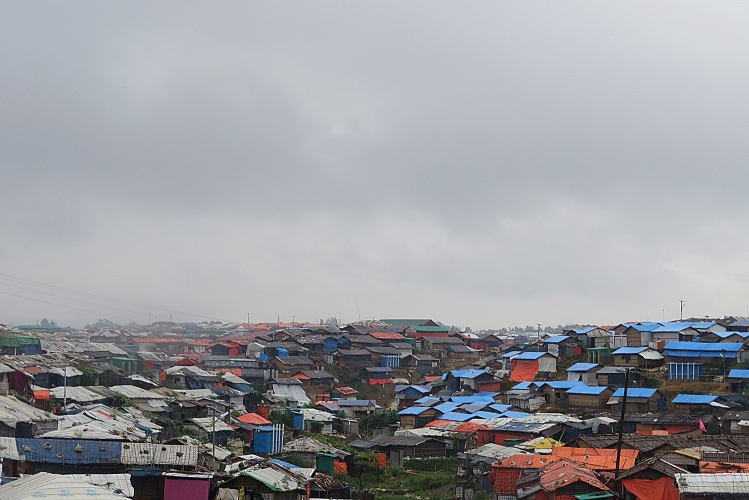
Because of ethnic and cultural violence in Myanmar, approximately a million Rohingya fled to neighboring Bangladesh starting from August 2017, in what the UN has called a "textbook example of ethnic cleansing". Those arriving in Bangladesh were able to escape decade-long ethnic violence in Myanmar, but the Rohingya's immediate destination, Cox's Bazar district is one of the most climate-vulnerable and disaster-prone areas in Bangladesh. Currently, they have been subjected to extreme rainfalls, landslides, and flashfloods. With the COVID-19 pandemic, they continue to face fear and further marginalization in resource-constrained Bangladesh, as well as increased vulnerability due to tropical cyclones, flashfloods, and landslides. The Rohingya in southeast Bangladesh are now at the epicenter of a humanitarian and sustainability crisis. However, their situation is not entirely unique. Millions of displaced, stateless or refugees around the world are facing multi-dimensional crises in various complex geopolitical, and climatic situations. Using the theoretical lens of political ecology and critical development studies, this paper analyzes the sustainability-peace nexus for millions of Rohingya in Myanmar and in Bangladesh. This paper is based on information from various sources, including three ethnographic field visits in recent years, which helped to get local insights into the current sustainability challenges in this humanitarian context. The core arguments of this paper suggest that sustainability-peace nexus will especially be compromised in climate-vulnerable resource-constrained conditions. To overcome this challenge, decolonizing Rohingya solutions would be critical, by engaging the Rohingya in the process of development and meaningful change, which can affect their lives, livelihoods, and wellbeing. Even though this paper has a specific geographical focus, the insights are relevant in parts of the world facing similar social, economic, political, and environmental challenges.
由于缅甸的种族和文化暴力,自2017年8月起,约100万罗兴亚人逃往邻国孟加拉国,联合国称这是“种族清洗的典型案例”。抵达孟加拉国的人得以逃离缅甸长达十年的种族暴力,但罗兴亚人的直接目的地科克斯巴扎尔地区是孟加拉国气候最脆弱、灾害最频发的地区之一。目前,他们遭受了极端降雨、山体滑坡和洪水。随着新冠疫情的爆发,他们在资源匮乏的孟加拉国继续面临恐惧和进一步的边缘化,同时由于热带气旋、洪水和山体滑坡,他们面临的脆弱性也在增加。孟加拉国东南部的罗兴亚人如今处于人道主义和可持续发展危机的中心。然而,他们的情况并非完全独特。世界各地数百万流离失所者、无国籍者或难民在各种复杂的地缘政治和气候形势下面临着多方面的危机。本文运用政治生态学和批判性发展研究的理论视角,分析了缅甸和孟加拉国数百万罗兴亚人的可持续发展与和平的关系。本文基于来自各种来源的信息,包括近年来的三次人种学实地考察,这些考察有助于深入了解当地在这一人道主义背景下当前面临的可持续发展挑战。本文的核心观点表明,在气候脆弱、资源匮乏的条件下,可持续发展与和平的关系将尤其受到损害。为了克服这一挑战,使罗兴亚问题非殖民化至关重要,要让罗兴亚人参与到发展和有意义的变革进程中,这会影响他们的生活、生计和福祉。尽管本文有特定的地理关注点,但这些见解在世界上其他面临类似社会、经济、政治和环境挑战的地区也具有相关性。