Beyene Asmare Mihret, Eshetie Aragaw, Tadesse Yohannes, Getnet Moges Gashaw
Department of Biostatistics, Central Statistical Agency of Ethiopia, Ethiopia.
Departments of Statistics, Collage of Natural and Computational Sciences, University of Gondar, Gondar, Ethiopia.
Ann Med Surg (Lond). 2021 Apr 9;65:102275. doi: 10.1016/j.amsu.2021.102275. eCollection 2021 May.
Cataracts is the major global causes of blindness and a vision-affecting disease of the eye. Cataract surgery is a curative and cost-effective intervention. The number of people who undergo cataract surgery has increased rapidly. Hence, this study was aimed to determine predictors and the time of recovery of cataract patients after cataract surgery by using Simi parametric models of survival analysis.
A retrospective cohort study was conducted from January/01/2015 and January/30/2019. STATA version14.0 statistical software was used for analysis. The Kaplan-Meier survival method and log-rank test curves were applied. Weibull regression was used and adjusted hazard ratio 95% CI with a value of p less than 0.05 was used to identify a significant association.
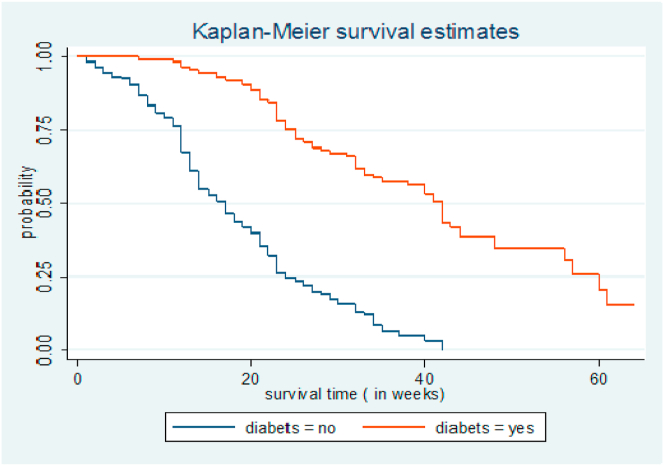
Two hundred twenty three cataract patients were recovered from cataract, 72.6% (95% CI 69.8%-75.9%). The overall median survival time was 23 weeks (IQR = 16 to 35) with (95% CI, 21%-25%). aged between 16 and 30year (AHR = 1.20 CI; 1.07-2.36), age 31 to 45 (AHR = 1.24 CI; 1.08-1.54), urban dwellers (AHR = 1.59; 95% CI, 1.18-2.14), medium visual acuity (AHR = 4.14 CI; 2.57-6.67), high visual acuity (AHR = 5.23 CI; 3.06-8.93), Secondary cataract (AHR = 2.59 CI; 1.01-3.02), traumatic cataract (AHR = 1.75 CI; 1.01-3.02), extra capsular cataract extraction surgery (AHR = 1.43 CI; 1.07-1.94),and diabetes mellitus (AHR = 0.75, CI; 0.41-0.96) were notably associated with time to recovery.
Time to recovery in the study area was slightly higher as compared with the global cut of time. Cataract patients with comorbidity of DM had lower recovery time.
白内障是全球失明的主要原因,也是一种影响视力的眼部疾病。白内障手术是一种具有治愈性且性价比高的干预措施。接受白内障手术的人数迅速增加。因此,本研究旨在通过使用生存分析的半参数模型来确定白内障患者白内障手术后恢复的预测因素和恢复时间。
从2015年1月1日至2019年1月30日进行了一项回顾性队列研究。使用STATA 14.0统计软件进行分析。应用了Kaplan-Meier生存方法和对数秩检验曲线。使用Weibull回归,并使用p值小于0.05的调整后风险比95%置信区间来确定显著关联。
223例白内障患者从白内障中恢复,占72.6%(95%置信区间69.8%-75.9%)。总体中位生存时间为23周(四分位间距=16至35周),(95%置信区间,21%-25%)。年龄在16至30岁之间(调整后风险比=1.20;置信区间1.07-2.36),31至45岁(调整后风险比=1.24;置信区间1.08-1.54),城市居民(调整后风险比=1.59;95%置信区间,1.18-2.14),中度视力(调整后风险比=4.14;置信区间2.57-6.67),高度视力(调整后风险比=5.23;置信区间3.06-8.93),继发性白内障(调整后风险比=2.59;置信区间1.01-3.02),外伤性白内障(调整后风险比=1.75;置信区间1.01-3.02),囊外白内障摘除手术(调整后风险比=1.43;置信区间1.07-1.94),以及糖尿病(调整后风险比=0.75;置信区间0.41-0.96)与恢复时间显著相关。
与全球规定时间相比,研究区域的恢复时间略长。患有糖尿病合并症的白内障患者恢复时间较短。