Ovalle Anaelia, Goldstein Orpaz, Kachuee Mohammad, Wu Elizabeth S C, Hong Chenglin, Holloway Ian W, Sarrafzadeh Majid
Department of Computer Science, University of California Los Angeles, Los Angeles, CA, United States.
Department of Social Welfare, University of California Los Angeles, Los Angeles, CA, United States.
J Med Internet Res. 2021 Apr 26;23(4):e22042. doi: 10.2196/22042.
Social media networks provide an abundance of diverse information that can be leveraged for data-driven applications across various social and physical sciences. One opportunity to utilize such data exists in the public health domain, where data collection is often constrained by organizational funding and limited user adoption. Furthermore, the efficacy of health interventions is often based on self-reported data, which are not always reliable. Health-promotion strategies for communities facing multiple vulnerabilities, such as men who have sex with men, can benefit from an automated system that not only determines health behavior risk but also suggests appropriate intervention targets.
This study aims to determine the value of leveraging social media messages to identify health risk behavior for men who have sex with men.
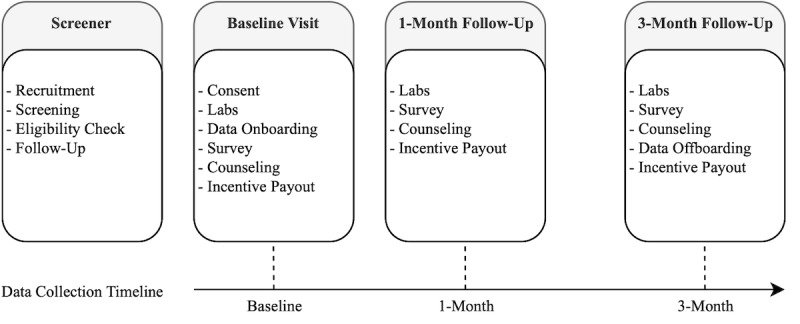
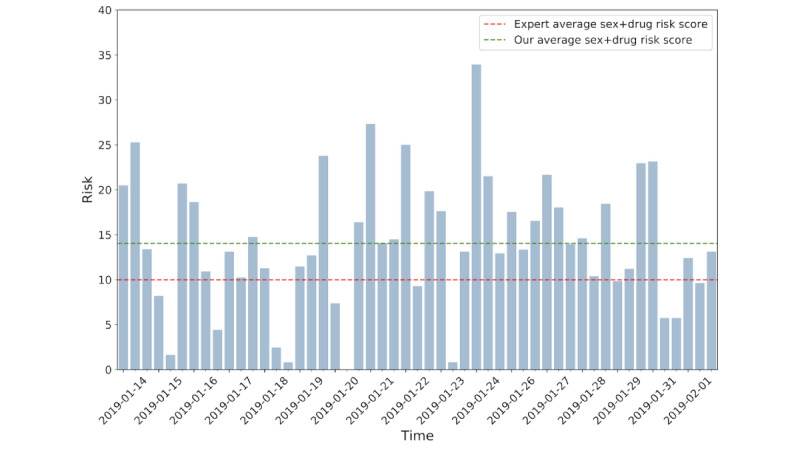
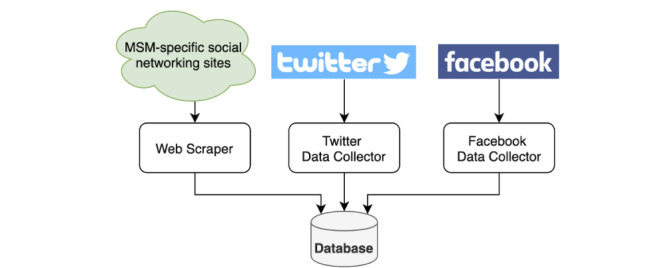
The Gay Social Networking Analysis Program was created as a preliminary framework for intelligent web-based health-promotion intervention. The program consisted of a data collection system that automatically gathered social media data, health questionnaires, and clinical results for sexually transmitted diseases and drug tests across 51 participants over 3 months. Machine learning techniques were utilized to assess the relationship between social media messages and participants' offline sexual health and substance use biological outcomes. The F1 score, a weighted average of precision and recall, was used to evaluate each algorithm. Natural language processing techniques were employed to create health behavior risk scores from participant messages.
Offline HIV, amphetamine, and methamphetamine use were correctly identified using only social media data, with machine learning models obtaining F1 scores of 82.6%, 85.9%, and 85.3%, respectively. Additionally, constructed risk scores were found to be reasonably comparable to risk scores adapted from the Center for Disease Control.
To our knowledge, our study is the first empirical evaluation of a social media-based public health intervention framework for men who have sex with men. We found that social media data were correlated with offline sexual health and substance use, verified through biological testing. The proof of concept and initial results validate that public health interventions can indeed use social media-based systems to successfully determine offline health risk behaviors. The findings demonstrate the promise of deploying a social media-based just-in-time adaptive intervention to target substance use and HIV risk behavior.
社交媒体网络提供了大量多样的信息,可用于各种社会科学和自然科学中以数据为驱动的应用程序。在公共卫生领域存在利用此类数据的机会,该领域的数据收集常常受到组织资金和用户采用率有限的限制。此外,健康干预措施的效果通常基于自我报告的数据,而这些数据并不总是可靠的。针对面临多种脆弱性的社区,如同性恋男性,的健康促进策略可以受益于一个自动化系统,该系统不仅能确定健康行为风险,还能建议适当的干预目标。
本研究旨在确定利用社交媒体信息识别男男性行为者健康风险行为的价值。
创建了同性恋社交网络分析程序,作为基于网络的智能健康促进干预的初步框架。该程序包括一个数据收集系统,该系统在3个月内自动收集了51名参与者的社交媒体数据、健康问卷以及性传播疾病和药物检测的临床结果。利用机器学习技术评估社交媒体信息与参与者线下性健康和物质使用生物学结果之间的关系。F1分数(精确率和召回率的加权平均值)用于评估每种算法。采用自然语言处理技术根据参与者信息创建健康行为风险分数。
仅使用社交媒体数据就能正确识别线下艾滋病毒、苯丙胺和甲基苯丙胺的使用情况,机器学习模型的F1分数分别为82.6%、85.9%和85.3%。此外,发现构建的风险分数与疾病控制中心采用的风险分数具有合理的可比性。
据我们所知,我们的研究是对针对男男性行为者的基于社交媒体的公共卫生干预框架的首次实证评估。我们发现社交媒体数据与线下性健康和物质使用相关,并通过生物学检测得到验证。概念验证和初步结果证实,公共卫生干预确实可以使用基于社交媒体的系统成功确定线下健康风险行为。研究结果表明,部署基于社交媒体的即时自适应干预措施以针对物质使用和艾滋病毒风险行为具有前景。