Institute for Medical Information Processing, Biometry and Epidemiology - IBE, LMU Munich, Marchioninistr. 15, 81377, Munich, Germany.
Pettenkofer School of Public Health, Munich, Germany.
Food Environ Virol. 2021 Sep;13(3):337-346. doi: 10.1007/s12560-021-09474-0. Epub 2021 Apr 26.
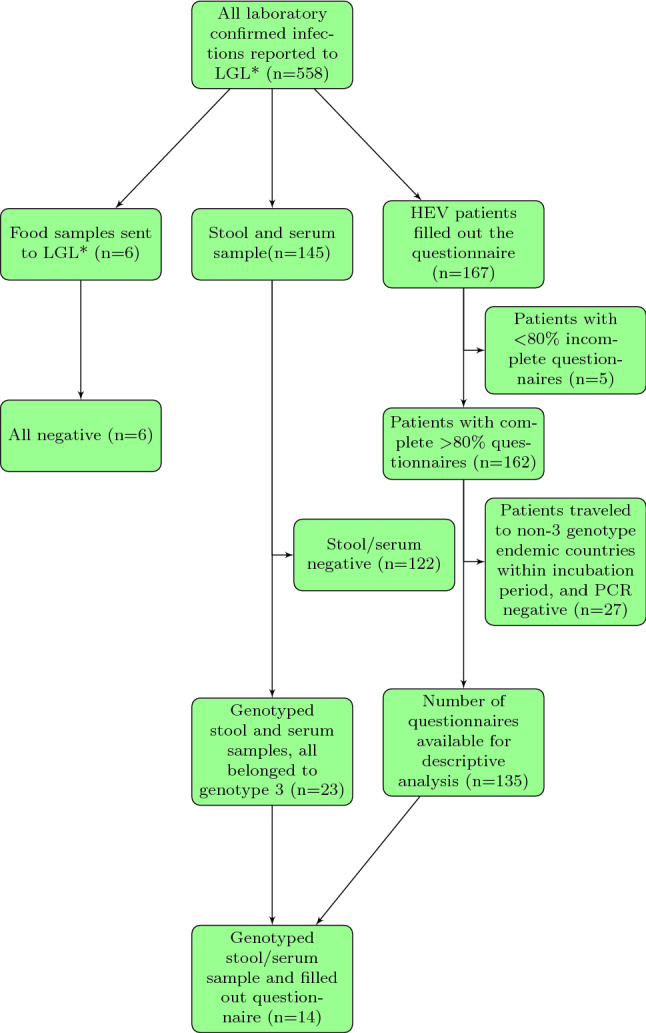
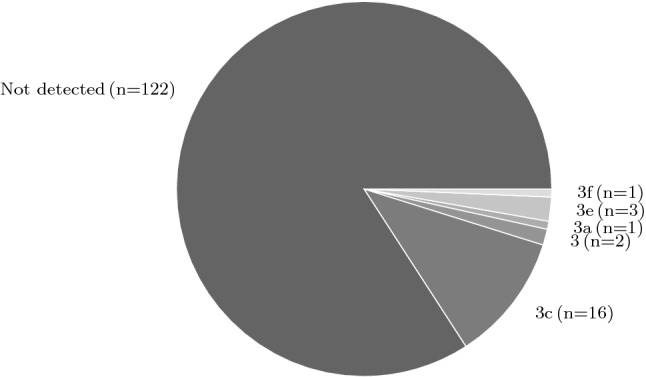
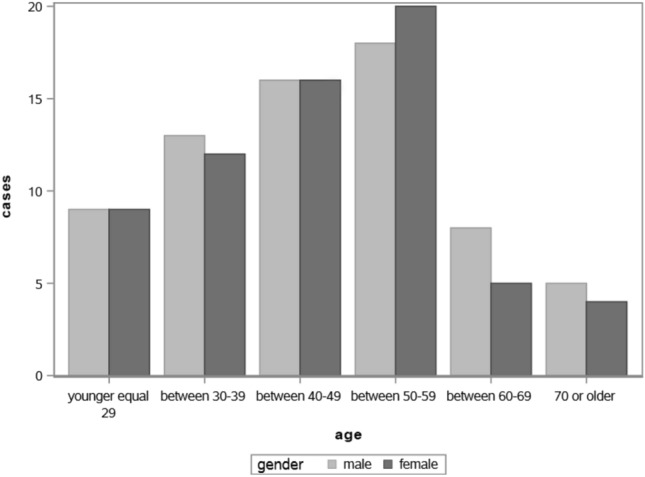
In the last decade, the number of reported hepatitis E virus (HEV) infections in Germany, including Bavaria, has continued to rise. In order to identify risk factors associated with HEV infection, we investigated notified hepatitis E cases from Bavaria during 2017. The project "Intensified Hepatitis E Surveillance in Bavaria" included interviews with questionnaires, collection and genotyping of stool, serum and food samples. In addition, certain risk factors were examined in a sample comparison with healthy population using univariable analysis and logistic regression. In total, 135 hepatitis E cases from Bavaria were included in the analysis. Mean age for women was 46 (range 20-74) years and 47.5 (range 20-85) for men. 56 of the cases (41.5%) were asymptomatic. Among the symptomatic cases, both men and women were equally affected with symptoms like fever (16.3%), jaundice (18.8%) and upper abdominal pain (28.2%). 145 human samples (serum, stool) and 6 food samples were collected. 15.9% of the human samples (n = 23) were positive for HEV RNA by reverse-transcription quantitative real-time PCR (RT-qPCR). Identified risk factors significantly associated with hepatitis E were sausage consumption with odds ratio 9.6 (CI 1.3-70.1), fish with OR 2.2 (CI 1.1-4.4) and cat ownership with OR 1.9 (CI 1.3-3.0) in multivariable analyses. Further investigation is needed to confirm the role of fish in HEV transmission. Autochthonous HEV genotype 3 is prevalent in Bavaria and there could be more transmission routes contributing to the spread of HEV than previously known. Undercooked meat, offal, sausages, fish, shellfish and contact with animals and pets are possible sources for infection.
在过去的十年中,德国(包括巴伐利亚州)报告的戊型肝炎病毒(HEV)感染数量持续上升。为了确定与 HEV 感染相关的危险因素,我们调查了 2017 年巴伐利亚州报告的戊型肝炎病例。该项目“巴伐利亚州强化戊型肝炎监测”包括对粪便、血清和食物样本进行访谈、收集和基因分型。此外,还使用单变量分析和逻辑回归在与健康人群的样本比较中检查了某些危险因素。共有 135 例来自巴伐利亚州的戊型肝炎病例纳入分析。女性的平均年龄为 46 岁(范围 20-74 岁),男性为 47.5 岁(范围 20-85 岁)。56 例病例(41.5%)无症状。在有症状的病例中,男性和女性的症状相同,如发热(16.3%)、黄疸(18.8%)和上腹痛(28.2%)。共采集 145 个人类样本(血清、粪便)和 6 个食物样本。通过逆转录实时定量 PCR(RT-qPCR),15.9%的人类样本(n = 23)HEV RNA 检测阳性。多变量分析显示,与戊型肝炎显著相关的危险因素包括食用香肠的比值比 9.6(CI 1.3-70.1)、食用鱼类的比值比 2.2(CI 1.1-4.4)和养猫的比值比 1.9(CI 1.3-3.0)。需要进一步调查以确认鱼类在 HEV 传播中的作用。巴伐利亚州流行的是本土 HEV 基因型 3,可能有比以前已知更多的传播途径导致 HEV 的传播。未煮熟的肉、动物内脏、香肠、鱼类、贝类以及与动物和宠物的接触可能是感染的来源。