Department of Biology, University of Virginia, Charlottesville, Virginia, United States of America.
Japan Fisheries Research and Education Agency, Watarai, Japan.
PLoS Genet. 2021 Apr 26;17(4):e1009364. doi: 10.1371/journal.pgen.1009364. eCollection 2021 Apr.
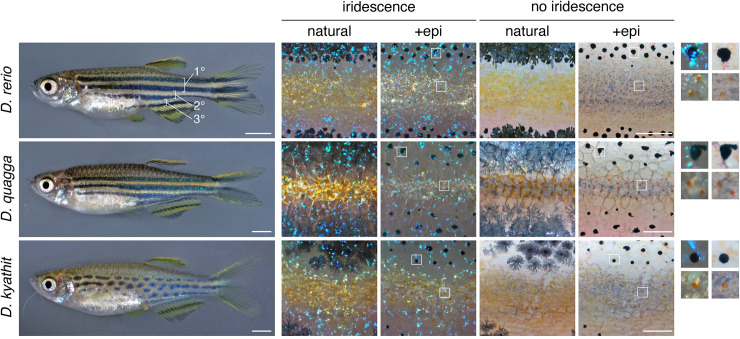
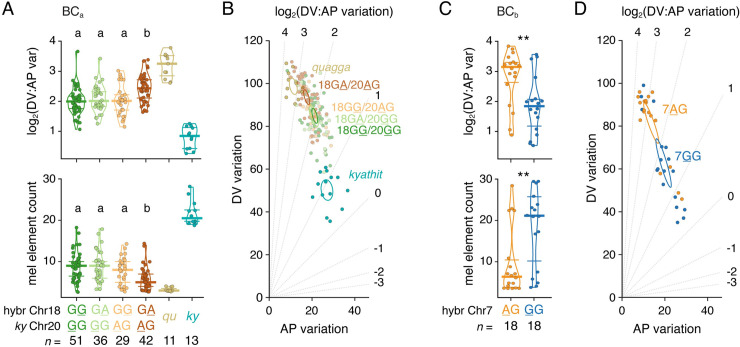
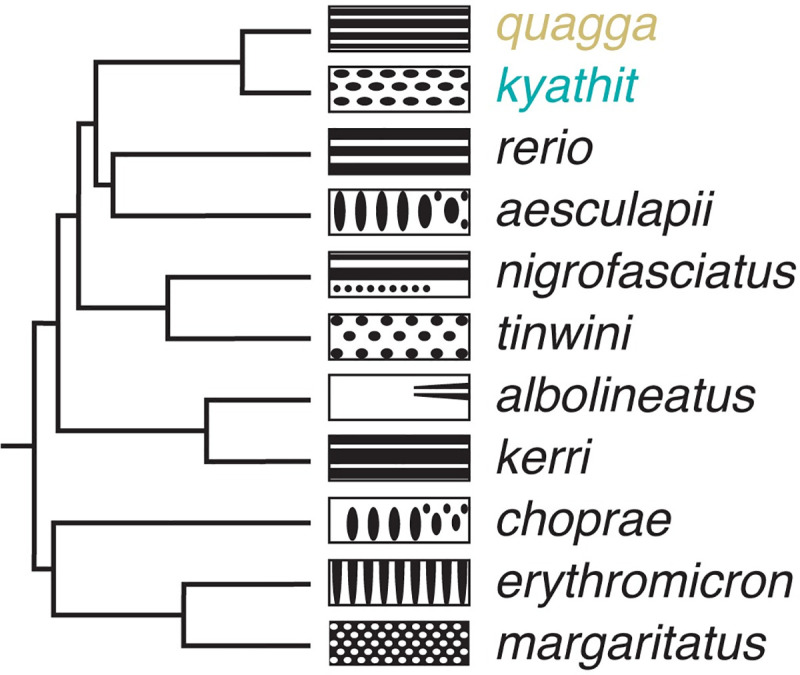
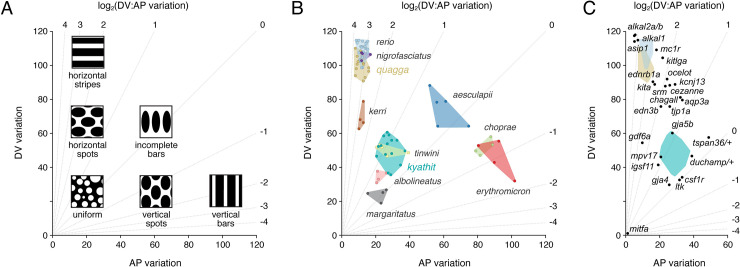
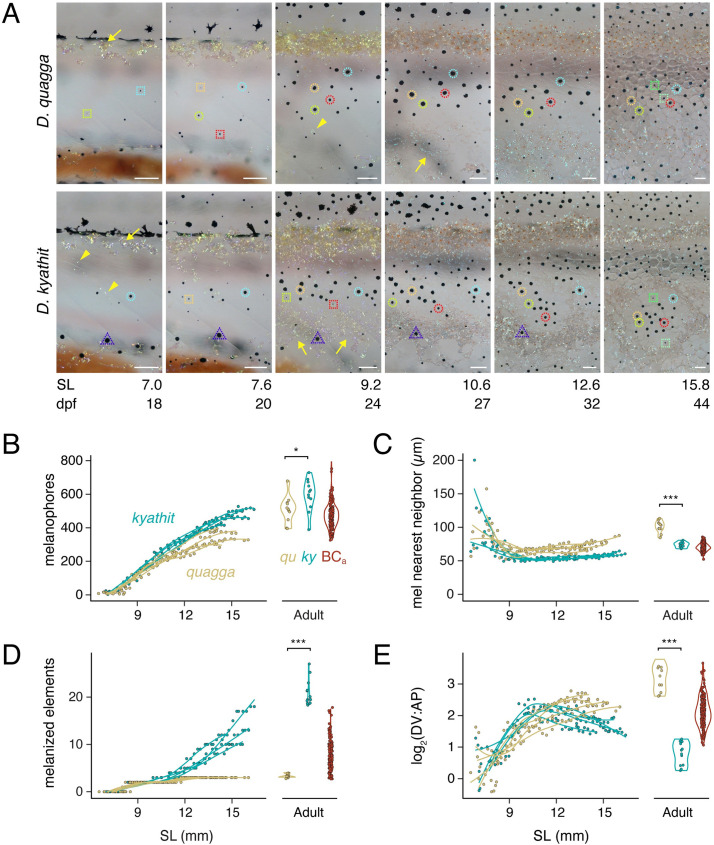
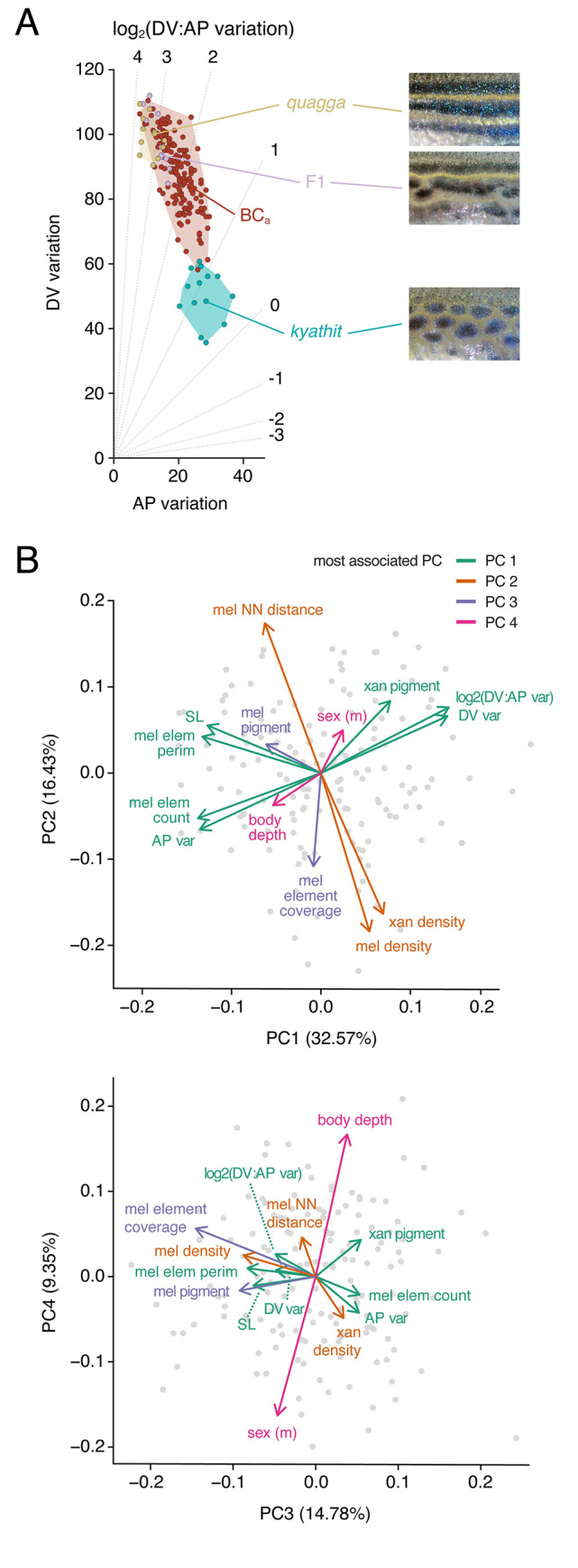
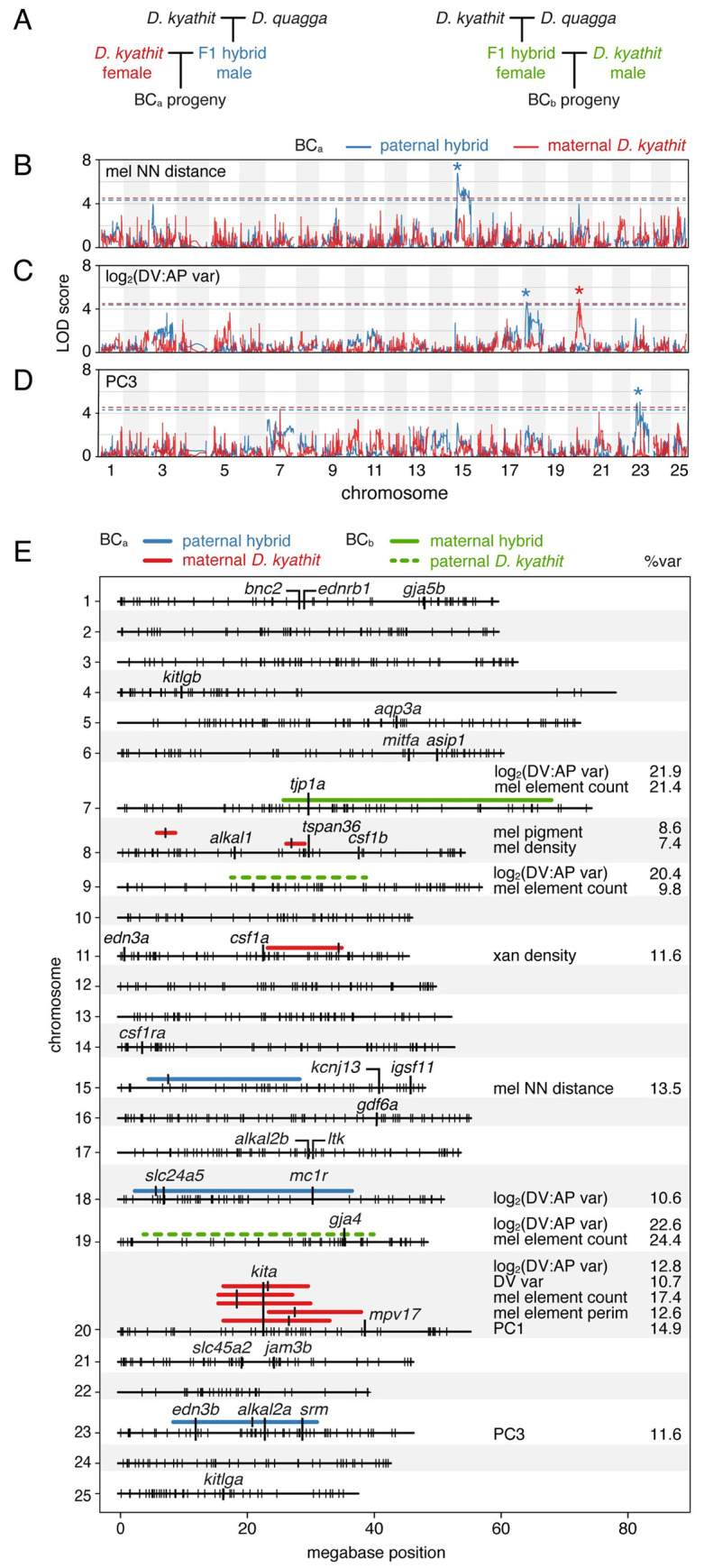
Vertebrate pigmentation is a fundamentally important, multifaceted phenotype. Zebrafish, Danio rerio, has been a valuable model for understanding genetics and development of pigment pattern formation due to its genetic and experimental tractability, advantages that are shared across several Danio species having a striking array of pigment patterns. Here, we use the sister species D. quagga and D. kyathit, with stripes and spots, respectively, to understand how natural genetic variation impacts phenotypes at cellular and organismal levels. We first show that D. quagga and D. kyathit phenotypes resemble those of wild-type D. rerio and several single locus mutants of D. rerio, respectively, in a morphospace defined by pattern variation along dorsoventral and anteroposterior axes. We then identify differences in patterning at the cellular level between D. quagga and D. kyathit by repeated daily imaging during pattern development and quantitative comparisons of adult phenotypes, revealing that patterns are similar initially but diverge ontogenetically. To assess the genetic architecture of these differences, we employ reduced-representation sequencing of second-generation hybrids. Despite the similarity of D. quagga to D. rerio, and D. kyathit to some D. rerio mutants, our analyses reveal a complex genetic basis for differences between D. quagga and D. kyathit, with several quantitative trait loci contributing to variation in overall pattern and cellular phenotypes, epistatic interactions between loci, and abundant segregating variation within species. Our findings provide a window into the evolutionary genetics of pattern-forming mechanisms in Danio and highlight the complexity of differences that can arise even between sister species. Further studies of natural genetic diversity underlying pattern variation in D. quagga and D. kyathit should provide insights complementary to those from zebrafish mutant phenotypes and more distant species comparisons.
脊椎动物的色素沉着是一种非常重要的、多方面的表型。斑马鱼(Danio rerio)因其遗传和实验的可操作性,成为理解色素模式形成的遗传学和发育学的一个非常有价值的模式生物,这一优势在多个具有引人注目的色素模式的 Danio 物种中是共有的。在这里,我们使用姐妹物种 D. quagga 和 D. kyathit,它们分别具有条纹和斑点,来了解自然遗传变异如何影响细胞和生物体水平的表型。我们首先表明,D. quagga 和 D. kyathit 的表型与野生型 D. rerio 的表型以及 D. rerio 的几个单基因座突变体的表型相似,表现在沿背腹轴和前后轴的图案变化的形态空间中。然后,我们通过在图案发育过程中重复进行每日成像,并对成年表型进行定量比较,在细胞水平上确定了 D. quagga 和 D. kyathit 之间的图案差异,结果表明,最初的图案是相似的,但在发生上存在差异。为了评估这些差异的遗传结构,我们采用第二代杂交种的简化代表性测序。尽管 D. quagga 与 D. rerio 相似,D. kyathit 与一些 D. rerio 突变体相似,但我们的分析表明,D. quagga 和 D. kyathit 之间的差异具有复杂的遗传基础,几个数量性状基因座对整体图案和细胞表型的变异有贡献,基因座之间存在上位性相互作用,并且在物种内存在大量的分离变异。我们的研究结果为 Danio 中图案形成机制的进化遗传学提供了一个窗口,并强调了即使在姐妹物种之间也可能出现的差异的复杂性。进一步研究 D. quagga 和 D. kyathit 中图案变异的自然遗传多样性,应该可以提供与斑马鱼突变体表型和更远缘物种比较的互补见解。