Division of Rheumatology, Department of Medicine Solna, Center for Molecular Medicine, Karolinska Institutet, Karolinska University Hospital, Stockholm, Sweden.
Institute of Environmental Medicine, Karolinska Institutet, Stockholm, Sweden.
PLoS One. 2021 Apr 26;16(4):e0250282. doi: 10.1371/journal.pone.0250282. eCollection 2021.
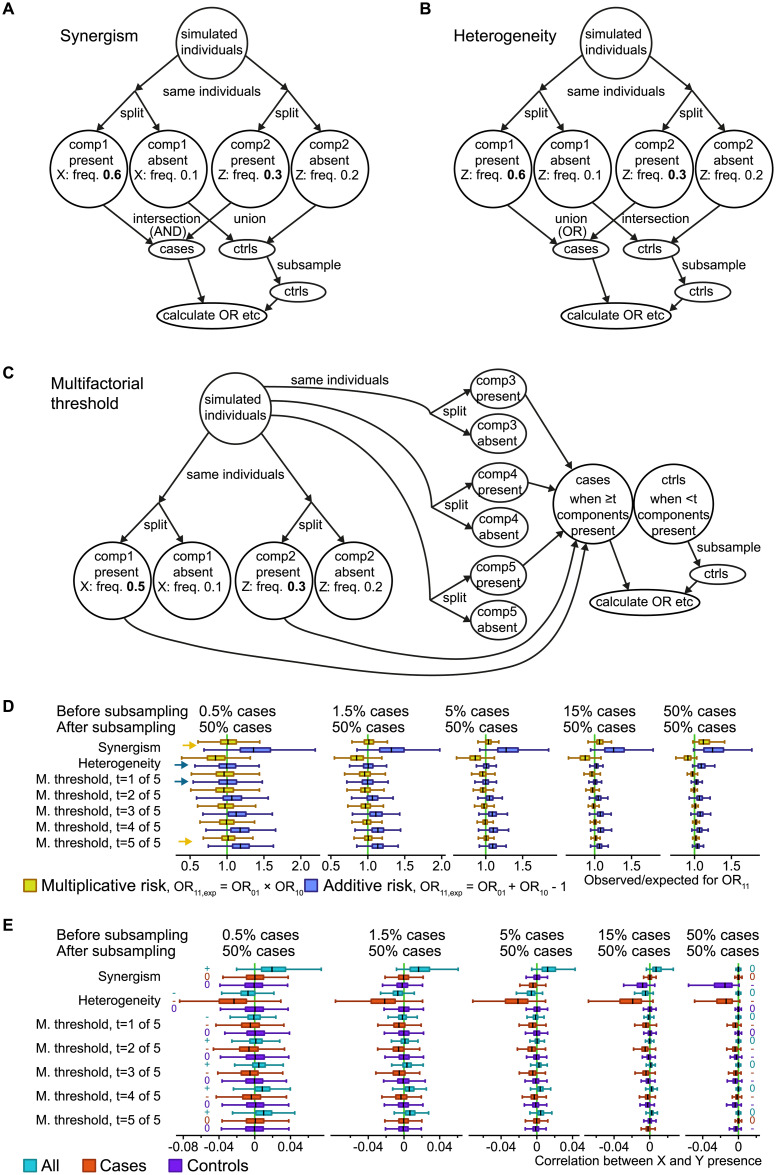
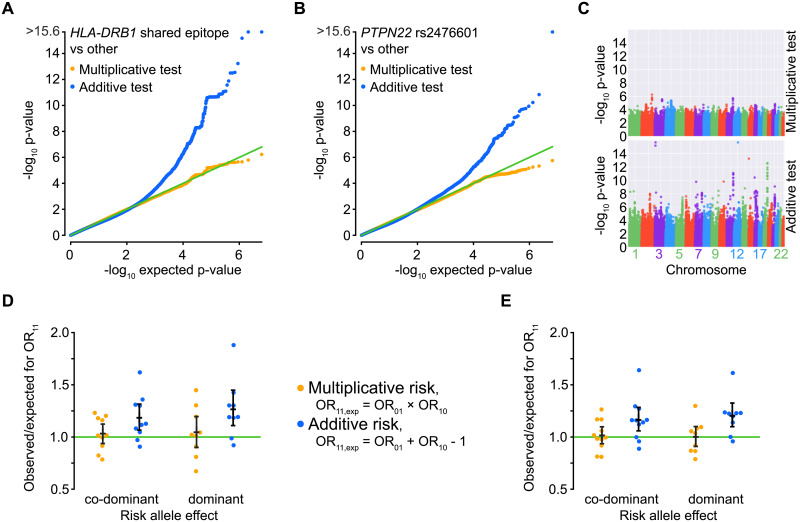
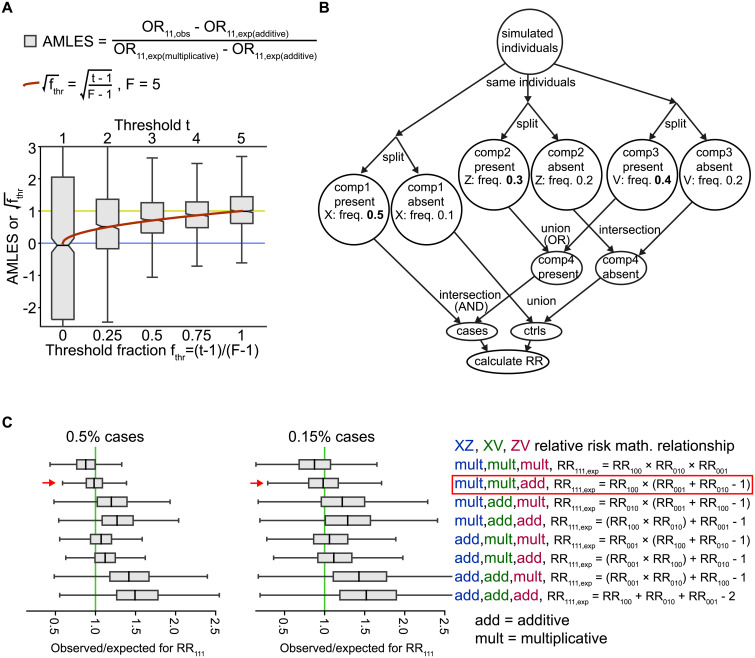
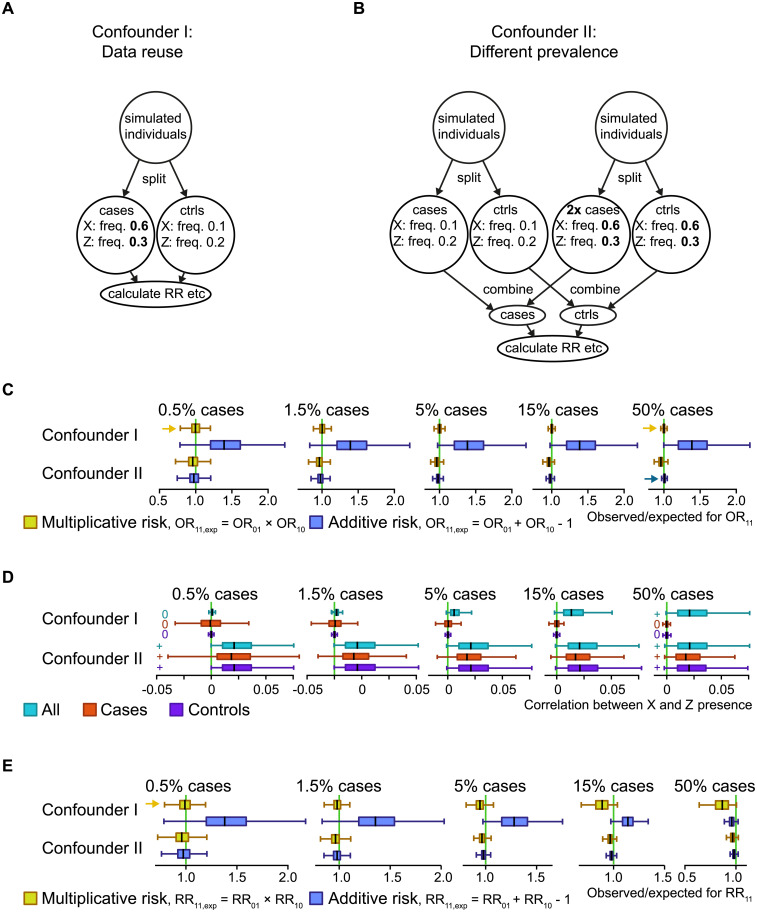
Understanding the genetic background of complex diseases requires the expansion of studies beyond univariate associations. Therefore, it is important to use interaction assessments of risk factors in order to discover whether, and how genetic risk variants act together on disease development. The principle of interaction analysis is to explore the magnitude of the combined effect of risk factors on disease causation. In this study, we use simulations to investigate different scenarios of causation to show how the magnitude of the effect of two risk factors interact. We mainly focus on the two most commonly used interaction models, the additive and multiplicative risk scales, since there is often confusion regarding their use and interpretation. Our results show that the combined effect is multiplicative when two risk factors are involved in the same chain of events, an interaction called synergism. Synergism is often described as a deviation from additivity, which is a broader term. Our results also confirm that it is often relevant to estimate additive effect relationships, because they correspond to independent risk factors at low disease prevalence. Importantly, we evaluate the threshold of more than two required risk factors for disease causation, called the multifactorial threshold model. We found a simple mathematical relationship (square root) between the threshold and an additive-to-multiplicative linear effect scale (AMLES), where 0 corresponds to an additive effect and 1 to a multiplicative. We propose AMLES as a metric that could be used to test different effects relationships at the same time, given that it can simultaneously reveal additive, multiplicative and intermediate risk effects relationships. Finally, the utility of our simulation study was demonstrated using real data by analyzing and interpreting gene-gene interaction odds ratios from a rheumatoid arthritis case-control cohort.
理解复杂疾病的遗传背景需要将研究扩展到单变量关联之外。因此,使用风险因素的相互作用评估来发现遗传风险变异是否以及如何共同作用于疾病发展是很重要的。相互作用分析的原理是探索风险因素对疾病发生的综合影响的大小。在这项研究中,我们使用模拟来研究不同的因果关系情景,以展示两个风险因素的相互作用的效应大小。我们主要关注两种最常用的相互作用模型,即加性和乘法风险尺度,因为它们的使用和解释常常存在混淆。我们的研究结果表明,当两个风险因素涉及相同的事件链时,它们的联合效应是乘法的,这种相互作用称为协同作用。协同作用通常被描述为偏离加性,这是一个更广泛的术语。我们的研究结果还证实,估计加性效应关系通常是相关的,因为它们在疾病低流行率时对应于独立的风险因素。重要的是,我们评估了两个以上的风险因素导致疾病的阈值,称为多因素阈值模型。我们发现了一个简单的数学关系(平方根),即阈值和加性到乘法线性效应尺度(AMLES)之间的关系,其中 0 对应于加性效应,1 对应于乘法效应。我们提出 AMLES 作为一种度量标准,可以同时用于测试不同的效应关系,因为它可以同时揭示加性、乘法和中间风险效应关系。最后,我们使用类风湿关节炎病例对照队列的基因-基因相互作用比值比的真实数据来分析和解释,展示了我们的模拟研究的实用性。